
BY:SpaceEyeNews.
A narrow gamma-ray feature has emerged from more than 15 years of observations by NASA’s Fermi Gamma-ray Space Telescope. Researchers found the feature while combining data from three nearby galaxy clusters. Its energy sits near 43.2 billion electron volts, or GeV.
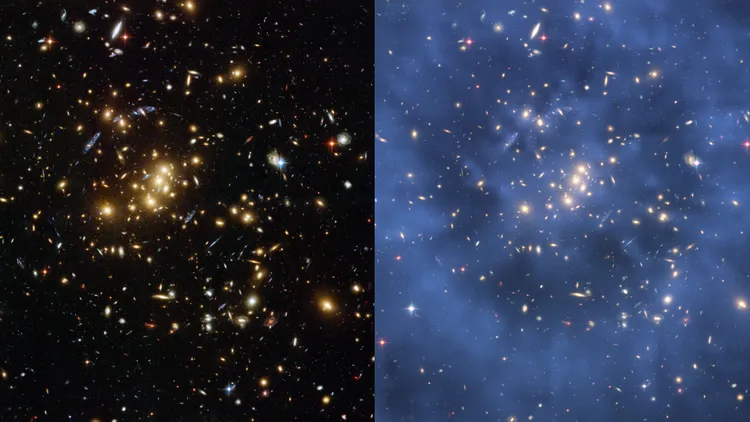
Two views from Hubble of the massive galaxy cluster Cl 0024+17 (ZwCl 0024+1652) are shown. To the right, a blue shading has been added to indicate the location of invisible material called dark matter that is mathematically required to account for the nature and placement of the gravitationally lensed galaxies that are seen, shown as blueish smudges on the left-hand image. (Image credit: NASA, ESA, M.J. Jee and H. Ford (Johns Hopkins University).
The Fermi dark matter signal could match a signature produced by certain hypothetical particles. Yet the finding does not confirm that scientists have discovered dark matter particles. In fact, one detail makes the result more complicated than early headlines suggest.
The peer-reviewed study appeared in Physical Review Letters on August 12, 2026. Its authors include researchers from the Purple Mountain Observatory of the Chinese Academy of Sciences and partner institutions.
Fermi Dark Matter Signal Appears in Three Galaxy Clusters
The researchers examined 15.5 years of public data from Fermi’s Large Area Telescope, or LAT. Their sample covered 13 massive galaxy clusters with redshifts of 0.028 or lower.
Instead of treating every cluster separately, the team used a stacking analysis. This method combines observations from several targets. It can reveal a shared feature that may appear too weak in any single target.
The clearest result came from the Virgo, Fornax and Ophiuchus clusters. These three systems have the sample’s highest estimated “J-factors.” A J-factor describes how strongly concentrated dark matter may be along a particular line of sight. A higher value could create a better opportunity to search for particle-related signals.
When the researchers combined data from these three clusters, they identified a gamma-ray line near 43.2 GeV. The analysis produced a net test statistic, or TS, of approximately 30.
However, the value dropped to about 21 when the ten other clusters entered the calculation. The team suggests that those clusters have lower signal-to-noise ratios. Therefore, their addition may have diluted the combined result rather than strengthened it.
Why the 43.2 GeV Gamma-Ray Line Matters
Dark matter represents most of the Universe’s matter, but its particle identity remains unknown. WIMPs, or weakly interacting massive particles, remain one widely studied possibility.
Some WIMP models predict that two particles could interact and convert their mass into familiar particles. Physicists call this process annihilation. It could produce gamma rays with nearly identical energies.
Most ordinary cosmic processes create broad or curved gamma-ray spectra. By contrast, a narrow line would resemble a concentrated spike at one energy. That unusual shape makes gamma-ray lines valuable in dark matter searches.
If researchers confirmed such a feature, its energy could help constrain the particle’s mass and interaction channel. A 43.2 GeV photon does not automatically prove the particle has exactly the same mass. That relationship depends on which particles the interaction produces.
NASA identifies gamma rays as one of Fermi’s main tools for indirect dark matter searches. The LAT’s broad coverage allows it to examine galaxy clusters, dwarf galaxies and the Milky Way’s central region.
How Researchers Checked the Fermi Data
Fermi launched in June 2008 and surveys the entire gamma-ray sky every three hours. Its LAT instrument covers energies from roughly 20 MeV to above 300 GeV. This range includes the newly reported feature.
For this analysis, the team used an updated Fermi dataset known as P8R3. The researchers selected events with strong energy reconstruction and applied filters designed to limit contamination from cosmic rays, Earth’s atmospheric glow, bright solar activity and major gamma-ray bursts.
They also tested changes to the regions selected around each cluster. Those checks produced only small differences. Still, statistical consistency does not establish the physical origin of a signal. A feature can remain present in an analysis without coming from dark matter.
The Result Contains an Important Contradiction
The study’s most important caution involves the inner Milky Way.
If an instrumental problem created the 43 GeV feature, scientists might expect it to appear in other Fermi observations. The researchers did not find an equivalent line toward the inner Galaxy. That result makes a simple instrument-wide artifact less likely.
However, the same absence also creates a challenge for the standard dark matter interpretation. Conventional models expect the inner Milky Way to contain a high concentration of dark matter. A particle process bright enough to appear across nearby clusters might also produce a detectable Galactic signal.
Consequently, the study says the result disfavors both a basic instrumental explanation and a conventional dark matter annihilation model. The authors suggest that a more complex dark matter scenario—or an unusual astrophysical source—may be necessary.
Therefore, claims that the calculations completely rule out instrument error go beyond the paper. The study reduces that possibility, but it does not eliminate every systematic effect. It also does not identify WIMPs as the confirmed source.
Earlier Gamma-Ray Signals Encourage Caution
The Fermi dark matter signal did not appear without history. Earlier analyses had reported hints of a gamma-ray feature near 43 GeV in galaxy-cluster data. The latest work finds that the feature remains present in a much longer dataset.
The paper also notes that the signal’s strength changed over time. It experienced a noticeable decline during an earlier period before increasing again in later observations. A genuine cosmic feature should generally become clearer as researchers collect more photons. Its uneven development deserves careful examination.
Fermi has produced other intriguing dark matter clues. In 2014, researchers reported unexplained gamma-ray emission near the Galactic center. Yet NASA has consistently emphasized that ordinary sources can imitate broad dark matter signatures. Multiple observations remain necessary before scientists can determine the origin.
What Could Confirm the Fermi Dark Matter Signal?
Independent teams must first reproduce the analysis. Researchers can test different background models, event selections and cluster samples. They must also determine whether another instrument detects photons at the same energy.
The study highlights the proposed Very Large Area Gamma-ray Space Telescope, or VLAST. Its planned energy resolution near 50 GeV could separate a narrow feature more clearly than Fermi. The authors estimate that VLAST could verify an intrinsic signal within one or two years of observations.
However, VLAST remains a proposed observatory. Its verification estimate describes potential performance, not a confirmed launch or observation schedule.
Conclusion: A Compelling Clue, Not a Discovery
The Fermi dark matter signal is an intriguing 43.2 GeV feature linked to the Virgo, Fornax and Ophiuchus clusters. Its narrow shape makes it scientifically valuable, while its persistence justifies further investigation.
Still, the missing equivalent signal near the Galactic center complicates a standard WIMP explanation. For now, the result should be described as evidence for an unexplained gamma-ray line—not confirmed evidence of dark matter particles. Future observations will decide whether this clue opens a new window on the invisible Universe or reveals an unexpected cosmic source.
Main Sources:
Physical Review Letters:
https://journals.aps.org/prl/abstract/10.1103/lq5r-sjp7
Full study on arXiv:
https://arxiv.org/abs/2407.11737
NASA Fermi dark matter research:
https://fermi.gsfc.nasa.gov/science/eteu/dm/
NASA Fermi mission:
https://science.nasa.gov/mission/fermi/
Fermi Large Area Telescope:
https://fermi.gsfc.nasa.gov/science/instruments/lat.html