
BY:SpaceEyeNews.
A G1 geomagnetic storm could bring enhanced auroras and minor technological effects on November 17–18, 2026. NOAA expects a fast solar-wind stream to influence Earth, with a possible additional contribution from a passing solar eruption.
The timing has shifted since the earliest forecast. NOAA’s latest checked update extends the expected peak into the evening of November 17, beginning at 18:00 UTC.
However, observations and predictions tell different parts of the story. Conditions remained quiet in NOAA’s accompanying summary. The coming hours will reveal whether the anticipated disturbance reaches minor storm levels.
G1 Geomagnetic Storm Forecast: The Updated Window
NOAA’s Space Weather Prediction Center issued its updated outlook at 12:30 UTC on November 17. It forecasts Kp 4.67 across three consecutive intervals, ending at 03:00 UTC on November 18.
Those intervals cover 18:00–21:00 UTC, 21:00–00:00 UTC, and 00:00–03:00 UTC. NOAA labels each interval G1 in the forecast.
The earlier outlook placed the peak from 21:00 UTC onward. The revision therefore brings the expected onset forward by three hours.
For readers in Egypt, the updated window runs from 8 p.m. Tuesday until 5 a.m. Wednesday. These times describe forecast intervals, rather than precise arrival appointments.
Throughout the preceding 24 hours, the highest observed three-hour Kp was only 1. That contrast shows how much conditions would need to change before reaching the forecast peak.
Two Solar Influences Behind the Outlook
The solar-wind stream takes the lead
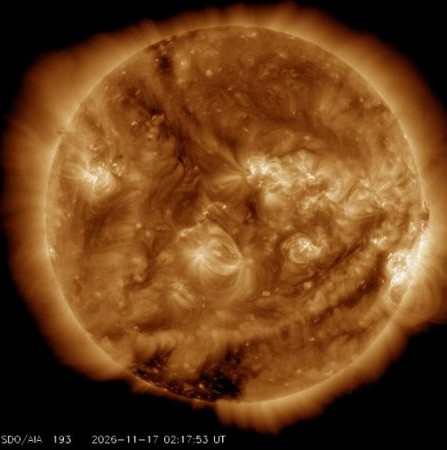
The main driver is a positive-polarity coronal-hole high-speed stream. NOAA expects its position to favor an influence on Earth during November 17–18.
Coronal holes can persist through several solar rotations. Their open magnetic structure allows faster solar wind to escape into space.
As faster material catches slower wind ahead, it can create a compressed region. NOAA explains that magnetic-field strength and particle density can rise before the main fast stream arrives.
That sequence matters here. A developing disturbance does not require solar-wind speed to jump immediately. Forecasters examine several measurements together as the incoming conditions evolve.
A possible CME adds uncertainty
A coronal mass ejection, or CME, from November 14 provides the second possible influence. NOAA’s discussion retains a potential arrival late November 17 or early November 18.
The original coverage described a low-confidence glancing encounter. The newer discussion still treats arrival as possible, rather than confirmed.
Neither forecast establishes that both influences will produce a stronger storm together. Their timing and magnetic characteristics remain essential to the eventual outcome.
What the Measurements Actually Show
NOAA’s observational summary provides a useful snapshot before the expected peak. Solar-wind speeds averaged approximately 300 kilometers per second, which forecasters described as relatively low.
Around 07:30 UTC, the total magnetic-field strength increased to approximately 7 nanoteslas. Meanwhile, its north–south component, known as Bz, reached minus 4 nanoteslas.
A southward magnetic orientation can favor energy transfer into Earth’s magnetic environment. However, its duration matters. A brief southward reading cannot establish the strength of an entire developing event.
NOAA’s broader explanation emphasizes sustained conditions over several hours. Speed alone therefore offers an incomplete picture of potential geomagnetic activity.
This distinction also prevents confusion about eruption speeds. A speed estimate near the Sun does not automatically describe conditions measured near Earth days later.
For this event, the observations showed changes in the solar-wind environment while Earth’s geomagnetic field remained quiet. Forecasters still expected further developments.
Aurora Prospects During the G1 Geomagnetic Storm
Auroras offer the most visible possibility for readers following this forecast. At G1 levels, NOAA lists high-latitude visibility, including examples such as northern Michigan and Maine.
Those examples describe typical effects on NOAA’s scale. They do not guarantee that observers in either location will see a display.
NOAA also cautions that relationships between Kp and auroral reach represent approximate averages. Actual displays can differ from those broad expectations.
Location and darkness still matter
A favorable geomagnetic forecast cannot overcome daylight, clouds, or strong local lighting. Observers need suitable sky conditions as well as sufficient auroral activity.
In the Northern Hemisphere, an unobstructed northern horizon can help reveal a display farther away. A darker location also improves the chances of noticing faint light.
Timing also requires a local check. The UTC peak covers different daylight and nighttime conditions around the world. A location can fall within the forecast window while its sky remains too bright for viewing.
Kp summarizes planetary activity, so it cannot provide a precise street-level visibility forecast. Nearby observers may also have different horizons or cloud cover. These practical limits explain why a promising outlook can produce uneven viewing experiences.
The useful approach is to follow current aurora guidance alongside local weather. This forecast supports a possible high-latitude opportunity, without establishing a widespread display across lower latitudes.
What Minor Storm Conditions Mean for Technology
G1 occupies the lowest level on NOAA’s five-category geomagnetic storm scale. Its listed effects include weak power-grid fluctuations and possible minor impacts on satellite operations.
These effects warrant monitoring, but they do not support predictions of widespread electrical outages. Nor does this outlook establish major satellite failures.
The distinction matters because geomagnetic storms span a wide range of intensities. Effects associated with severe categories should not accompany a minor forecast without supporting evidence.
Separate forecasts cover radiation and radio
NOAA assesses solar radiation storms and radio blackouts separately. They involve different conditions and do not automatically follow from a G1 designation.
The November 17 outlook does not expect an S1-or-greater solar radiation storm. It assigns a five percent daily probability across the three-day period.
Radio-blackout probabilities also appear separately in the forecast. Readers should therefore avoid treating every space-weather effect as part of one predicted event.
For satellite and power-system operators, the relevant message remains limited: monitor changing conditions and assess their actual effects. The forecast describes potential minor disturbances, rather than confirmed operational problems.
What to Watch Through November 19
NOAA expects the solar-wind enhancements to weaken through November 19. Its discussion anticipates largely unsettled geomagnetic conditions as the disturbance eases.
Before then, incoming observations will help clarify whether the possible CME contributes. Sustained magnetic conditions will also determine how efficiently the solar wind transfers energy into Earth’s surroundings.
The G1 geomagnetic storm forecast offers a specific window for attention, especially for aurora observers at high latitudes. Its significance rests on modest expected effects and an evolving solar-wind environment.
Updated measurements will show whether the forecast becomes an observed event, how long it lasts, and when quieter conditions return.
Main sources:
NOAA three-day forecast: https://services.swpc.noaa.gov/text/3-day-forecast.txt
NOAA forecast discussion: https://services.swpc.noaa.gov/text/discussion.txt
NOAA space weather scales: https://www.swpc.noaa.gov/noaa-scales-explanation
NOAA geomagnetic storms: https://www.swpc.noaa.gov/phenomena/geomagnetic-storms
NOAA coronal holes: https://www.swpc.noaa.gov/phenomena/coronal-holes
NOAA aurora viewing guidance: https://www.swpc.noaa.gov/content/tips-viewing-aurora
You Might Also Like:
Sunspot Region 4455 Solar Flares Trigger Major Space Weather Alert