
BY:SpaceEyeNews.
Astronomers have finally clarified the identity of a giant loop seen toward the Milky Way’s center. The Galactic Center Lobe discovery shows that the structure is not a vast feature rising from the galactic core. Instead, it is a much closer bubble of glowing, ionized gas.
The finding resolves a long-running debate about an object that appeared physically connected to the center of our galaxy. New observations place it around 6,500 light-years from Earth. That is far closer than the Milky Way’s central region, which lies about 26,000 light-years away.
Why the Galactic Center Lobe Caused Confusion
The object has long been known as the Galactic Center Lobe, or GCL. In radio images, it appears as a towering loop extending about one degree above the Galactic plane.
Its position made it look like a structure emerging from the heart of the Milky Way. As a result, researchers proposed several explanations. Some linked it to intense star formation near the center. Others suggested that activity around Sagittarius A*, the Milky Way’s supermassive black hole, may have shaped it.
However, the galactic center is one of the hardest regions of the sky to interpret. Dust blocks visible light. Dense fields of stars and gas also overlap along the same line of sight. Unrelated objects can therefore appear connected in a flat image.
That problem affected the GCL. Its lower edge blended into the bright and crowded Galactic plane. Earlier observations made the loop look incomplete. This strengthened the idea that it extended upward from the central region.
Earlier Evidence Challenged the Original Picture
The new result did not appear without warning. Previous studies had already questioned whether the GCL belonged to the galactic center.
In 2019, radio observations found low gas velocities across the loop. Those measurements did not match the motion expected for material near the Milky Way’s center. The researchers instead favored a giant H II region located much closer to Earth.
A 2024 study reached a similar conclusion. It found that the object’s infrared appearance, dust temperature and radio properties resembled known H II regions. The team also identified possible young stellar groups at a distance of about two kiloparsecs.
Therefore, the 2026 Galactic Center Lobe discovery is best viewed as strong confirmation. It adds detailed optical maps, gas diagnostics, velocity measurements and a direct distance estimate.
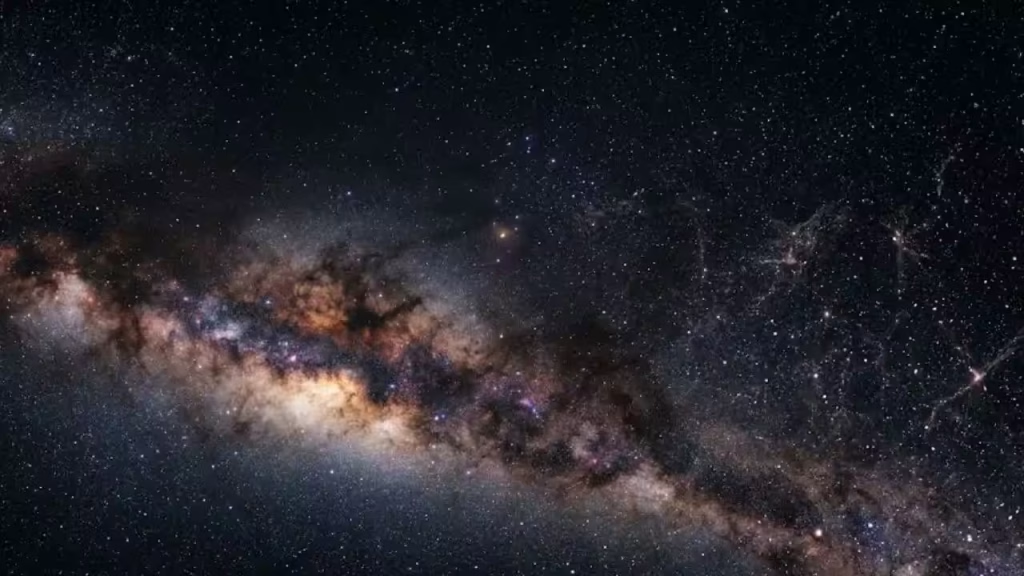
Astronomers just mapped a massive ‘hidden’ structure behind the Milky Way.
How SDSS-V Revealed the Complete Bubble
The breakthrough came from the SDSS-V Local Volume Mapper. This survey maps glowing gas by collecting spectra across many positions in the sky.
Instead of relying on one wavelength, the researchers examined several emission lines. These signals reveal the gas composition, motion and source of ionization.
One line proved especially useful. Ionized sulfur produces light at a wavelength of 9532 angstroms. This signal passes through dusty regions more effectively than many shorter optical wavelengths.
The resulting map revealed emission around a closed outer loop. Its lower section had not vanished. Astronomers had simply struggled to separate it from the complicated background near the Galactic plane.
A Shell Rather Than a Plume
The glowing gas did not fill the loop evenly. Most of the visible emission followed an outer shell. This pattern showed that astronomers were viewing a bubble, not a solid plume extending from the galactic center.
Measurements of ionized nitrogen added more evidence. The gas displayed a uniform velocity pattern across the structure. That result confirmed that the visible sections belong to one coherent bubble.
The Distance Behind the Galactic Center Lobe Discovery
Distance provided the decisive clue. The team measured how dust reddened light coming from the ionized gas. It then compared that reddening with three-dimensional maps of dust in the same direction.
The comparison placed the GCL at roughly two kiloparsecs, or about 6,500 light-years, from Earth. This location is far in front of the Milky Way’s central region.
At that distance, the bubble measures about 35 parsecs across. That equals roughly 115 light-years. It remains an enormous interstellar structure, but it is not a galaxy-scale feature rising from the core.
Perspective created the confusion. From Earth, the loop appears directly above the galactic center. In three-dimensional space, however, thousands of light-years separate the two regions.
What the Giant Milky Way Bubble Really Is
The evidence identifies the structure as a photoionized H II region. Ultraviolet radiation from hot, young stars removes electrons from surrounding hydrogen atoms. The gas then produces its characteristic glow.
Emission-line ratios across the loop support photoionization. They do not indicate that activity from the galactic center dominates the structure.
Its shape also resembles Barnard’s Loop near Orion. In both cases, observers mainly see an illuminated outer shell. The center appears fainter because the gas does not glow equally throughout the entire volume.
Which Stars Created the Bubble?
Researchers suggest that an off-center young stellar cluster may illuminate the shell. Stellar winds and earlier activity from massive stars may also have helped create the cavity.
However, the detailed history remains uncertain. The research confirms the bubble’s location and physical nature. It does not identify one definitive group of stars responsible for forming it.
Reports that describe supernova explosions as the confirmed cause go beyond the study’s conclusion. Such events remain possible, but researchers still need more evidence to reconstruct the bubble’s history.
Why This Corrected Identity Matters
The Galactic Center Lobe discovery changes how astronomers interpret a familiar Milky Way feature. Scientists no longer need a large event near Sagittarius A* to explain the loop.
More importantly, the result demonstrates the risks of judging cosmic structures through two-dimensional images. Objects can overlap in the sky while remaining widely separated in space.
The research also shows the value of combining several methods. Optical spectroscopy revealed the gas properties. Dust maps constrained its distance. Velocity measurements linked the visible shell into one structure.
Together, these tools replaced an appealing visual assumption with a stronger physical explanation.
The researchers even proposed a playful new meaning for GCL: “Greatly Confused Loop.” The nickname reflects how effectively perspective misled observers for decades.
Conclusion
The Galactic Center Lobe discovery has transformed a supposed feature of the Milky Way’s core into a much closer stellar bubble. Located about 6,500 light-years away, the shell spans roughly 115 light-years and glows under ultraviolet radiation from hot stars.
Its apparent position above the Milky Way’s center created a convincing cosmic illusion. New SDSS-V observations finally separated that appearance from reality.
Astronomers now understand what the bubble is and where it lies. Yet one mystery remains: which stars created the enormous cavity and continue to illuminate its glowing edge?
Main Sources:
Astronomy & Astrophysics — “SDSS-V LVM: Verifying what, and where, the ‘Galactic center lobe’ is”
https://www.aanda.org/articles/aa/full_html/2026/06/aa59505-26/aa59505-26.html
SDSS Official Publications — SDSS-V Local Volume Mapper research
https://www.sdss.org/science/publications/
arXiv — “SDSS-V LVM: Verifying what, and where, the ‘Galactic Center’ Lobe is”
https://arxiv.org/abs/2604.16601
arXiv — “The Galactic Center Lobe as an H II Region”
https://arxiv.org/abs/2405.11054
arXiv — “The Galactic Center Lobe Filled with Thermal Plasma”
https://arxiv.org/abs/1905.01800