BY:SpaceEyeNews.
🌌 Introduction: A Galaxy Inside the Milky Way Hidden in Plain Sight
What if part of another galaxy has been inside ours for billions of years—completely unnoticed?
New research points to exactly that. Scientists have identified evidence of a galaxy inside the Milky Way, not as a visible structure, but as a hidden population of stars with a shared origin.
This ancient system, nicknamed “Loki,” appears to be the remains of a dwarf galaxy that merged with the Milky Way early in its history. The finding does not rely on images or direct detection. Instead, it emerges from detailed analysis of stellar chemistry and motion.
The result is a deeper, more complex picture of our galaxy—one shaped by ancient mergers and long-forgotten structures.
🔬 Tracing a Galaxy Inside the Milky Way Through Stellar Chemistry
The evidence for a galaxy inside the Milky Way comes from studying stars that do not quite fit their surroundings. Rather than searching for a distinct object, astronomers examined the chemical composition of stars embedded in the galactic disk.
Chemical Signatures as Clues
Every star forms under specific conditions. Its chemical makeup reflects the environment in which it was born. By comparing these signatures, researchers can identify stars that share a common origin.
In this case, a small group of stars stood out. They are unusually metal-poor, meaning they formed early in cosmic history, before heavier elements became widespread.
What the Data Revealed
These stars show clear signs of energetic events such as supernovae and neutron star mergers. However, one expected signal is missing. There is no evidence of white dwarf explosions.
That absence matters. White dwarfs take billions of years to form. Their absence suggests that the parent system did not survive long enough to produce them.
A Short-Lived Dwarf Galaxy
This combination points to a compact, short-lived galaxy. Researchers classify it as an extreme dwarf system. Compared to the Milky Way, it would have contained only a fraction of the stars.
The name “Loki” reflects its elusive nature. It is not visible as a separate structure, yet its presence is encoded in the stars themselves.
🌠 What “Galaxy Inside the Milky Way” Really Means
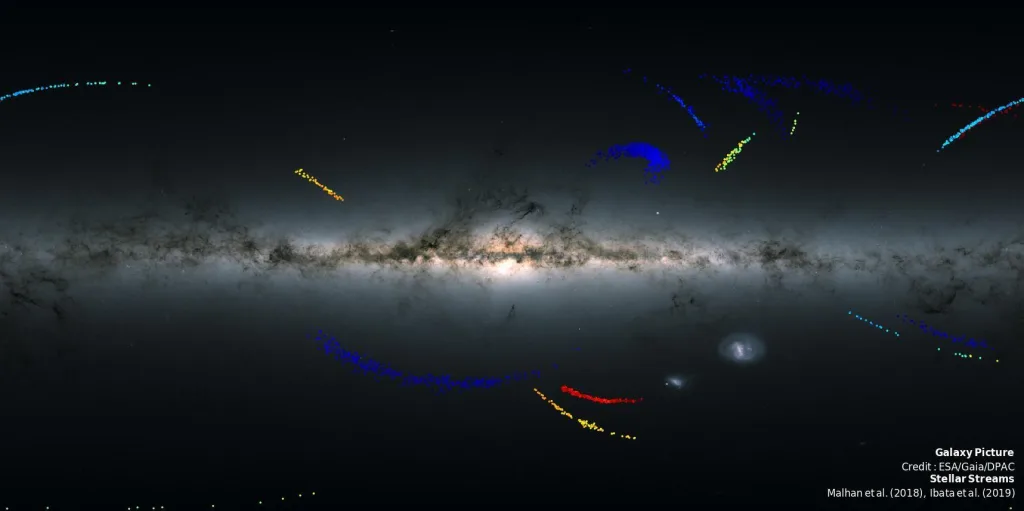
The phrase can sound dramatic, but the reality is more subtle. This is not a separate galaxy sitting intact within our own. Instead, it represents the remnants of a past merger.
A Merger Preserved in Stars
Galaxies grow by absorbing smaller systems. Over time, those systems lose their structure. Their stars disperse and become part of the larger galaxy.
Loki fits this pattern. Its stars are now mixed into the Milky Way, but they still carry the chemical imprint of their origin.
A Layered Galactic History
This discovery reinforces the idea that our galaxy formed in stages. Each merger added new material and reshaped its structure. What we see today is the result of many such events.
The Influence of Dark Matter
These processes are driven by gravity, much of it tied to Dark Matter. Invisible mass forms large halos that pull smaller galaxies inward. Over billions of years, this leads to repeated mergers and gradual growth.
The result is not a uniform system, but a layered one, built from earlier generations of galaxies.
🔄 Orbital Clues to a Hidden Galaxy Inside the Milky Way
Motion provides another critical piece of evidence. The stars linked to Loki do not move in a uniform way.
Opposing Stellar Paths
Some of these stars orbit in the same direction as the Milky Way. Others move in the opposite direction. This split is unusual for stars in the galactic disk.
A Chaotic Early Environment
The most likely explanation is timing. The merger occurred when the Milky Way was still forming. At that stage, its structure was less stable, and stellar orbits were not yet organized.
As a result, stars from the smaller galaxy were scattered in multiple directions.
Combining Motion and Chemistry
Neither motion nor chemistry alone would be enough to support the conclusion. Together, they form a consistent picture. These stars share both an unusual composition and an unusual pattern of movement.
That combination strengthens the case for a shared origin in a now-absorbed galaxy.
🚀 Why This Discovery Matters for Galactic Evolution
The idea of a hidden system within our galaxy has broader implications. It helps refine our understanding of how galaxies form and evolve.
Building Galaxies from Smaller Systems
Large galaxies do not form in isolation. They grow through repeated mergers with smaller ones. Dwarf galaxies act as building blocks, contributing stars and altering structure over time.
A Window into the Early Universe
Metal-poor stars are among the oldest objects in the galaxy. Studying them provides insight into the early stages of star formation, when the universe was still chemically simple.
Improving Models of the Milky Way
Each new discovery adds detail to our picture of the Milky Way. Hidden structures like Loki help scientists test and refine theoretical models. They also highlight how much of the galaxy’s history remains hidden.
⚠️ Limits and Next Steps
Despite the strength of the evidence, this is not a final answer.
A Small Sample
The current findings are based on a limited number of stars. Expanding the sample will be essential for confirmation.
Indirect Detection
There is no direct image of Loki. The conclusion relies on interpreting chemical and orbital data. This approach is well established, but it requires further validation.
Future Observations
Upcoming surveys and more detailed measurements will help test this idea. If additional stars with similar properties are found, the case will become stronger.
🎯 Conclusion: A Hidden Layer Within Our Galaxy
The concept of a galaxy inside the Milky Way reveals a deeper truth about our cosmic home. The Milky Way is not a single, uniform structure. It is a record of past mergers, preserved in the stars that orbit within it.
Loki may represent one of many such hidden systems. Its stars continue to move through the galaxy, carrying clues from a distant past.
As research advances, more of these hidden layers may come into view. Each discovery brings us closer to understanding how galaxies grow, evolve, and connect across time.
🔗 Main Sources:
- Futurism article: https://futurism.com/space/galaxy-inside-our-galaxy
- Monthly Notices of the Royal Astronomical Society: https://academic.oup.com/mnras