BY:SpaceEyeNews.
Introduction: A Galaxy That Should Not Exist
A galaxy without dark matter sounds impossible. For decades, scientists believed dark matter forms the invisible framework that holds galaxies together. Without it, stars should drift apart over time. Yet new observations now point to something unexpected. A growing group of galaxies appears to exist without it.
This discovery centers on three unusual systems: DF2, DF4, and now DF9. Each one shows the same pattern. Their stars move as if dark matter is missing. That detail alone challenges one of the most widely accepted ideas in modern cosmology.
So what exactly did scientists find—and what does it mean for our understanding of the universe?
Galaxy Without Dark Matter: A Growing Pattern
A chain of unusual galaxies
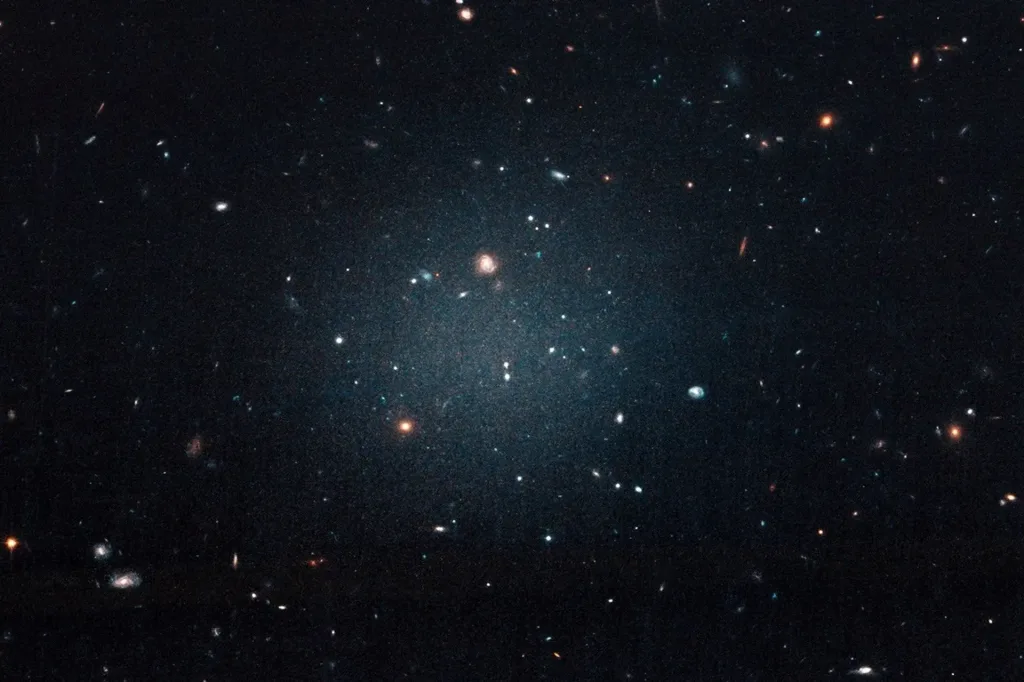
The story began with DF2, an ultra-diffuse galaxy that stunned astronomers. It has a size comparable to the Milky Way but contains far fewer stars. Soon after, DF4 appeared with similar properties. Now, DF9 strengthens the case even further.
Unlike a single anomaly, these three galaxies form a clear alignment in space. This structure suggests a shared origin rather than coincidence. A galaxy without dark matter is no longer an isolated case. It is now part of a consistent pattern.
What makes these galaxies different
These galaxies belong to a class known as ultra-diffuse galaxies. Their stars are spread out across large distances, creating extremely low brightness. In some cases, background galaxies can be seen through them.
More importantly, their internal motion reveals something unusual. The stars move at speeds consistent with normal visible matter alone. There is no sign of the extra gravitational pull typically attributed to dark matter.
This behavior sets them apart. A galaxy without dark matter follows standard gravitational laws without requiring hidden mass.
Confirmed by precise observations
At first, scientists questioned the data. Some suggested that measurement errors, especially distance estimates, could explain the results. If the galaxies were closer than expected, their motion might appear misleading.
However, follow-up observations resolved this uncertainty. High-precision imaging confirmed the distances. With that, the original findings remained intact.
Now, with three galaxies showing the same behavior, the evidence carries more weight. The consistency across DF2, DF4, and DF9 points to a real physical process.
Galaxy Without Dark Matter vs Modern Physics
Testing two competing ideas
This discovery places pressure on two major frameworks used to explain galaxies.
The first relies on dark matter as a physical substance. It assumes that invisible mass provides the extra gravity needed to hold galaxies together. The second approach, known as Modified Newtonian Dynamics (MOND), suggests that gravity behaves differently at very low accelerations.
A galaxy without dark matter provides a direct test of these ideas.
Why MOND struggles to explain it
According to MOND, galaxies with low internal acceleration should show stronger gravitational effects than expected. In such systems, stars should move faster than their visible mass suggests.
That is not what astronomers observe here.
Instead, the stars move exactly as predicted by standard Newtonian physics. This creates a serious challenge for MOND. If it represents a universal law, it should apply everywhere.
The existence of a galaxy without dark matter introduces a contradiction that MOND cannot easily resolve.
Why dark matter gains support
At the same time, these observations strengthen the case for dark matter as a real substance. If dark matter exists independently of normal matter, it can separate under extreme conditions.
That possibility offers a straightforward explanation. These galaxies may have formed in a way that removed or displaced their dark matter component.
In this context, a galaxy without dark matter does not break physics. Instead, it reveals a new outcome of known processes.
How a Galaxy Without Dark Matter Could Form
The Bullet Dwarf scenario
To explain this phenomenon, scientists propose the “Bullet Dwarf” collision scenario. This idea builds on how different forms of matter behave during high-speed interactions.
Imagine two dwarf galaxies moving toward each other. Each one contains stars, gas, and a surrounding dark matter halo.
When they collide, their components respond differently. Dark matter interacts only through gravity. It passes through the collision without slowing down. Gas clouds, on the other hand, collide directly. They lose energy and remain in place. Stars tend to follow the gas.
This separation creates a new structure. The visible matter forms galaxies, while the dark matter continues on a separate path. The result can be a galaxy without dark matter.
Clues from their alignment
The spatial alignment of DF2, DF4, and DF9 supports this idea. They appear along a narrow path, as if shaped by a single event.
This structure matches predictions from collision-based models. It suggests that all three galaxies formed from the same interaction.
Such a scenario explains both their position and their unusual properties.
Why this explanation works
The Bullet Dwarf scenario accounts for multiple observations at once. It explains the absence of dark matter, the shared alignment, and the similar structure of these galaxies.
It also relies on known physics. There is no need to modify gravity or introduce new laws. Instead, it highlights how extreme conditions can produce unexpected outcomes.
This makes it one of the most compelling explanations so far.
What This Means for Galaxy Formation
More than one formation pathway
For years, scientists assumed galaxies form in a similar way. Dark matter halos act as a foundation. Gas collects within them and forms stars.
A galaxy without dark matter challenges that view. It suggests that galaxy formation may follow multiple pathways. Some systems may emerge from standard processes, while others result from rare interactions.
This expands the range of possible cosmic structures.
Dark matter as a separate component
Another key implication involves the nature of dark matter itself. If it can separate from normal matter, it behaves as a distinct physical component.
This strengthens the argument that dark matter is real. It is not just a mathematical adjustment to gravity. It has its own behavior and distribution.
Understanding this separation could lead to new ways of detecting it.
New directions for research
This discovery opens the door to several important questions. How many such galaxies exist? Are they rare, or simply hard to detect? Can we trace the missing dark matter from these systems?
Future observations will focus on these questions. Scientists aim to identify more galaxies in similar environments. They will also measure their motion in greater detail.
These efforts will determine whether this phenomenon is common or exceptional.
A Turning Point or a Rare Exception?
Scientific caution remains
Despite the strong evidence, scientists remain careful in their conclusions. Unusual discoveries require repeated confirmation. Additional observations will help verify the findings.
Some debate continues around interpretation. However, the growing number of consistent observations makes the phenomenon harder to dismiss.
Why it still matters
Even if rare, a galaxy without dark matter carries significant implications. It proves that galaxies can exist outside traditional expectations.
In science, exceptions often lead to deeper understanding. They reveal limits in current models and point toward new ideas.
Conclusion: Rethinking the Cosmic Framework
The discovery of a galaxy without dark matter marks a turning point in our understanding of the universe. It shows that galaxies do not always follow a single formation path. Some may emerge through processes that separate visible matter from dark matter entirely.
At the same time, this finding strengthens the case for dark matter as a real and independent component of the cosmos. It also challenges alternative theories that attempt to replace it.
Most importantly, it highlights how much remains unknown. The universe continues to surprise us, even in areas we thought were well understood.
If galaxies can exist without dark matter, then one question remains. What else are we missing?
Sources:
https://universemagazine.com/en/astronomers-discover-a-third-galaxy-lacking-dark-matter/
https://www.nature.com/articles/s41586-018-0459-7
https://hubblesite.org/contents/news-releases/2019/news-2019-02