
BY:SpaceEyeNews.
Could Jupiter and the other outer planets help scientists uncover dark matter? A research team has explored that possibility by studying faint ultraviolet light from the night sides of Jupiter, Saturn, Uranus, and Neptune.
The researchers investigated giant planets as dark matter detectors by analysing archival spacecraft observations. They found no confirmed dark matter signal. However, the results placed some of the strongest limits yet on certain interactions between dark matter and ordinary matter.
The method could also reach particle types that remain difficult to test with detectors on Earth. In effect, scientists are turning entire planets into natural physics laboratories.
How Giant Planets Could Capture Dark Matter
The Solar System travels through a region of the Milky Way believed to contain large amounts of dark matter. As a result, hypothetical dark matter particles may regularly pass through planets.
Most particles would continue moving without leaving a detectable trace. However, some could collide with protons inside a giant planet. Such a collision may reduce the particle’s speed.
If it loses enough energy, the planet’s gravity could capture it. Over long periods, many particles might collect inside the planet.
Under some dark matter models, captured particles could then meet and annihilate. This process would convert their energy into other particles, including energetic electrons and photons.
Those particles could move through the planet and transfer energy into its upper atmosphere. Scientists would not observe the dark matter itself. Instead, they would search for atmospheric radiation produced by that energy.
Why Hydrogen-Rich Worlds Matter
Jupiter, Saturn, Uranus, and Neptune contain large amounts of hydrogen. That makes them useful targets for this type of research.
Dark matter sensitivity may become especially strong when a particle has a mass close to that of a proton. In that range, the particle can transfer energy to hydrogen more efficiently.
The four planets also differ in size, gravity, temperature, and composition. Therefore, each world may test a different range of dark matter masses and interaction models.
Researchers do not expect planetary observations to replace underground experiments. Instead, the planets could investigate areas that conventional detectors struggle to reach.
Giant Planets as Dark Matter Detectors Through Airglow
The proposed signal involves a faint phenomenon called ultraviolet airglow.
When energetic electrons enter a hydrogen-rich atmosphere, they can excite molecular hydrogen. The molecules briefly move into higher-energy states. As they return to lower-energy states, they release ultraviolet light.
Dark matter annihilation products could, in theory, start this process. The result would be a weak glow in molecular hydrogen’s Lyman and Werner ultraviolet bands.
This radiation should appear across much of a planet rather than only in a small auroral region. That distribution could help researchers distinguish a possible dark matter contribution from some natural sources.
However, the expected signal would remain extremely faint.
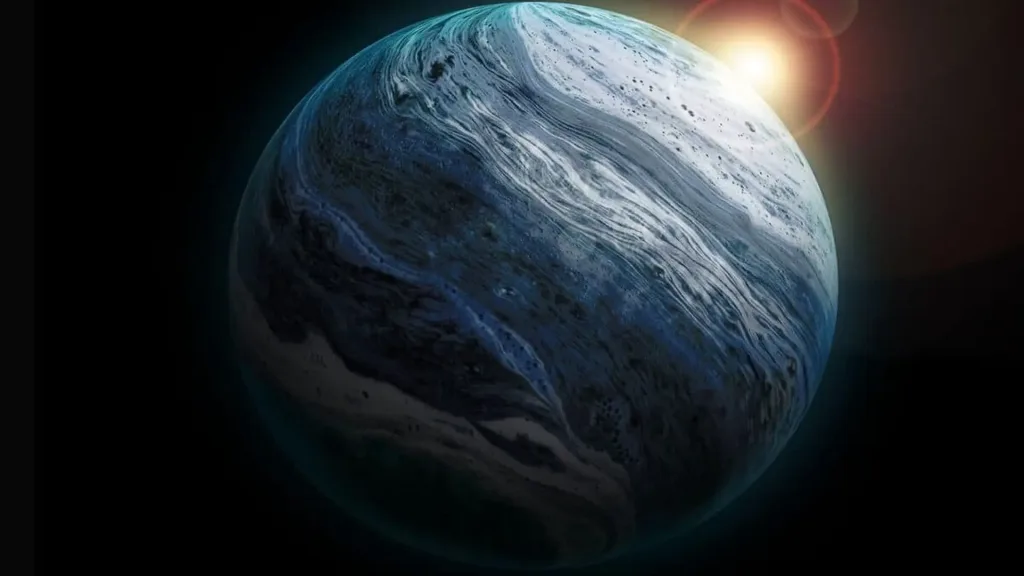
Giant Planets May Detect Dark Matter via Subtle Ultraviolet Airglow
Why Scientists Focused on the Night Sides
Sunlight causes strong ultraviolet emissions in planetary atmospheres. Any possible dark matter signal on a sunlit side would probably disappear beneath that much brighter radiation.
For this reason, the researchers concentrated on nightside observations.
Even the dark side of a planet does not remain completely dark. Auroras, charged particles, atmospheric chemistry, and magnetospheric activity can all produce ultraviolet light.
The team therefore did not claim that the measured radiation came from dark matter. Instead, it used the total observed brightness as a maximum allowed signal.
Any dark matter model that predicted more ultraviolet light than the spacecraft recorded could be ruled out or strongly restricted.
Historic Spacecraft Data Tests a Modern Theory
The research relied on ultraviolet measurements from Voyager 1, Voyager 2, and New Horizons.
These missions collected data during encounters with Jupiter, Saturn, Uranus, and Neptune. Their instruments originally aimed to study planetary atmospheres and surrounding space environments.
Decades later, scientists can reuse those measurements to test new particle-physics ideas.
The researchers calculated how much ultraviolet airglow different dark matter models should produce. They considered factors such as particle mass, scattering strength, planetary composition, and the energy released after capture.
Next, they compared those predictions with the observed ultraviolet brightness.
If a model produced a signal brighter than the actual measurement, the team treated that model as incompatible with the data. This conservative approach did not require scientists to identify every natural source of nightglow.
The study found constraints on the dark matter–nucleon scattering cross section down to around (10^{-40}) square centimetres in parts of the tested range. This value describes the probability of a dark matter particle interacting with a proton or neutron.
What the Dark Matter Results Actually Mean
The researchers did not discover dark matter inside any planet.
Instead, they narrowed the range of properties that dark matter could possess. Their findings show that some particles cannot interact with ordinary matter as strongly as certain models had allowed.
That may sound less dramatic than a direct detection, but exclusion results remain essential. Each new limit removes possible explanations and guides future experiments toward more promising areas.
Planetary observations could become especially useful for strongly interacting dark matter. Some such particles may lose energy in Earth’s atmosphere or crust before reaching underground detectors.
Very light particles can also present challenges for conventional experiments. A giant hydrogen-rich planet offers a much larger target and a different physical environment.
Later research expanded this idea by combining ultraviolet airglow with planetary heat flow and ionospheric measurements. The results support planetary spectroscopy as a complementary way to investigate the dark sector.
The Main Challenges Facing Planetary Detection
Several uncertainties still limit the method.
First, scientists must understand how efficiently giant planets capture different dark matter particles. A particle may collide several times before gravity traps it. Others may pass through without losing enough energy.
Planetary heat creates another challenge. The lightest captured particles might regain enough energy to escape. This process, called evaporation, would reduce the number available to produce a signal.
Researchers must also model how annihilation energy travels from a planet’s interior to its upper atmosphere. Not all released energy would necessarily create ultraviolet radiation.
Finally, natural atmospheric emissions can imitate or hide the proposed glow. A convincing future detection would need the correct spectrum, intensity, distribution, and relationship with planetary properties.
Future Missions Could Improve the Search
Future observations could provide more sensitive ultraviolet measurements of giant-planet nightsides.
ESA’s Jupiter Icy Moons Explorer, or Juice, launched on April 14, 2023. It is scheduled to reach Jupiter in July 2031. The spacecraft carries ten instruments and will examine Jupiter, its environment, and the moons Ganymede, Callisto, and Europa.
Juice was not designed as a dedicated dark matter detector. Still, detailed atmospheric and environmental measurements could help scientists understand natural backgrounds more accurately.
Future missions with ultraviolet instruments designed for faint nightside observations could offer even stronger tests.
Giant Planets as Dark Matter Detectors Open a New Path
Using giant planets as dark matter detectors turns the Solar System into a vast particle-physics experiment.
Current spacecraft data have not revealed a confirmed signal. Yet they have already restricted how strongly certain dark matter candidates may interact with ordinary matter.
The approach also shows the long-term value of planetary archives. Measurements gathered decades ago can answer questions that mission designers never expected.
As future missions study giant planets with greater precision, researchers may gain new ways to separate ordinary atmospheric glow from more unusual energy sources. Jupiter and its neighbours may never replace laboratories on Earth, but they could become powerful partners in the search for the universe’s hidden matter.
Main Sources:
Search for Dark Matter Induced Airglow in Planetary Atmospheres:
https://arxiv.org/abs/2408.15318
Complementary Planetary Spectroscopy Probes of Dark Matter:
https://arxiv.org/abs/2508.00980
Optimal Celestial Bodies for Dark Matter Detection:
https://arxiv.org/abs/2405.05312
ESA Juice Mission Overview:
https://www.esa.int/Science_Exploration/Space_Science/Juice
ESA Juice Mission Calendar:
https://www.cosmos.esa.int/web/juice/mission-calendar