
BY:SpaceEyeNews.
GJ 251 c Is Not Earth 2.0, But It Is Extremely Interesting
Astronomers have found a nearby world that could become one of the most important targets in the search for life beyond the Solar System. It is called GJ 251 c. It sits only about 18 light-years away, which is close by cosmic standards. Even better, it appears to orbit inside the habitable zone of a small red dwarf star.
That sounds exciting. It should. But this discovery also needs careful language.
GJ 251 c has not been photographed. Scientists have not detected an atmosphere there. They have not found water. They have not found biology. The planet is a candidate super-Earth detected through the motion of its star.
Still, the discovery matters because it may be testable. That single idea makes GJ 251 c stand out. Many possible habitable-zone planets are too distant or too difficult to study. This one is close enough that future giant telescopes may be able to separate its faint light from the glare of its star.
That would mark a major step. Instead of only asking whether planets exist, scientists could begin asking what a nearby rocky world is really like.
What Is GJ 251 c?
GJ 251 c is a candidate super-Earth orbiting the star GJ 251. This star is a red dwarf, also called an M-type star. Red dwarfs are smaller and cooler than the Sun. Because they shine with less energy, their habitable zones sit much closer in.
The reported planet takes about 53.6 days to complete one orbit. Its minimum mass is about 3.8 times the mass of Earth. That places it in the super-Earth category.
But “super-Earth” is often misunderstood. It does not mean Earth-like. It only means the planet is more massive than Earth, while still smaller than worlds like Uranus or Neptune.
A super-Earth can be many things. It could be rocky. It could be rich in water. It could have a thick atmosphere. It could be dry, frozen, airless, or very different from Earth.
For GJ 251 c, the radius is still unknown. That matters because radius helps scientists calculate density. Without density, they cannot confirm whether the planet is rocky.
So the correct takeaway is simple. GJ 251 c is not confirmed as a second Earth. It is a nearby candidate world with a mass and orbit that make it very important for future study.
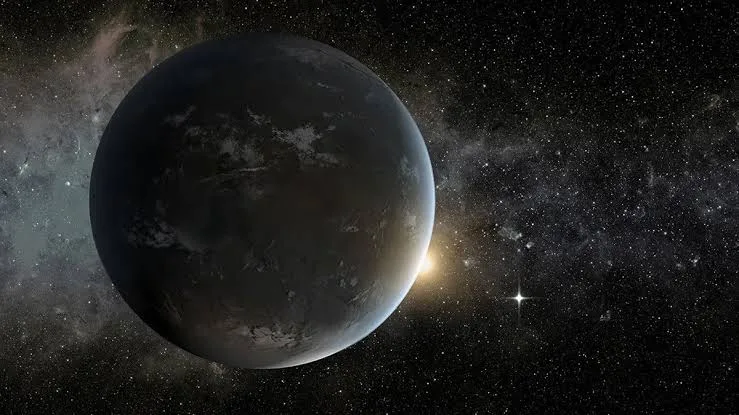
Scientists find nearby ‘super Earth’ that may be able to support alien life .
Why 18 Light-Years Changes the Story
Eighteen light-years is still far beyond any spacecraft journey we can make today. No human-made probe is heading there. No mission can reach it soon. But for telescopes, distance works differently.
A nearby planetary system appears wider on the sky than a similar system much farther away. That extra apparent separation matters. It can help future instruments separate a planet from the bright light of its host star.
This is one reason GJ 251 c is so exciting. It is not just another habitable-zone candidate in a distant catalog. It is close enough to become a practical target for powerful future telescopes.
Direct imaging is one of the hardest tasks in astronomy. A small planet reflects very little light compared with its star. The star can be billions of times brighter. The planet also appears very close to the star from our point of view.
Distance can make that challenge easier. A nearby system gives astronomers a better chance of pulling the planet out of the glare.
That is why GJ 251 c deserves attention. It sits in a rare category. It is nearby, possibly terrestrial, and placed in a region where liquid water could exist under the right conditions.
How Astronomers Found GJ 251 c
Astronomers did not discover GJ 251 c by seeing it cross in front of its star. They used the radial-velocity method.
This method looks for tiny movements in a star. A planet does not only orbit a star. It also pulls on the star with its gravity. That pull makes the star move slightly toward and away from Earth.
As the star moves, its light shifts by a very small amount. Scientists can measure that shift through the star’s spectrum. Over time, a repeating pattern can reveal the presence of an orbiting planet.
For GJ 251 c, researchers used high-precision measurements from the Habitable-zone Planet Finder and NEID. They also added older data from HIRES, CARMENES, and SPIRou.
That long data history matters. Red dwarf stars can be tricky. Their surfaces can show starspots. Their magnetic fields can create activity. Their rotation can produce signals that look like planets.
So the team had to do more than find a repeating wobble. They compared more than 50 models. They also used color-dependent analysis to test whether the signal behaved like a planet or like stellar activity.
That careful approach is important. It explains why scientists describe GJ 251 c as a candidate in many reports. The signal is strong and interesting, but the planet still needs more confirmation and follow-up study.
GJ 251 c and the Habitable Zone
The habitable zone is one of the most powerful ideas in exoplanet science. It is also one of the easiest to overstate.
A planet in the habitable zone receives the right amount of starlight for liquid water to exist on its surface, but only under the right atmospheric conditions. That does not prove the planet has oceans. It does not prove clouds. It does not prove air. It does not prove life.
GJ 251 c appears to sit in the habitable zone of its red dwarf star. That makes it interesting. Yet many unknowns remain.
Does it have an atmosphere? No one knows. Is it rocky? That is possible, but not confirmed. Does it have water? There is no detection yet. Could its surface support stable conditions? That depends on its atmosphere, rotation, clouds, chemistry, and history.
The planet also receives less starlight than Earth receives from the Sun. That could mean colder conditions. But the final climate would depend on many factors. A thicker atmosphere could trap heat. Clouds could change the balance. A lack of atmosphere could leave the surface harsh and exposed.
So the habitable zone should be treated as a starting point. It tells scientists where to look. It does not give the final answer.
Why Red Dwarfs Are Useful and Difficult
Red dwarfs are attractive targets in the search for small planets. Their low mass makes planetary signals easier to detect. A small planet pulls more strongly on a red dwarf than it would on a Sun-like star.
Their habitable zones are also closer in. That gives planets shorter orbits. Shorter orbits create more chances to collect repeated measurements.
But red dwarfs also bring challenges.
Many red dwarfs can be active, especially when young. Flares and high-energy radiation may affect nearby planets. Over long periods, this activity can damage atmospheres or change atmospheric chemistry.
Another issue is tidal locking. A planet close to a red dwarf may keep one side facing the star. One hemisphere could remain in daylight, while the other stays in darkness.
That does not automatically make a planet uninhabitable. Climate models show that atmospheres and oceans can move heat around a tidally locked planet. But the situation becomes more complex than an Earth-like world around a Sun-like star.
GJ 251 is interesting because it is close and well studied. It also appears quiet enough for precise radial-velocity work. Even so, the discovery team had to account for stellar activity very carefully.
That caution is part of the story. GJ 251 c is exciting because it survives serious checks, not because all questions have already been answered.
Future Telescopes Could Make GJ 251 c a Test Case
The most exciting part of GJ 251 c is what may come next.
Future 30-meter-class telescopes may be able to directly image planets in the habitable zone of GJ 251. These observatories will use huge mirrors and advanced instruments to block starlight and detect faint planetary light.
Direct imaging would change the type of evidence scientists can collect. Radial velocity reveals a planet through gravity. Direct imaging could reveal light from the planet itself.
That light can carry useful information. It may help scientists constrain the planet’s orbit. It may reveal brightness changes. It may show broad color information. With enough sensitivity, spectroscopy could search for molecules in the atmosphere.
This is where the search for habitability becomes more serious. Future observations could look for gases such as water vapor, carbon dioxide, methane, oxygen, or ozone.
But even then, caution remains essential. A single gas is not proof of life. Oxygen can form without biology. Methane can come from geology. Water vapor does not automatically mean oceans.
Scientists need patterns. They need context. They need to rule out false positives. They need to understand the star, the planet, and the environment.
GJ 251 c may offer a rare chance to do that kind of work on a nearby world.
How GJ 251 c Fits NASA’s Habitable Worlds Vision
NASA’s Habitable Worlds Observatory concept shows where exoplanet science is heading. The goal is not only to discover planets. The goal is to directly image potentially habitable worlds and study their atmospheres.
That vision makes GJ 251 c especially relevant.
A nearby super-Earth candidate in a habitable-zone orbit gives future observatories a real target. It may not be the final answer in the search for life. But it could help scientists test the tools needed for that search.
This is a major shift. Early exoplanet discoveries proved that planets exist around other stars. Later surveys showed that planets are common. Now the field is moving toward characterizing individual worlds.
That means asking deeper questions. Does the planet have air? What is that air made of? Does it have clouds? Does it reflect light like a rocky world? Are there chemical signals that deserve closer study?
GJ 251 c belongs to that next stage. It is not just a number in a catalog. It is a nearby target that future instruments may examine in far greater detail.
Could GJ 251 c Support Life?
This is the question everyone wants to ask. It is also the question scientists cannot answer yet.
GJ 251 c could be rocky. It could have an atmosphere. It could have conditions that allow liquid water. But none of that has been confirmed.
The planet could also be very different. It may have a dense atmosphere. It may have no stable atmosphere. It may be too cold. It may be locked in a difficult climate state. It may have a composition unlike Earth.
The right way to describe GJ 251 c is not “a planet with life.” It is a planet that may let scientists test the search for life.
That distinction matters. It keeps the discovery exciting without turning it into hype.
If future telescopes detect an atmosphere, that would be a huge step. If spectroscopy finds water-related features, that would add another layer. If several gases appear in a pattern that is hard to explain without biology, then the scientific debate would become even more intense.
For now, GJ 251 c remains a nearby question mark. That is exactly why it matters.
Why This Discovery Matters
GJ 251 c is important because it connects two eras of astronomy.
The first era focused on finding planets. The second era counted them and sorted them by mass, size, and orbit. The next era will study nearby worlds as places, not just detections.
That is the larger meaning of this discovery.
A candidate super-Earth only 18 light-years away gives scientists a possible target for the next generation of observatories. Its orbit makes it interesting. Its mass makes it plausible. Its distance makes it practical.
No one should call it Earth 2.0. That label would go too far. But no one should ignore it either.
GJ 251 c may become one of the best nearby laboratories for studying a potentially rocky planet in a temperate orbit around a red dwarf star.
Conclusion: GJ 251 c Is a Nearby Question Worth Watching
GJ 251 c is one of the most exciting nearby super-Earth candidates in the search for life. It sits about 18 light-years away, orbits in the habitable zone of a red dwarf star, and has a minimum mass that places it in a promising range.
Yet the mystery remains wide open. Scientists have not found water, air, or biology there. They have not even measured its radius.
That is what makes GJ 251 c so important. It is not an answer yet. It is a rare nearby target that future telescopes may finally test.
The search for life beyond Earth will not depend on one dramatic claim. It will depend on careful evidence, better instruments, and nearby worlds that scientists can study in detail.
GJ 251 c may be one of those worlds.
Main Sources:
NASA Science — GJ 251 c
https://science.nasa.gov/exoplanet-catalog/gj-251-c/
NASA Exoplanet Archive — GJ 251 System Overview
https://exoplanetarchive.ipac.caltech.edu/overview/GJ%20251
Discovery Paper — “Discovery of a Nearby Habitable Zone Super-Earth Candidate Amenable to Direct Imaging”
https://arxiv.org/abs/2510.19956
NASA Science — Habitable Worlds Observatory
https://science.nasa.gov/astrophysics/programs/habitable-worlds-observatory/
SpaceDaily Article Shared by User — GJ 251 c News Article
https://spacedaily.com/t-just-18-light-years-away-astronomers-have-found-one-of-the-best-nearby-targets-in-the-search-for-life-a-candidate-super-earth-called-gj-251-c-sitting-in-the-habitable-zone-of-a-red-dwarf-star-futu/