BY:SpaceEyeNews.
A GRB 221009A photon may have crossed the cosmos when standard models predict it should have disappeared along the way. Its extraordinary energy makes that apparent survival difficult to explain. Now, researchers propose a framework that could account for its arrival and help interpret other observations from the same event.
The possibility is exciting, but the distinction matters: scientists have proposed an explanation. They have not established that Einstein’s relativity fails.
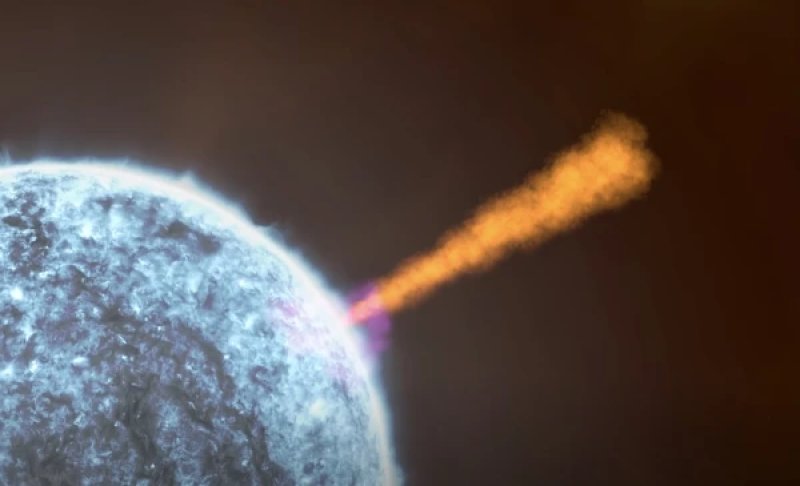
Scientists Find Possible Explanation for Photon That ‘Shouldn’t Have’ Reached Earth
What Makes the GRB 221009A Photon Exceptional?
A remarkable signal from the BOAT
Astronomers detected GRB 221009A on October 9, 2022. They nicknamed it the BOAT, meaning “Brightest of All Time.”
NASA reports that its observed brightness surpassed earlier gamma-ray burst records by roughly 70 times. The signal traveled for approximately 1.9 billion years before reaching Earth.
That makes “brightest gamma-ray burst ever recorded” a more accurate description than “biggest event since the Big Bang.” Observed brightness, total energy, and physical size describe different properties.
The burst also overwhelmed several space instruments, requiring scientists to reconstruct its intensity from their measurements. Yet this latest puzzle concerns one unusually energetic event within that remarkable stream of radiation.
Carpet’s unusually energetic detection
The Carpet detector at Russia’s Baksan Observatory recorded a photon-like atmospheric particle shower consistent with the burst’s direction and timing.
A fuller analysis estimated the original particle’s energy at approximately 300 teraelectronvolts, or 300 trillion electron volts. Earlier work placed it near 251 teraelectronvolts.
Researchers infer that energy from the shower’s measured properties. They also evaluate whether another cosmic particle could mimic the signal.
Why Its Journey Challenges Standard Models
Space contains background radiation that can absorb extremely energetic gamma rays. Over enormous distances, even sparse radiation creates a major obstacle.
When a sufficiently energetic photon interacts with a background photon, the interaction can produce an electron and a positron. Consequently, the original gamma ray no longer continues toward Earth.
At approximately 300 teraelectronvolts, the cosmic microwave background becomes the dominant source of this absorption.
The difficulty therefore concerns survival across the entire journey. Under the standard propagation assumptions examined by the researchers, an arrival from this distance becomes extraordinarily improbable.
Calling that survival “impossible” skips an essential distinction. The calculation describes a vanishingly small expectation within particular models, rather than a direct observation of broken physical laws.
Could Axion-Like Particles Explain the Signal?
A possible change of identity
One proposed explanation involves axion-like particles, often shortened to ALPs. These extremely light particles remain hypothetical.
In suitable magnetic fields, photons could convert into ALPs. Those particles could cross regions that absorb gamma rays, then convert back into photons elsewhere, including within our galaxy.
This mechanism offers a possible explanation for some lower-energy observations associated with the BOAT. However, applying it to the highest-energy event creates additional difficulties.
Why ALPs alone fall short
The new study finds that ALPs alone struggle to explain the Carpet event within the scenarios it explores.
That limitation does not exclude every imaginable ALP model. Instead, it motivates the researchers to examine an additional ingredient.
Crucially, nobody watched this particular photon transform. The proposed conversions belong to a theoretical interpretation of the observations.
How the GRB 221009A Photon Could Test Relativity
Giorgio Galanti of INAF and Marco Roncadelli of INFN examine a possible departure from Lorentz invariance.
This symmetry underlies Einstein’s special relativity. It requires physical laws to retain their form for observers moving uniformly relative to one another.
Certain theoretical frameworks allow departures from that symmetry at extreme energies. Such changes could affect both photon propagation and the conditions required for absorption.
Under specific scenarios, the universe would become more transparent to the highest-energy gamma rays. That could allow a photon to survive a journey that standard calculations strongly disfavor.
The researchers also explore frameworks combining this effect with photon–ALP conversions. Each ingredient addresses different parts of the BOAT’s high-energy observations.
Their work offers a consistent interpretation under stated assumptions. It does not demonstrate that nature actually follows those assumptions.
The Delayed Arrival Adds Another Clue
Carpet recorded its event 4,536 seconds after the initial Fermi trigger, approximately 76 minutes later.
Separate research by Dmitry Ofengeim and Tsvi Piran examines whether an energy-dependent photon speed could explain this timing. The proposed effect can accumulate over a cosmological journey.
In the relevant scenario, the high-energy photon travels slightly slower than ordinary light propagation would predict. Describing this as a faster route through space would therefore mislead readers.
The timing makes the proposal more interesting because it offers another observable feature to explain.
However, an arrival delay does not automatically measure a travel delay. Researchers must also consider when the source emitted photons at different energies.
What Would Strengthen the Evidence?
Further observations must test both the event’s origin and the proposed physics. A photon-like detection and its association with a particular burst involve separate uncertainties.
For this event, Carpet researchers estimate a chance coincidence probability of about 0.9% for direction and timing. That figure does not give the probability that relativity is wrong.
Comparable detections could reveal whether energy, distance, and arrival time follow a repeatable pattern. Any successful explanation must also remain consistent with other astronomical measurements.
GRB 221009A photon: An Open Question
The GRB 221009A photon presents a specific challenge: explaining an apparent high-energy arrival across a universe that should strongly absorb it. The proposed framework connects that puzzle with broader questions about particle physics and spacetime.
For now, the evidence supports continued investigation. Future observations will help determine whether this unusual signal points toward new physics or requires a different explanation.
Main sources:
- NASA — BOAT observations and travel time: https://www.nasa.gov/universe/nasa-missions-study-what-may-be-a-1-in-10000-year-gamma-ray-burst/
- INAF — Official research announcement: https://www.media.inaf.it/2026/09/08/fotone-grb-221009a/
- Galanti and Roncadelli — Theoretical study: https://arxiv.org/abs/2504.01830
- Carpet collaboration — Detection analysis: https://arxiv.org/abs/2502.02425
- Ofengeim and Piran — Arrival-time analysis: https://arxiv.org/abs/2508.07153