
BY:SpaceEyeNews.
A green star discovery has revealed an unexpected side of stellar life after death. Researchers have identified a white dwarf whose light would appear green to human eyes. Its unusual appearance comes from rocky planetary debris and the chemistry of its dense atmosphere.
The object, WD J1330+6435, already existed in astronomical records. What changed was scientists’ understanding of its color. By studying its spectrum, researchers calculated a yellowish-green appearance that ordinary temperature-based descriptions would miss.
The finding raises an intriguing question: how can the remains of a planetary system change the apparent color of a star?
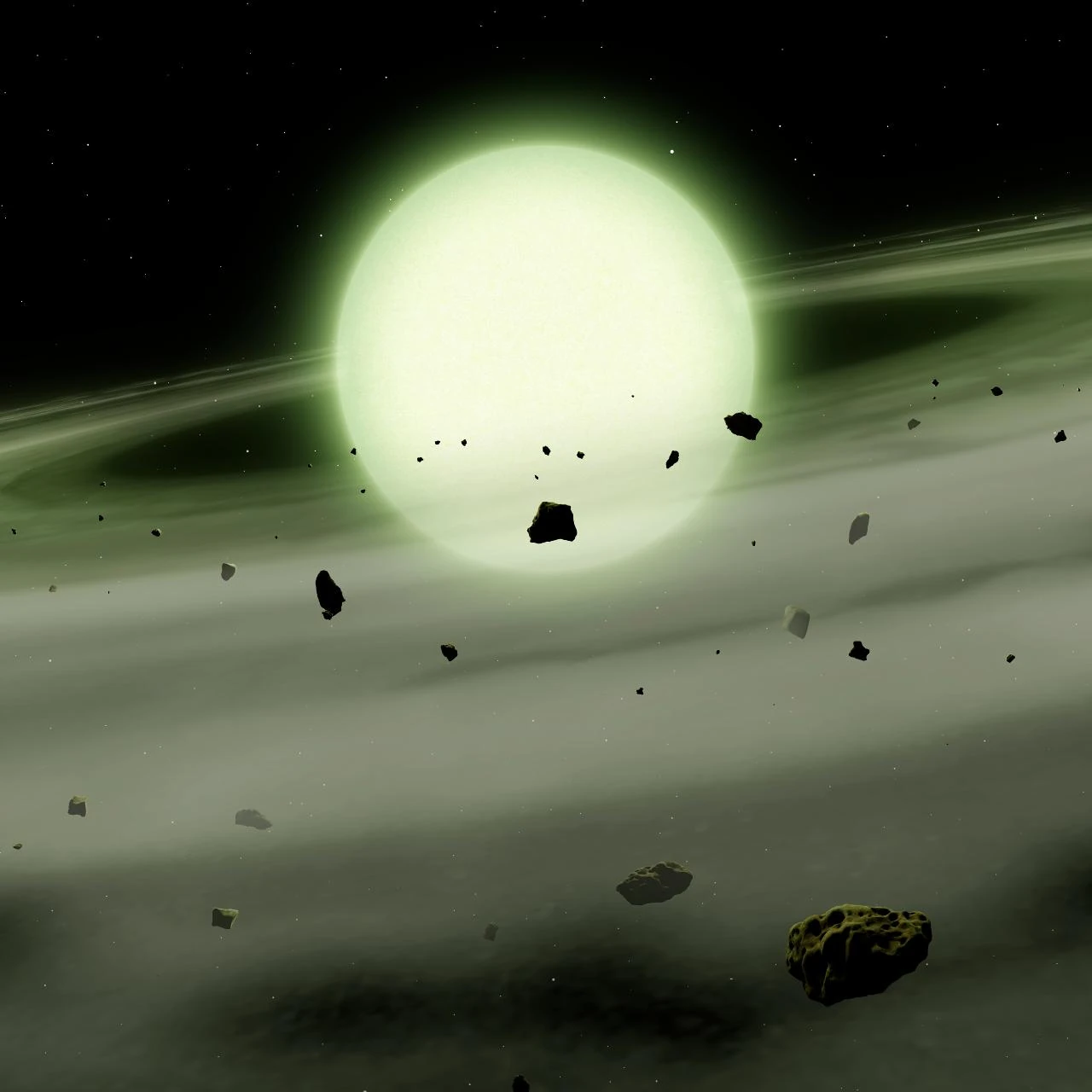
Green White Dwarf Surrounded by Planetary Debris.
A Green Star Discovery Hidden in Familiar Data
Mark Hollands and colleagues at the University of Warwick investigated the possible colors of white dwarfs. Their study appears in RAS Techniques and Instruments.
These stellar remnants usually follow a familiar pattern, with temperature strongly influencing their appearance. However, certain atmospheres reshape the escaping light enough to produce unexpected colors.
WD J1330+6435 provides a particularly striking example. Its atmosphere contains calcium, lithium, and sodium from rocky material in its planetary system. Together with the surrounding atmospheric conditions, these ingredients give its light an unusual balance.
The resulting shade resembles chartreuse, a yellowish green. This is a calculated appearance grounded in spectral evidence, rather than a close-up photograph of a green stellar surface.
How Planetary Debris Changes Starlight
Sodium Filters the Orange Light
The key to this green star discovery lies in what the atmosphere removes from the outgoing light.
Sodium absorbs orange wavelengths. Meanwhile, calcium absorbs light toward the violet end of the visible spectrum. These changes alter the proportions of colors that reach an observer.
Consequently, the combined light can appear green. The star does not simply produce one isolated green wavelength. Instead, its atmosphere changes a broader mixture of visible light.
A useful comparison is a selective filter. Remove enough of some colors, and the remaining mixture takes on a different appearance.
Dense Atmospheres Strengthen the Effect
Density makes this process especially effective. The coolest white dwarf atmospheres can approach the density of water, despite their extremely high temperatures.
That comparison describes atmospheric material, not the average density of an entire white dwarf.
Within these conditions, interactions with surrounding helium broaden the wavelengths that certain elements absorb. Their influence therefore extends across a wider portion of the spectrum.
Rocky debris supplies the ingredients, while the dense atmosphere helps those ingredients reshape the star’s light. Both parts matter when explaining the unusual result.
How Scientists Calculated the Green Glow
The researchers used stellar spectra to investigate how these objects would look. A spectrum separates incoming light by wavelength, revealing where the star emits strongly and where absorption reduces that light.
They then applied a model of human color vision. This step translated the wavelength balance into an estimated visual appearance.
The distinction matters because the accompanying images serve different purposes. An artist’s illustration introduces the idea, while a color simulation represents a calculation.
Neither should carry a caption suggesting that astronomers photographed the star’s surface glowing green.
There is also some uncertainty in the precise shade. The team notes noise in the spectrum of WD J1330+6435. However, different atmospheric models support its green appearance.
The paper also identifies two paler green examples. Therefore, describing this object as the only green star would oversimplify the findings. It stands out as the most vivid green example in that sample. academic.oup.com
White Dwarfs Reveal More Unexpected Colors
Pink and Purple From Carbon
Green forms only one part of the wider discovery. Carbon-rich white dwarfs can display pink or purple hues because their atmospheres absorb different portions of visible light.
In some objects, convection carries carbon upward from deeper layers. Carbon molecules then influence the emerging spectrum.
One notable example is WD J1011+2845, approximately 48 light-years away. Its calculated appearance has a deep salmon-pink character.
Researchers suggest it could rank as the reddest star known. That description remains a qualified comparison, rather than a reason to present every carbon-rich white dwarf as equally extreme.
Yellow and Cyan Have Different Origins
Other white dwarfs enriched with planetary debris tend toward yellow. Their final appearance depends on their temperatures and atmospheric ingredients.
Meanwhile, cool atmospheres containing hydrogen and helium can produce cyan or pale-blue appearances. Collisions involving hydrogen molecules and helium help alter the escaping radiation.
These examples share one message: temperature remains important, but atmospheric chemistry can change the visible outcome substantially. warwick.ac.uk
How Common Are Unusually Colored White Dwarfs?
To place these findings in context, the team examined 151 white dwarfs within about 65 light-years of Earth.
Five showed unusual colors: two yellow and three pink. That corresponds to roughly one in 30 within the nearby sample.
Crucially, this figure describes unusual coloring overall. It does not mean that one in 30 white dwarfs appears green.
Most objects retained more familiar appearances. The researchers also found that the representative population’s median color corresponds to white.
The name “white dwarf” therefore still makes sense, even though it leaves room for some remarkable exceptions. warwick.ac.uk
What the Green Star Discovery Changes
The green star discovery connects a star’s appearance with the chemical traces of its planetary surroundings.
It also shows how familiar astronomical data can reveal something unexpected when researchers ask a different question.
For readers, the lasting image is a stellar remnant with a surprisingly colorful atmosphere. Behind that image lies a measurable process: rocky material changes atmospheric chemistry, absorption reshapes starlight, and the resulting mixture changes the color we would perceive.
Main sources:
University of Warwick — Green, pink and purple: astronomers reveal the surprising true colours of white dwarf stars
RAS Techniques and Instruments — Any colour you like: the diverse chromaticities of white dwarfs
Space.com — Astronomers discover the 1st ever green star, a cosmic zombie just in time for Halloween