
BY:SpaceEyeNews.
A scorching planet has given astronomers an unexpected clue: its dayside looks cooler than a dark, airless world should. New HD 3167 b atmosphere evidence suggests that gases around this lava planet could explain the difference. Despite its extreme surroundings, the rocky world may carry an atmosphere that changes how it absorbs and distributes heat.
The finding raises a compelling question. How can a planet so close to its star maintain an atmosphere? Answering that could help researchers understand other rocky worlds, including Earth during its molten beginnings.
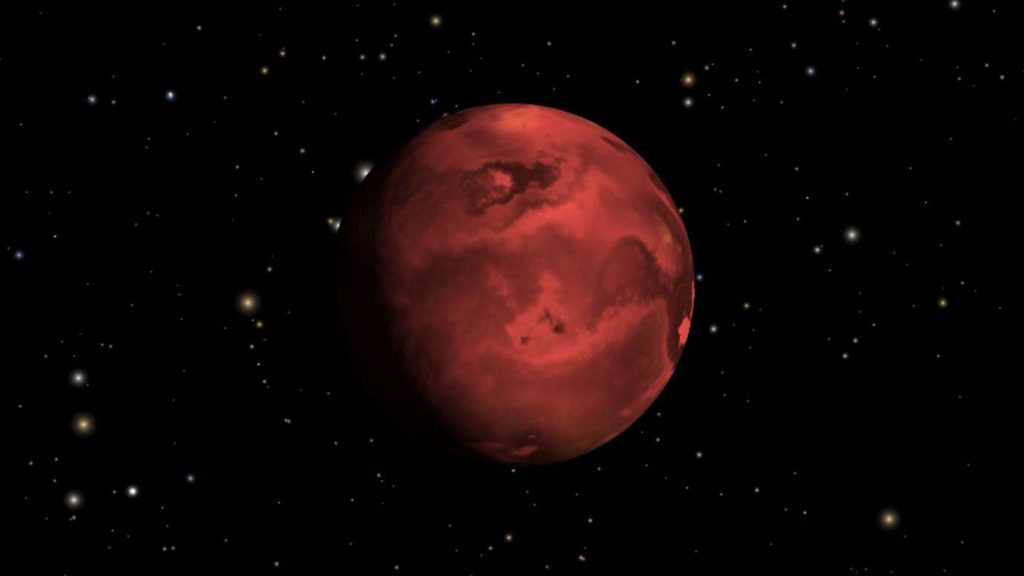
Lava world HD 3167 b. Source: NASA
HD 3167 b: An Extreme World Worth Revisiting
HD 3167 b lies around 154 light-years away in Pisces. It circles a K-type star in approximately 23 hours. With a radius about 1.6 times Earth’s, it belongs to the super-Earth category.
NASA lists its discovery year as 2016. The latest development therefore concerns its possible atmosphere, rather than the discovery of the planet itself. science.nasa.gov
Intense heating likely melts rock on its star-facing surface. However, astronomers cannot inspect that landscape directly. They must extract clues from the faint light that reaches their instruments. This makes its thermal emission particularly valuable: it can reveal whether the planet behaves like exposed rock or something more complex.
What Webb Measured Behind the Star
Researchers used the James Webb Space Telescope’s Mid-Infrared Instrument to observe a secondary eclipse. During this event, HD 3167 b slipped behind its host star.
Before the eclipse, Webb received light from both objects. With the planet hidden, only the star contributed. Comparing those measurements allowed the team to estimate the planet’s infrared emission.
The measured drop was just 38 parts per million, with an uncertainty of 11 parts per million. Although tiny, that signal held the central clue. arxiv.org
A Fainter Dayside Than Expected
The planet emitted less infrared light than the researchers expected from a dark, maximally hot bare-rock model. Its inferred dayside brightness temperature therefore fell below that model’s prediction.
This distinction matters. Webb measured emitted light, which researchers compared with physical models. It did not photograph clouds or directly sample atmospheric gases. The result supports an atmospheric explanation, while leaving important questions about that atmosphere unanswered.
How an HD 3167 b Atmosphere Could Cool Its Dayside
An atmosphere could explain the observations through two processes. First, circulating gases could carry energy away from the illuminated hemisphere. Moving heat toward the nightside would reduce the dayside temperature.
Second, reflective clouds could send some incoming starlight back into space. Less absorbed energy would also mean a cooler dayside.
Both processes can influence a planet’s heat balance. However, the current measurements do not reveal which mechanism dominates on HD 3167 b.
Why Keeping an Atmosphere Is Surprising
Close to a star, rocky planets face conditions that can remove atmospheric material. Energetic radiation and stellar wind make long-term atmospheric survival challenging.
Yet several intensely heated rocky worlds show atmospheric clues. HD 3167 b adds another case to that puzzle. Researchers now want to understand which conditions allow these envelopes to persist, and how their properties change between different lava worlds.
What “Coolest Lava World” Actually Means
Calling HD 3167 b the “coldest lava planet” can create the wrong impression. This world remains extremely hot. The comparison concerns lava worlds showing evidence of atmospheres, rather than every molten planet astronomers know.
More precisely, the study describes it as the least irradiated ultra-short-period super-Earth with atmospheric evidence. arxiv.org
That position makes it useful for investigating a possible transition. Researchers suspect atmospheric behavior could change across a particular temperature range. Perhaps hotter conditions support thicker atmospheres or encourage reflective silicate clouds.
The finding comes from a program studying 10 lava worlds. By comparing them, scientists hope to identify whether a consistent pattern emerges. One planet cannot establish a universal threshold, but it can help narrow the possibilities and guide the next observations.
The Atmospheric Ingredients Remain Unknown
What might surround this planet? Vaporized rock offers one possibility. Its likely molten surface makes gases derived from silicate material an obvious candidate for investigation.
However, researchers have not established the composition of the HD 3167 b atmosphere. The university’s explanation also discusses carbon dioxide, carbon monoxide, and water as possibilities in lava-world atmospheres more broadly. news.uchicago.edu
Those examples do not mean Webb detected these substances here. Nor does the cooling signal establish that silicate clouds exist above this particular surface.
Different gases absorb and emit light at different wavelengths. A more detailed spectrum could help researchers distinguish between competing atmospheric models. That would move the investigation beyond a temperature clue toward a clearer description of the planet.
Identifying atmospheric ingredients will require stronger spectral evidence. Until then, the distinction between a plausible explanation and a measured chemical signature remains essential.
A Glimpse of Earth’s Molten Beginnings
HD 3167 b cannot offer a home for life as we know it. Nevertheless, its extreme environment could help scientists investigate processes that once shaped Earth.
During terrestrial planet formation, collisions released enormous amounts of energy. Early Earth experienced a magma-ocean phase, with molten material covering its surface.
Studying lava worlds provides a way to explore relationships between hot rock and surrounding gases. These relationships matter because a planet’s surface and atmosphere can evolve together.
The comparison has limits. HD 3167 b endures intense stellar heating and follows a very different orbit. Still, it offers a natural setting for testing ideas about molten rocky planets.
What Comes Next for HD 3167 b Atmosphere Research?
The next challenge is to determine what produces the planet’s unexpectedly faint dayside emission. The researchers propose follow-up observations with Webb’s NIRSpec instrument to investigate atmospheric composition. arxiv.org
For now, the HD 3167 b atmosphere evidence offers a promising lead. More detailed measurements could show which gases surround this extreme world and how they influence its temperature. That would bring scientists closer to understanding the earliest chapters of rocky planetary evolution.
Main sources:
- University of Chicago — Official announcement and researcher explanation.
- NASA — HD 3167 b planet catalog.
- The Astrophysical Journal Letters — Evidence for an Atmosphere on the Ultra-short-period Super-Earth HD 3167 b.
- arXiv — Open-access research paper.