BY:SpaceEyeNews.
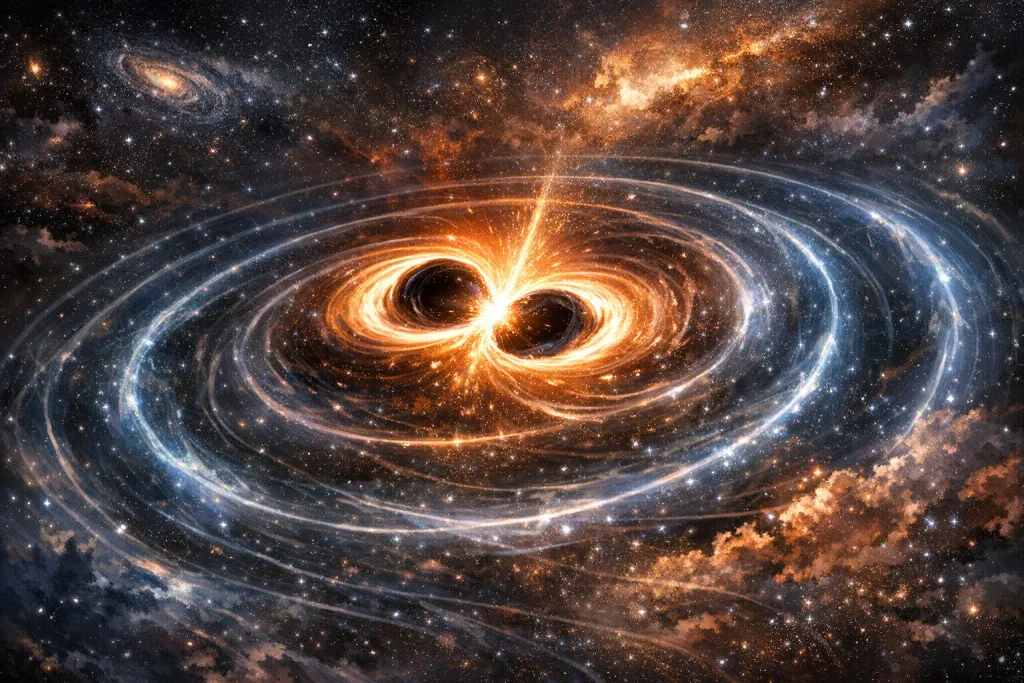
stronomers may have uncovered hidden black hole populations inside the growing catalog of gravitational-wave detections. Two independent research teams analyzed the masses and spins of merging black holes. Both reached a similar conclusion. The detected objects do not belong to one uniform group.
Instead, the catalog appears to contain several distinct families. Each may reflect a different formation pathway.
One group has drawn particular attention. It contains unusually massive black holes, often around 40 times the mass of the Sun or more. Many also appear to spin rapidly. Their spin directions may not follow the orientation of their new orbit.
Together, those features suggest an extraordinary possibility. Some of these black holes may have formed through earlier black hole mergers. They later entered new systems and merged again.
This would make them second-generation black holes. Their presence could explain how black holes reach masses that ordinary stellar evolution struggles to produce.
Hidden Black Hole Populations Inside the Merger Catalog
Since the first direct gravitational-wave detection in 2015, LIGO, Virgo, and KAGRA have transformed black hole astronomy. Their observations now allow researchers to study black holes as a population rather than as isolated discoveries.
Each detected merger carries information about the two objects involved. Scientists can estimate their masses, spin rates, spin directions, and relative sizes.
However, individual measurements often contain large uncertainties. One signal rarely reveals the full formation history of a black hole.
The larger catalog changes that situation. By studying many events together, researchers can search for repeated trends. These trends may reveal groups that formed through different astrophysical processes.
Two studies published in Physical Review Letters applied this population-level approach to gravitational-wave data. The teams used different statistical models. Yet both found signs of distinct black hole subpopulations.
That agreement matters. It suggests the result does not depend entirely on one narrow model or one assumed formation scenario.
One Catalog, Several Black Hole Families
The study led by Sharan Banagiri of Monash University used a flexible method. The model allowed the data to determine how many groups were present.
The researchers did not begin by assigning every black hole to a known formation route. Instead, they searched for changes in mass, spin, and mass ratio across the observed population.
Their results favored at least three subpopulations of merging binary black holes. The groups occupied different ranges of primary black hole mass.
The primary black hole is the heavier object in a binary system.
Each group also showed different behavior in its spin or mass ratio. That pattern suggests the detected mergers may come from several astrophysical environments.
Some binaries could have evolved from pairs of massive stars. Others may have assembled later inside crowded stellar systems.
A Separate Search for Hierarchical Mergers
A second team, led by Cailin Plunkett at MIT, focused more directly on spin.
The researchers studied two spin parameters that gravitational-wave signals can measure relatively well. One describes how much the black holes spin along the direction of their orbit. The other tracks spin components that tilt away from that direction.
This distinction is important because different formation pathways produce different spin patterns.
Black holes born from two stars that evolved together may retain some connection between their spins and orbital plane. In contrast, black holes paired through random encounters may have spins pointing in many directions.
Plunkett’s team found evidence for a massive population with strong and broadly oriented spins. This group appeared consistent with black holes produced by previous mergers.
Why the 40-Solar-Mass Boundary Matters
Both studies identified a notable change near a primary mass of roughly 40 solar masses.
This does not mean that every black hole above that level has already merged once. The boundary is statistical, not absolute.
Still, the result suggests that the population above this mass may differ from the objects below it.
The heavier group contains black holes with higher spins than the broader population. In the Plunkett-led analysis, the spin orientations also appeared more random.
That combination matches a key prediction for hierarchical black hole mergers.
What Is a Second-Generation Black Hole?
A second-generation black hole begins with an earlier merger.
Two first-generation black holes combine and produce a larger remnant. That remnant may remain inside a dense environment instead of leaving it.
Later, gravitational interactions can pair it with another black hole. The new binary eventually merges and sends gravitational waves across the universe.
Scientists call this process a hierarchical merger.
The word “hierarchical” describes repeated growth. One merger creates an object that participates in another merger later.
This process can continue under the right conditions. Each stage builds a more massive black hole.
Dense star clusters provide one possible setting. Their strong gravitational interactions can bring unrelated black holes together.
Nuclear star clusters near galactic centers may also support repeated encounters. Disks around active galactic nuclei could offer another route, although researchers continue to test that possibility.
Earlier Mergers Leave a Spin Signature
Mass alone cannot reveal whether a black hole formed through an earlier merger. Spin provides another clue.
When two black holes combine, the remnant usually carries substantial angular momentum. As a result, it often rotates quickly.
If that remnant later joins a new binary through a random gravitational encounter, its spin direction may not align with the new orbit.
This creates a recognizable combination: high mass, strong spin, and a tilted or random spin direction.
Plunkett’s team found this pattern in the heavier population. The result supports the idea that some detected black holes are previous-merger remnants.
Banagiri’s team also found a high-mass population with relatively high spins. However, the study did not identify the same clear spin-orientation pattern.
That difference introduces necessary caution.
The two analyses support the existence of hidden black hole populations. Yet they do not prove the precise origin of every group.
Why Massive Black Holes Challenge Stellar Evolution
Most stellar-mass black holes form after massive stars exhaust their fuel. The star’s core can then collapse and create a compact remnant.
However, very massive stars do not always follow a simple path from collapse to black hole formation.
At certain core temperatures, energetic photons can transform into electron and positron pairs. This process reduces the pressure supporting the star.
The star may then experience violent pulsations that remove large amounts of material. In more extreme cases, the entire star may disrupt and leave no black hole behind.
These processes can create a shortage of black holes within a particular mass range. Astronomers often call this region the pair-instability mass gap.
The exact boundaries depend on stellar models, composition, rotation, and mass loss. Therefore, scientists do not treat the gap as one perfectly fixed interval.
Even so, black holes inside or near this difficult mass range raise important questions.
Hierarchical Growth Offers Another Route
Repeated mergers can bypass some limits of direct stellar collapse.
Two smaller black holes can merge to form a larger object. That remnant does not need to come from one star with the same final mass.
As a result, hierarchical mergers may place black holes in regions of the mass spectrum that ordinary stellar evolution rarely reaches.
The gravitational-wave event GW190521 provided an early example of this puzzle. Its component masses appeared unusually high. Researchers considered previous mergers as one possible explanation.
More recent catalogs now contain an even wider variety of massive and rapidly spinning systems.
For example, GWTC-4.0 included a binary known as GW231123_135430. LIGO reported that both black holes were roughly 130 times the mass of the Sun.
Such objects are difficult to explain through standard stellar collapse alone. Previous mergers offer a plausible pathway.
However, one unusual system cannot define an entire population. The new studies go further because they search for a recurring statistical pattern across many events.
Hidden Black Hole Populations Could Reveal Their Birth Environments
Different black hole formation environments leave different signatures.
A binary that begins as two companion stars follows one evolutionary history. A binary created through random encounters follows another.
Researchers often describe these broad routes as isolated and dynamical formation.
Isolated Binary Evolution
In the isolated pathway, two massive stars begin their lives as a pair.
They exchange material and influence each other’s evolution. Each star may eventually leave behind a black hole.
The resulting black holes can remain bound and slowly move closer together.
Because the stars shared the same orbital system, their black hole spins may show some alignment with the orbit. Stellar evolution can disturb that alignment, so the result is not always simple.
Still, aligned spins can provide evidence for this pathway.
Dynamical Formation
In dense clusters, black holes can meet through gravitational encounters.
A black hole may exchange partners several times before settling into a binary. These interactions can create systems with unusual mass ratios.
They can also produce random spin orientations because the paired black holes did not evolve together.
Dense clusters are especially important for hierarchical growth. If a merger remnant stays inside the cluster, it may find another companion.
The key challenge is retention.
A black hole merger can send the remnant moving through space due to uneven gravitational-wave emission. This recoil can eject it from a small cluster.
Larger and denser environments have stronger gravity. They may retain more merger remnants and allow repeated growth.
Population studies can therefore reveal more than black hole properties. They can also test which cosmic environments produce the observed systems.
Could Repeated Mergers Build Intermediate-Mass Black Holes?
The new findings may also connect to one of astronomy’s longest-running mysteries.
Stellar-mass black holes usually contain a few to several dozen solar masses. Supermassive black holes contain millions or billions.
Between them lies the proposed intermediate-mass class. These black holes would contain hundreds or thousands of solar masses.
Astronomers have identified several promising candidates. Yet the population remains difficult to confirm and explain.
Repeated mergers offer one possible growth route.
A dense cluster could combine black holes through several generations. Each merger would increase the remnant’s mass.
Over time, this process might produce an intermediate-mass black hole.
The new studies do not prove that this full chain occurs. They focus on lower-mass systems detected in gravitational waves.
Still, evidence for second-generation black holes would show that hierarchical growth already operates in nature.
That would strengthen models in which repeated mergers help create larger black holes.
A Possible Link to Supermassive Black Hole Seeds
Supermassive black holes existed surprisingly early in cosmic history. Some had already reached enormous masses when the universe was less than one billion years old.
Scientists continue to debate how their initial seeds formed and grew so quickly.
Hierarchical stellar-mass mergers alone may not explain the entire process. Gas accretion and direct-collapse scenarios likely play major roles.
Even so, repeated mergers could contribute to early seed growth in dense environments.
They may also help form intermediate objects that later gain mass through gas.
Therefore, hidden black hole populations could reveal one part of a much larger growth story.
The Important Limits of the New Findings
The studies provide strong evidence for several black hole groups. However, the interpretation remains statistical.
Researchers cannot yet examine one event and declare its full history with complete certainty.
Mass and spin estimates depend on the quality of the signal. Detector sensitivity also shapes the observed catalog.
Massive systems are easier to detect across greater distances. This creates selection effects that researchers must model carefully.
Population results can also change when scientists adopt different assumptions about mass and spin distributions.
The disagreement between the two studies over spin orientation illustrates this challenge.
Both teams found a massive, high-spin group. Yet only one recovered a clear signature associated with hierarchical mergers.
The most careful conclusion is therefore straightforward.
The catalog contains distinct populations. At least one heavy group has properties consistent with earlier mergers. More data will determine how strong that link becomes.
Newer Gravitational-Wave Catalogs Will Test the Result
The two studies used GWTC-4.0, which included observations from the first section of the fourth LIGO–Virgo–KAGRA observing run.
That catalog added 128 gravitational-wave candidates from the period between May 2023 and January 2024. It more than doubled the previous catalog size.
Since then, the collaboration has released GWTC-5.0.
The newer catalog includes 161 additional significant signals from the second part of the fourth observing run. It brings the cumulative number of gravitational-wave detections to 390.
This much larger sample gives astronomers a powerful opportunity.
Researchers can test whether the same mass boundaries remain visible. They can also search for rarer populations and improve estimates of spin orientation.
More detections will not remove every uncertainty. However, they should make broad population trends harder to confuse with statistical fluctuations.
The expanded catalog may also show whether the high-mass group contains several subgroups of its own.
Some objects may have formed through previous mergers. Others could reflect unusual stellar evolution or different environments.
Hidden Black Hole Populations Are Changing Gravitational-Wave Astronomy
The first gravitational-wave detections proved that black hole mergers occur. The latest population studies are asking a deeper question: how many different types of merger exist?
Two independent analyses now suggest that the catalog contains hidden black hole populations with distinct masses and spins.
The most intriguing group includes massive and rapidly rotating black holes. Some also carry randomly oriented spins.
Those characteristics fit the expected signature of second-generation objects. These black holes may have formed in earlier mergers before joining new binaries.
The evidence does not reveal the exact history of every detected system. Nor does it prove that all massive black holes share one origin.
Yet the broader pattern is becoming harder to ignore.
Gravitational waves are no longer only announcing distant mergers. They are beginning to reveal the family histories of black holes.
As future catalogs grow, astronomers may learn where these objects formed, how many merged before, and how repeated mergers shaped the black hole population across cosmic time.
Main Sources
Physical Review Letters — “Evidence for Three Subpopulations of Merging Binary Black Holes at Different Primary Masses”
https://journals.aps.org/prl/accepted/10.1103/blyb-lqv6
Physical Review Letters — “Signatures of a Subpopulation of Hierarchical Mergers in the Gravitational-Wave Catalog”
https://journals.aps.org/prl/abstract/10.1103/n6p4-ftgq
LIGO Scientific Collaboration — GWTC-4.0 Catalog Announcement
https://ligo.org/new-catalog-more-than-doubles-the-number-of-gravitational-wave-detections-made-by-ligo-virgo-and-kagra-observatories/
LIGO Scientific Collaboration — GWTC-5.0 O4b Catalog
https://ligo.org/detections/o4b-catalog/
Gravitational Wave Open Science Center — Gravitational-Wave Transient Catalog
https://gwosc.org/eventapi/html/GWTC/