BY:SpaceEyeNews.
A hidden solar storm crossed the inner Solar System in December 2024 while its Earth-directed path escaped normal forecasting. From our planet, the main coronal mass ejection appeared to travel southward. A faster, narrower section was moving toward Earth, however. Scientists discovered it by combining observations from 17 spacecraft. Their findings expose a major viewing problem for future crewed missions beyond Earth’s magnetic field.
Europa Clipper Finds the Hidden Solar Storm
NASA’s Europa Clipper was travelling between Earth and Mars on December 19, 2024. During a short instrument check, its Plasma Instrument for Magnetic Sounding detected unusual solar-wind conditions. The surrounding plasma appeared hotter and less dense than models predicted.
Researchers traced that signal to the wake of a CME launched several days earlier. Europa Clipper had crossed the disturbance during its journey to Jupiter.
Engineers designed PIMS to measure plasma density, temperature, and flow near Jupiter’s moon Europa. Those abilities also revealed an unexpected structure in interplanetary space.
Why the Earth-Based View Missed the CME
The event began with a long solar filament eruption on December 14 and 15. Images from the Sun–Earth line showed its most prominent material moving mainly southward.
The view concealed a second feature. The Earth-directed front overlapped the brighter southward section, making the narrower component difficult to identify.
NASA’s STEREO-A spacecraft supplied the missing angle. It sat about 29 degrees west of the Sun–Earth line and viewed the eruption from the side. Its images separated the two components and exposed the faster front heading toward Earth.
Its geometry hid the Earth-directed section from the main viewing line used for operational forecasts.
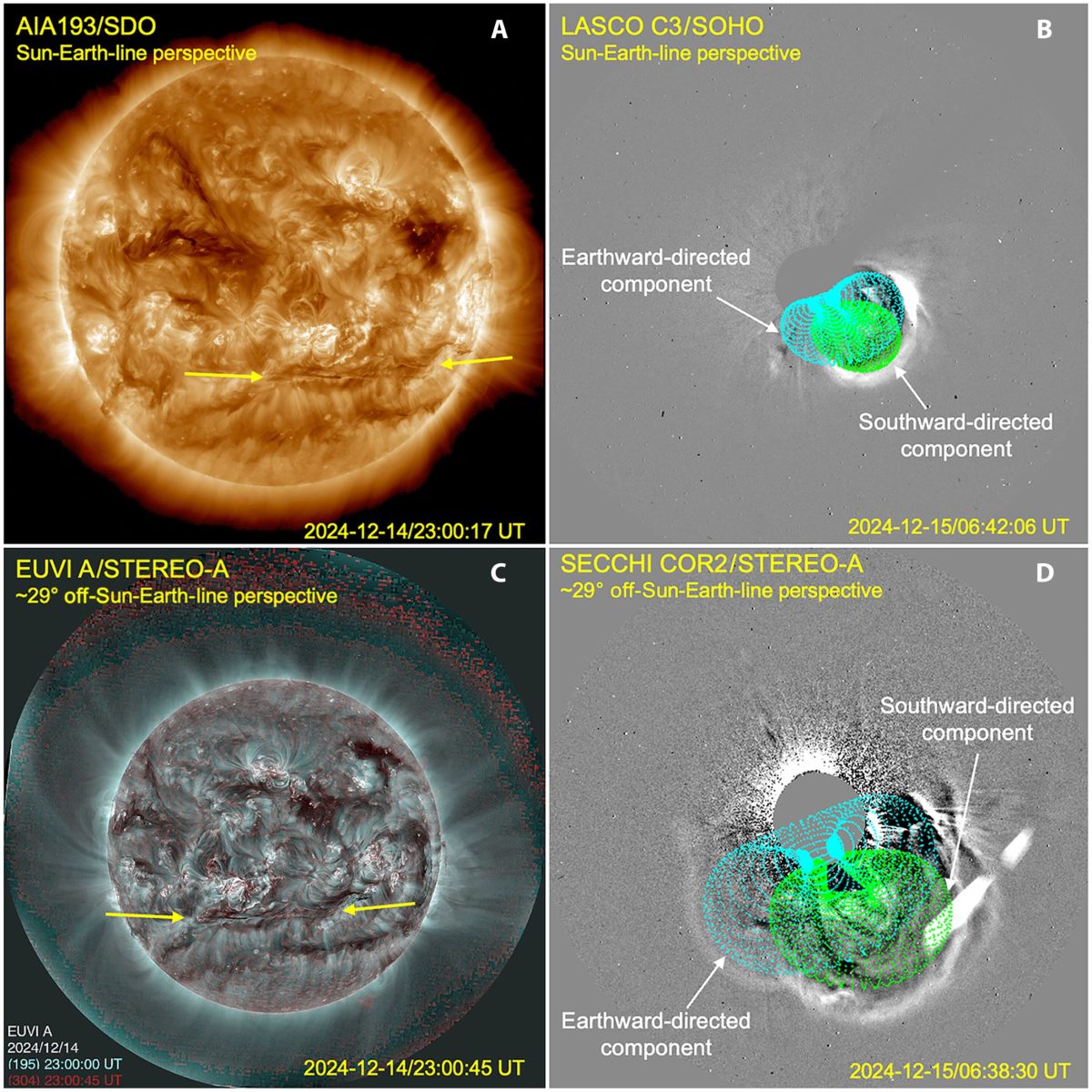
Observations of the solar disk and corona in extreme ultraviolet and with a coronagraph, showing a branching filament that caused the formation of a complex coronal mass ejection. Source: Science Advances.
Seventeen Spacecraft Trace an Uneven Solar Eruption
Seventeen spacecraft occupied useful positions across the inner Solar System, from near Mercury to beyond Earth.
BepiColombo detected the Earth-directed component near Mercury on December 16. Wind, ACE, and DSCOVR registered its arrival near Earth on December 17. Spacecraft operating around Earth and the Moon recorded related magnetic changes. Europa Clipper encountered the CME during its cruise, while MAVEN detected associated pressure changes near Mars.
Together, the measurements showed that the CME did not expand as one uniform front.
Faster and Slower Sections Took Different Paths
STEREO-A sat at almost the same distance from the Sun as Earth. Yet it encountered its local section about 25 hours after the disturbance reached Earth. Solar Orbiter, positioned only about 10 degrees east of the Sun–Earth line, recorded no clear shock or magnetic cloud from the event.
Researchers estimated that the faster Earth-sector component averaged about 840 kilometres per second from the corona to Earth. The section extending toward STEREO-A averaged roughly 534 kilometres per second over a comparable distance.
Those differences revealed a narrow, dual-lobed structure with uneven speeds. The team reconstructed its radial and longitudinal development, but gaps remained. Most of the spacecraft stayed near the Solar System’s main orbital plane. As a result, the observations could not deliver a complete three-dimensional map.
The Hidden Solar Storm Exposes a Forecasting Gap
Forecasting a CME from one main viewing direction creates unavoidable uncertainty. When an eruption approaches almost head-on, its width and speed become harder to separate. Bright structures can also conceal fainter components moving along different paths.
Models add another challenge. They must simplify a changing magnetic structure that interacts continuously with the surrounding solar wind. A broad, regular front cannot always represent a narrow CME with faster and slower regions.
Remote images show how an eruption leaves the Sun. Direct plasma and magnetic measurements reveal what actually passes each spacecraft. Combining both methods produces a more reliable picture than either can provide alone.
In this case, operational forecasts identified the obvious southward CME but missed the Earth-directed component. The event reached Earth without producing the kind of major disruption associated with the strongest solar storms. Its importance lies in what the same blind spot could mean during a more energetic event.
What It Means for Crewed Moon and Mars Missions
Future crews outside Earth’s magnetic protection will depend on timely space-weather alerts. A missed CME could leave astronauts with less time to enter shielded areas, delay an activity, or change a flight plan.
Fast CMEs can drive interplanetary shocks that accelerate energetic particles. Those particles may pass through spacecraft materials and affect both people and electronics. Communications, navigation, and scientific instruments can also experience disruption.
The December event demonstrates a serious forecasting risk. It does not prove that this particular CME would have delivered a lethal radiation dose. Exposure depends on particle energy, intensity, shielding, location, and duration. Describing the risk accurately makes the discovery no less important.
Turning Planetary Missions Into a Warning Network
The researchers propose using planetary spacecraft in transit as supplementary space-weather monitors. Many already carry magnetometers, particle detectors, or plasma instruments. Keeping suitable instruments active during cruise could fill gaps between dedicated observatories.
Such a network would need reliable communications, shared data formats, and rapid analysis. Planetary missions also have limited power and separate scientific priorities. Therefore, they cannot replace purpose-built monitoring systems. They can provide valuable measurements from locations that dedicated satellites do not cover.
ESA’s planned Vigil mission offers another part of the solution. Vigil will observe from the Sun–Earth L5 region, giving forecasters a continuing side view of Earth-directed CMEs. Its data will complement observations from spacecraft positioned along the Sun–Earth line.
Hidden Solar Storm Changes How We Watch the Sun
Europa Clipper turned a routine check into evidence of a major forecasting weakness. The hidden solar storm was not a simple expanding cloud. It contained narrow regions moving at different speeds and toward different destinations. Future protection will require more viewing angles and measurements across interplanetary space. A connected network of dedicated observatories and travelling probes could provide the wider perspective that Moon and Mars missions will need.
Main Sources:
Original Science Advances study:
https://www.science.org/doi/10.1126/sciadv.aed9960
NASA – Plasma Instrument for Magnetic Sounding:
https://science.nasa.gov/mission/europa-clipper/spacecraft-instruments-pims/
Johns Hopkins Applied Physics Laboratory – PIMS:
https://www.jhuapl.edu/destinations/instruments/pims
ESA – Vigil Mission Overview:
https://www.esa.int/Space_Safety/Vigil/Vigil_mission_overview
Starting news source – Universe Magazine:
https://universemagazine.com/en/a-fleet-of-space-probes-detects-a-hidden-threat-from-the-sun/