BY:SpaceEyeNews.
Deep below Earth’s surface, far beyond the reach of any drill, scientists may have found a clue to one of our planet’s oldest secrets. A Hidden Structure Inside Earth’s Core could exist within the solid inner core, revealing that Earth’s center is more complex than earlier models suggested.
This is not a hidden cave or empty space. It is a possible metallic region inside the inner core where seismic waves behave in a different way. That small difference matters. It could point to a distinct zone deep inside Earth, sometimes called the “innermost inner core.”
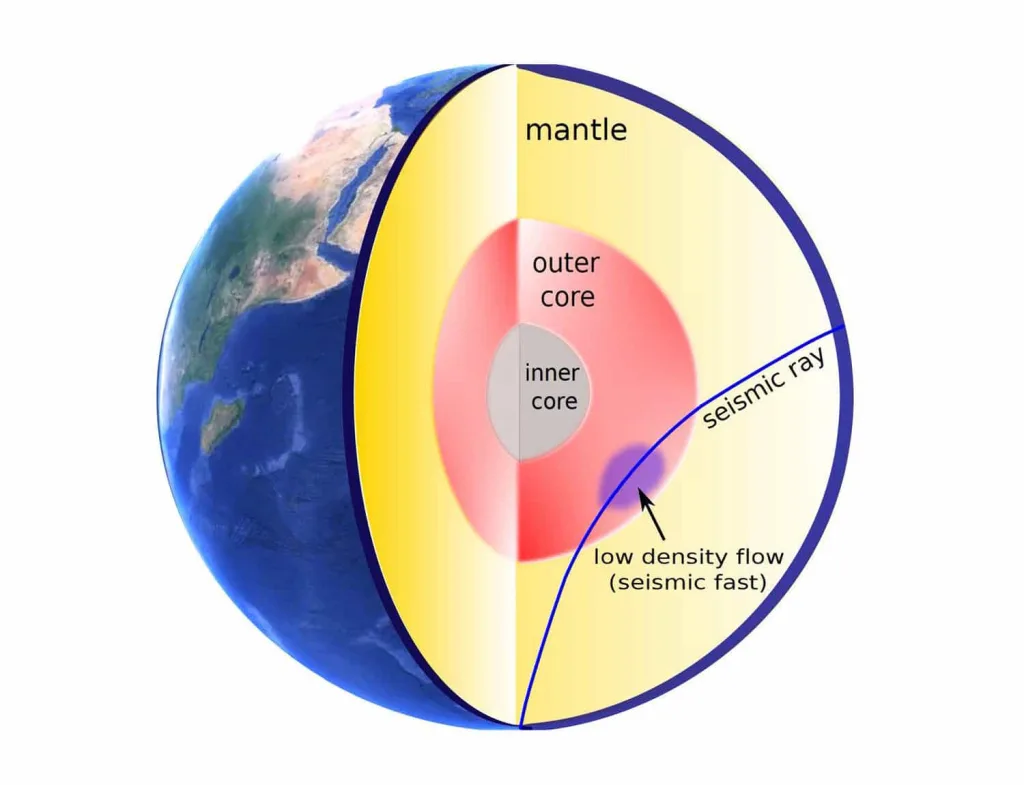
For decades, most people learned that Earth has four major layers: crust, mantle, outer core, and inner core. That model still works as a broad picture. Yet new seismic studies suggest the inner core may contain another internal division. If confirmed, this finding could reshape how scientists describe Earth’s deepest structure.
The discovery also has a much bigger meaning. Earth’s core is tied to the planet’s cooling history, magnetic field, and long-term evolution. By studying this hidden central region, researchers may uncover clues from a time when Earth was still forming into the world we know today.
A Hidden Structure Inside Earth’s Core Is Not Science Fiction
The phrase Hidden Structure Inside Earth’s Core sounds dramatic. But the research behind it is careful and grounded in seismic data. Scientists are not claiming that Earth contains a secret chamber. They are studying how earthquake waves move through the planet’s deepest interior.
Earth’s inner core is a solid sphere made mostly of iron and nickel. It sits beneath the liquid outer core. Temperatures there exceed 5,000 degrees Celsius, yet the inner core remains solid because the pressure is extreme.
For many years, researchers treated the inner core as one main solid region. Now, that picture may need more detail. Evidence suggests the inner core could contain a smaller central zone with different physical properties.
This possible region is known as the innermost inner core. Studies indicate that seismic waves shift their behavior near a radius of about 650 kilometers from Earth’s center. That suggests the iron crystals in this deep zone may be arranged differently from those in the surrounding inner core.
In simple terms, Earth’s center may not be one uniform metal ball. It may contain a smaller structure inside the inner core itself.
How Earthquake Waves Revealed the Clue
Scientists cannot travel to Earth’s core. No machine can survive the distance, heat, and pressure. Instead, researchers use earthquakes as natural probes.
When a strong earthquake occurs, seismic waves travel through the planet. Some move through the mantle. Others pass through the outer core and inner core before reaching sensors on the opposite side of Earth. By measuring how quickly these waves arrive, scientists can infer what they encountered along the way.
One key concept is anisotropy. This means a material behaves differently depending on direction. In the inner core, seismic waves may move faster along one path and slower along another.
That directional behavior can reveal how iron crystals are arranged deep inside Earth. If the crystals point in a certain pattern, waves traveling through them may speed up or slow down.
Researchers found that wave behavior changes in the central part of the inner core. In some models, the slowest wave speeds appear at an angle of about 50 to 54 degrees relative to Earth’s rotation axis. That pattern differs from what scientists see in the surrounding inner core.
This is why the evidence is so important. The waves are not simply telling scientists that Earth has a dense metallic center. They may be showing that the inner core has its own layered structure.
Why the New Evidence Matters
A major 2020 study from researchers at The Australian National University examined decades of seismic data. Instead of relying on broad averages, the team tested thousands of possible models. This helped them search for subtle changes that earlier methods could miss.
The results supported the idea of a distinct innermost inner core. The study suggested that the central part of the inner core has a different seismic signature. That difference may reflect a change in the structure of iron deep inside Earth.
A second major study in 2023 strengthened the case. Researchers used rare seismic waves that reverberated through Earth’s center multiple times. These signals are valuable because they sample the core more than once.
The study again pointed to a distinct central region. It also found that wave speeds were slower at certain angles relative to Earth’s rotation axis. That result matches the broader idea that the inner core is not uniform.
This does not mean every detail is settled. Earth’s center is one of the hardest places in science to study. Still, when different methods point toward a similar structure, the case becomes harder to ignore.
What the Innermost Inner Core Could Reveal
The most exciting part of this discovery is not only the possible new layer. It is what that layer may tell us about Earth’s ancient past.
Earth formed about 4.5 billion years ago. Over time, dense metals sank toward the center. Lighter materials formed the mantle and crust. As the planet cooled, part of the liquid core began freezing into a solid inner core.
If the innermost inner core has a different structure, it may record a major shift in that cooling process. Some researchers suggest the evidence could point to separate cooling events in Earth’s history.
That idea turns the core into a kind of deep archive. Rocks at the surface preserve fossils, impacts, and climate clues. But the inner core may preserve evidence from a much older and more extreme chapter.
The possible Hidden Structure Inside Earth’s Core may reflect changes in pressure, temperature, crystal alignment, or core growth. It may even point to a major event that changed how the inner core developed. Scientists do not yet know the exact cause.
That uncertainty makes the discovery even more interesting. Earth’s deepest region may hold a record that researchers are only beginning to decode.
Why This Matters Beyond Geology
At first glance, this sounds like a geology story. But it reaches much further.
Earth’s core plays a major role in the planet’s magnetic field. That magnetic field helps shield Earth from charged particles from space. It also helps keep the planet more stable over long periods.
The innermost inner core does not create the magnetic field by itself. The field comes mainly from motion in the liquid outer core. Yet the growth of the solid inner core affects how heat and energy move through Earth’s interior.
That makes core science important for planetary science. If scientists understand Earth’s core more clearly, they can build better models for other rocky worlds.
Mars, Mercury, Venus, and rocky exoplanets all have internal histories. Some may have active cores. Others may have cooled too quickly. A planet’s interior can shape its atmosphere, surface, and long-term habitability.
This is where the SpaceEyeNews angle becomes clear. A Hidden Structure Inside Earth’s Core is not only about what lies beneath our feet. It also helps scientists ask bigger questions about how rocky planets evolve across the universe.
Earth Is Still a Planetary Mystery
We often think of Earth as familiar. We map its continents, oceans, weather, and atmosphere in great detail. Satellites track its surface every day. Spacecraft study other worlds from millions of kilometers away.
Yet Earth’s center remains out of reach.
That contrast makes this discovery powerful. Humanity can study distant galaxies and black holes, but the deepest part of our own planet is still understood through indirect signals. Every seismic wave becomes a message from a place no human can visit.
The possible innermost inner core reminds us that Earth is not a finished story. It is still changing. It still holds hidden structure. And it still contains records from the earliest stages of planetary evolution.
This also shows how science advances. Researchers do not always find new worlds by looking through telescopes. Sometimes, they find new layers by listening carefully to vibrations inside the planet.
Why Scientists Are Still Careful
The evidence is exciting, but scientists are not treating it as the final word. Studying the core is extremely difficult.
Earthquakes do not happen evenly around the planet. Seismic stations are also unevenly distributed. This creates gaps in the data. Some paths through the inner core are sampled better than others.
Because of that, future studies may refine the size, shape, or interpretation of the innermost inner core. New seismic records could make the boundary clearer. They could also reveal a more complex structure than current models show.
That caution is important. The discovery is not a sensational claim. It is a developing scientific picture based on careful measurement.
Still, the evidence is strong enough to matter. The 2020 and 2023 studies give researchers a serious reason to rethink Earth’s deepest layer. They also show how improved seismic methods can reveal hidden features thousands of kilometers below the surface.
A New Chapter in Earth Science
The possible Hidden Structure Inside Earth’s Core may change how textbooks explain the planet. The classic four-layer model remains useful, but it may not tell the full story.
Earth may still have the familiar crust, mantle, outer core, and inner core. But the inner core itself may contain another division. That would add a deeper level to Earth’s internal architecture.
This does not mean older science was wrong. It means newer data can reveal finer details. Better tools often turn simple models into richer ones.
That is the real importance of this discovery. It is not about replacing everything scientists know. It is about improving the picture. Earth’s center may be more layered, more dynamic, and more historically complex than once believed.
Conclusion: Earth’s Deepest Secret Is Still Being Decoded
The possible Hidden Structure Inside Earth’s Core shows that our planet still holds major mysteries. Even with modern science, Earth’s center remains beyond direct reach. Yet seismic waves are giving researchers a rare window into that extreme world.
If the innermost inner core is confirmed, it could reveal a major chapter in Earth’s cooling history. It may also help scientists understand how rocky planets evolve, protect themselves, and remain stable over billions of years.
For SpaceEyeNews readers, this discovery connects Earth to the wider universe. The same questions scientists ask about our planet’s core also apply to Mars, Mercury, Venus, and distant exoplanets. What happens inside a rocky world can shape everything above it.
Earth’s story is not only written on the surface. Some of its oldest clues may be locked deep inside a metallic sphere at the center of the planet.
Main Sources:
SciTechDaily — Scientists Say a Hidden Structure May Exist Inside Earth’s Core
https://scitechdaily.com/scientists-say-a-hidden-structure-may-exist-inside-earths-core/
Journal of Geophysical Research: Solid Earth — Evidence for the Innermost Inner Core
https://agupubs.onlinelibrary.wiley.com/doi/full/10.1029/2020JB020545
Nature Communications — Up-to-fivefold reverberating waves through the Earth’s center and distinctly anisotropic innermost inner core
https://www.nature.com/articles/s41467-023-36074-2
Phys.org — Bouncing seismic waves reveal distinct layer in Earth’s inner core
https://phys.org/news/2023-02-seismic-reveal-distinct-layer-earth.html