BY:SpaceEyeNews.
Hidden water on mini-Neptunes could be far more abundant than their atmospheres suggest. A new study led by University of Chicago researchers proposes that water may separate from hydrogen inside some warm, water-rich planets. The denser water could then sink beneath the outer hydrogen envelope.
That process may place a large reservoir beyond the reach of the James Webb Space Telescope. JWST could still measure the visible atmosphere correctly. However, that atmosphere might not represent the planet’s full composition.
The finding could change how astronomers interpret one of the galaxy’s most common planet classes. It also offers a possible explanation for the continuing debate over TOI-270 d, a nearby sub-Neptune with a complex atmosphere.
Hidden Water on Mini-Neptunes Challenges a Key Assumption
Scientists often connect atmospheric chemistry with a planet’s interior. Many models assume that hydrogen, helium, water, and heavier materials remain well mixed throughout a sub-Neptune’s envelope.
Under that model, atmospheric measurements act as a window into the deeper planet. If JWST detects methane, carbon dioxide, hydrogen, or water vapor, researchers can estimate the world’s overall composition.
The new study questions that connection.
Researchers used combined atmospheric and interior models to examine how hydrogen and water behave under extreme pressure and temperature. Their framework, called ATHENAIA, suggests that the two materials may stop mixing under certain conditions.
The study identified a possible separation window in warm, metal-rich sub-Neptunes. In astronomy, “metal-rich” means rich in elements heavier than hydrogen and helium. It does not mean these worlds contain large quantities of metal.
According to the models, this separation may affect planets with equilibrium temperatures between about 330 and 500 kelvin. It appears more likely on colder and more massive planets. A high total water content also plays an important role.
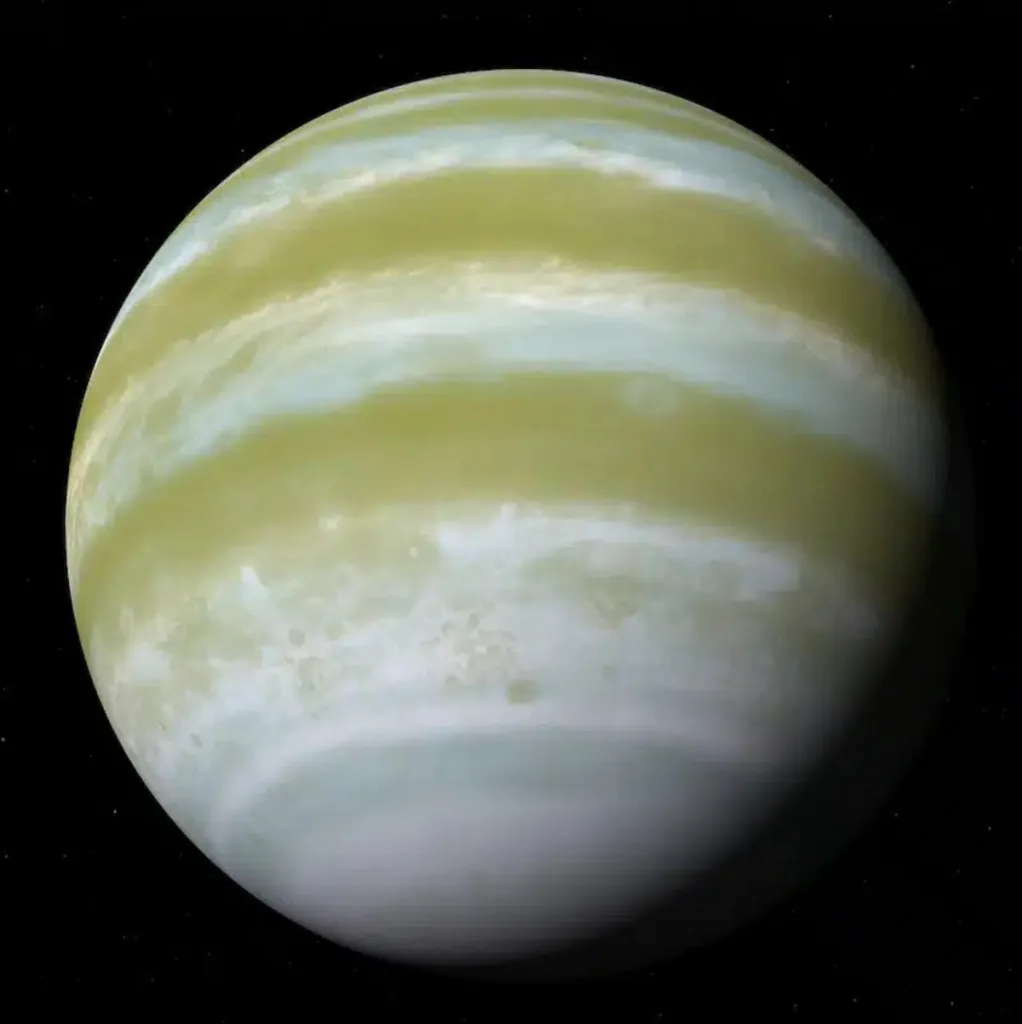
Water on mini-Neptunes may be invisible to the James Webb Space Telescope.
How Water Could Sink Beneath Hydrogen
Hydrogen is much lighter than water. When the two materials remain fully mixed, they can form one broad planetary envelope. Yet changes in pressure, temperature, and composition may cause them to separate.
Hydrogen would tend to remain near the top. Water could move into deeper regions because of its greater density. Over time, the planet might develop several chemically distinct layers.
The outer atmosphere could stay rich in hydrogen. Beneath it, a transition zone may mark a sharp change in composition. A deep water-rich region could then exist beyond direct observation.
However, this hidden material would not necessarily form an Earth-like ocean. Conditions inside mini-Neptunes can be extreme. Water may exist as hot dense fluid, vapor, supercritical material, or high-pressure ice. Its physical state would depend on local temperature and pressure.
That distinction matters when discussing habitability. A planet can contain an enormous amount of water without having a calm liquid surface. Deep water beneath a thick hydrogen atmosphere may have little in common with Earth’s oceans.
Why JWST May Miss Hidden Water
JWST studies many exoplanet atmospheres through transmission spectroscopy. As a planet passes in front of its star, a small amount of starlight travels through the planet’s outer atmosphere.
Different molecules absorb specific wavelengths. Astronomers analyze those patterns to identify gases such as methane, carbon dioxide, and water vapor.
This method reveals the chemistry of accessible atmospheric layers. It cannot directly examine an entire planet.
A thick hydrogen envelope may prevent useful signals from emerging from deeper regions. If most of the water has moved below the observable atmosphere, it may produce little or no clear feature in the transmission spectrum.
This does not mean JWST has failed. The telescope may provide an accurate reading of the atmosphere crossed by starlight. The problem begins when scientists assume that the upper atmosphere matches the deeper envelope.
Greater sensitivity alone may not solve this issue. A deeply buried layer cannot easily affect an observed spectrum when the measured starlight never passes through it.
TOI-270 d Tests the Hidden-Water Idea
Researchers applied their models to TOI-270 d. This Neptune-like exoplanet circles an M-type star about 73 light-years away in the constellation Pictor.
NASA lists TOI-270 d at about twice Earth’s radius. It has a mass of roughly four to five Earths and completes one orbit every 11.4 days. NASA’s TESS mission discovered the planetary system in 2019.
The planet has become an important target for atmospheric research. Previous observations supported the presence of a hydrogen-rich atmosphere and found evidence for methane and carbon dioxide. Water remains more difficult to constrain.
Different teams have proposed competing interpretations. Some studies describe TOI-270 d as a possible Hycean world, with liquid water beneath a hydrogen-rich atmosphere. Others favor a hotter, mixed interior where water blends with hydrogen.
A 2025 analysis again found a hydrogen-rich atmosphere with strong methane and carbon dioxide signals. It reported weaker evidence for water. The results remained consistent with a Hycean or dark Hycean interpretation, but the researchers said more observations were required.
The new study introduces another possibility. TOI-270 d may contain a deep water-rich layer beneath its observable hydrogen atmosphere.
The models do not prove that this structure exists. Instead, they show that water-hydrogen separation remains physically plausible under conditions compatible with the planet. Current observations cannot confirm or reject that scenario.
What Hidden Water Means for Exoplanet Science
The wider impact extends beyond TOI-270 d.
When astronomers assume that every warm sub-Neptune has a fully mixed envelope, they may underestimate its total water and heavy-element content. A hydrogen-rich atmosphere does not necessarily describe the bulk planet.
This uncertainty affects models of planetary formation and evolution. Scientists use atmospheric chemistry to study where a planet formed, what materials it collected, and how its interior changed. Chemical layering could alter each interpretation.
The research also calls for caution when discussing habitability. Abundant water does not confirm an ocean, a solid surface, or life-friendly conditions. Temperature, pressure, atmospheric depth, and internal energy remain crucial.
For that reason, the study matters more for understanding planetary structure than for identifying habitable worlds.
Hidden Water on Mini-Neptunes Changes the Bigger Picture
Hidden water on mini-Neptunes may explain why atmospheric data cannot always reveal a planet’s true interior. JWST can identify molecules in the layers it observes, but those layers may tell only part of the story.
For TOI-270 d, water-hydrogen separation provides another possible explanation for its complex atmospheric evidence. Scientists still need stronger observations before selecting one internal model.
Future progress will require more atmospheric measurements, improved interior simulations, laboratory research on water-hydrogen mixtures, and long-term evolution models. Together, those tools may reveal whether many mini-Neptunes contain far more water than they appear to hold.
Main Sources:
University of Chicago News — Distant exoplanets may be hiding water beyond Webb Telescope’s reach:
https://news.uchicago.edu/story/distant-exoplanets-may-be-hiding-water-beyond-webb-telescopes-reach-study-finds
Research paper — A Window for Water-Hydrogen Demixing on Warm Metal-Rich Sub-Neptunes:
https://arxiv.org/abs/2512.01805
NASA Exoplanet Catalog — TOI-270 d:
https://science.nasa.gov/exoplanet-catalog/toi-270-d/
NASA — TESS Mission Scores “Hat Trick” With Three New Worlds:
https://www.nasa.gov/universe/nasas-tess-mission-scores-hat-trick-with-3-new-worlds/
Research paper — The Atmospheric Composition of TOI-270 d:
https://arxiv.org/abs/2511.13830