
BY:SpaceEyeNews.
Astronomers have confirmed four hidden white dwarfs near Earth that remained concealed beside much brighter red dwarf stars. All four binary systems lie within 65 light-years of the Sun. One is only 25 light-years away.
Researchers had suspected that these systems contained unseen companions. However, visible-light observations could not reveal their true nature. Ultraviolet data from the Hubble Space Telescope finally exposed the concealed stars.
The discovery shows how much astronomers may still be missing in our local stellar neighborhood. It also raises new questions about how close binary systems evolve after a period of intense interaction.
The research team included scientists from the University of Warwick and the University of Colorado Boulder. They published their results in the Monthly Notices of the Royal Astronomical Society.
Four Hidden White Dwarfs Near Earth Confirmed
The team directly confirmed white dwarfs in four systems named G 203-47, GJ 207.1, LHS 1817 and Wolf 1130. Each system contains a white dwarf orbiting with a red dwarf.
The red dwarf dominates the system at visible wavelengths. Its light effectively overwhelms the fainter companion. From Earth, the pair can therefore resemble a single ordinary red star.
This contrast explains how the white dwarfs escaped direct detection for so long. They were not hidden behind clouds of material. Instead, their brighter companions concealed their visible signatures.
Astronomers had already catalogued the red dwarfs. Yet identifying their companions required a different observing strategy. The result highlights an important challenge in stellar surveys. A nearby system may look simple while hiding a much more complex structure.
The discovery also demonstrates that distance alone does not determine whether an object is easy to find. Several of these systems sit within a region that astronomers have studied extensively. Even so, the white dwarfs remained unresolved until researchers examined them at ultraviolet wavelengths.
A Stellar Wobble Exposed the Unseen Companions
The first major clue came from the movement of each red dwarf.
Researchers detected clear radial-velocity variations. In simple terms, the visible star moved slightly toward and away from Earth as an unseen companion pulled it through its orbit.
That repeating wobble showed that the red dwarf was not alone. It also gave astronomers information about the companion’s orbit and possible mass.
However, motion alone could not provide direct confirmation. The unseen objects could not be securely classified as white dwarfs without detecting their own light.
The team therefore needed observations that could separate the compact companions from the dominant red dwarfs. Ultraviolet spectroscopy offered that opportunity.
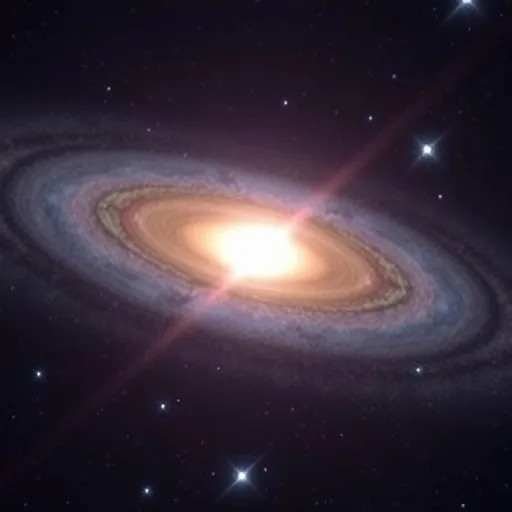
Astronomers Discover Four Nearby White Dwarf Stars Hidden in Space.
Hubble Found the Stars in Ultraviolet Light
Researchers used Hubble’s Space Telescope Imaging Spectrograph, known as STIS, to examine the four systems in near-ultraviolet light.
White dwarfs can produce a much clearer signature at ultraviolet wavelengths. Meanwhile, the red dwarfs become less dominant than they appear in visible light. This difference allowed the team to isolate radiation from the hidden companions.
The process was not straightforward. Red dwarfs often produce energetic flares that release ultraviolet light. Those temporary signals can resemble or contaminate the emission expected from a white dwarf.
To solve that problem, the researchers developed specialized calibration methods. They also combined white dwarf atmosphere models with representative red dwarf spectra. Their analysis identified a persistent ultraviolet component in every system.
The resulting spectra provided the first direct confirmations of all four white dwarfs. Hubble had turned long-standing indirect evidence into measurable detections.
G 203-47 Took 27 Years to Confirm
One system stands out from the rest.
G 203-47 lies around 25 light-years from Earth. Astronomers first detected its unusual radial motion 27 years before the new study confirmed the white dwarf.
That companion now ranks as the ninth-closest known white dwarf to the Sun. Its location makes the long delay especially surprising.
Yet distance is not the system’s only unusual feature. The red dwarf and white dwarf complete one orbit every 14.9 days. Despite that close orbit, the red dwarf needs more than 100 days to complete one rotation.
Astronomers would normally expect a close pair like this to show stronger rotational synchronization. Repeated gravitational interactions can gradually align a star’s rotation with the orbital period.
That has not happened in G 203-47.
A Slow Rotation Challenges Binary Evolution Ideas
The four systems belong to a class known as post-common-envelope binaries.
During an earlier stage, one star expanded and surrounded both objects within a shared envelope of material. Friction inside that envelope reduced the distance between them. The outer material later dispersed, leaving a compact white dwarf beside a main-sequence companion.
This phase can strongly affect the surviving star’s rotation. Longer or more intense interactions may leave the pair rotating in a synchronized pattern.
G 203-47 suggests a different outcome. Its slow red dwarf may have experienced a shorter or gentler common-envelope phase. That interaction may have ended before tidal forces could accelerate and synchronize its rotation.
Researchers have not established one final explanation. Still, the system shows that similar-looking binaries may follow different evolutionary paths.
Some pairs may undergo prolonged interactions. Others may leave the common-envelope phase much sooner. These variations could explain why their present-day orbital and rotational properties differ.
More Hidden White Dwarfs May Remain Nearby
The four detections closely match earlier population predictions. Models suggested that roughly four or five close white dwarf–red dwarf systems should exist within 20 parsecs, or about 65 light-years.
Finding four therefore supports those estimates.
However, the local census may remain incomplete. Researchers say astronomers have systematically surveyed only about 30 percent of red dwarfs within that distance for concealed white dwarf companions.
The team estimates that another nine or ten systems could remain undiscovered in the Sun’s wider neighborhood.
Future searches could combine several methods. Radial-velocity measurements can identify unexplained stellar motion. Ultraviolet observations can reveal hot compact companions. Data from ESA’s Gaia mission can also refine distances and orbital behavior.
Together, these techniques may expose binaries that visible-light surveys have overlooked.
Hidden White Dwarfs Near Earth Change the Local Picture
The discovery of four hidden white dwarfs near Earth adds more than four objects to a catalogue. It reveals a blind spot in how astronomers map nearby stellar systems.
Bright red dwarfs can hide compact companions even at relatively small distances. Hubble’s ultraviolet vision provided the evidence needed to separate those overlapping signals.
G 203-47 adds another layer to the story. Its unusually slow rotation suggests that close binaries do not all experience the same evolutionary history.
Most importantly, the search is not over. More hidden white dwarfs near Earth may still orbit stars that appear ordinary in visible light. Targeted ultraviolet observations could soon reveal how crowded our apparently familiar cosmic neighborhood really is.
Main Sources:
University of Warwick — “Dead stars in our cosmic backyard: scientists spot four white dwarfs hiding under our noses”
https://warwick.ac.uk/news/pressreleases/dead-stars-in-our-cosmic-backyard/
Monthly Notices of the Royal Astronomical Society — “Direct detections of white dwarfs in four WD+dM post-common envelope binaries within 20 pc”
https://academic.oup.com/mnras/article/550/2/stag1195/8733147
University of Warwick — Dr. Mairi O’Brien research profile and Hubble observing program
https://warwick.ac.uk/fac/sci/physics/research/astro/people/mairiobrien/