
BY:SpaceEyeNews.
Astronomers have confirmed four hidden white dwarfs near the Sun that escaped direct detection for decades. Each stellar remnant orbits a brighter red dwarf, whose visible light concealed the compact companion.
All four systems lie within about 65 light-years of Earth. That distance places them inside our immediate stellar neighborhood. Yet previous surveys could not clearly separate the stars.
Researchers finally confirmed the white dwarfs using ultraviolet observations from the Hubble Space Telescope. The discovery shows that even nearby space may contain important objects missing from current catalogues. It also offers new clues about how close binary stars evolve.
How the Hidden White Dwarfs Near the Sun Escaped Detection
The four systems are G 203-47, GJ 207.1, LHS 1817, and Wolf 1130. Astronomers had already identified them as unusual binary candidates through changes in the motion of their visible stars.
However, directly confirming the white dwarfs proved much harder.
Each system contains a cool white dwarf beside a red dwarf. Although red dwarfs are relatively faint stars, they are far larger than white dwarfs. As a result, they dominate the system’s visible light.
The combined glow can therefore resemble a single ordinary red dwarf. Broad sky surveys may record the visible companion while missing the smaller stellar remnant entirely.
The systems also occupy unusual positions in data from missions such as Gaia. Still, unusual brightness or color alone cannot confirm a hidden white dwarf.
Red dwarfs frequently produce flares and strong emission features. These effects may create ultraviolet signals that resemble light from a compact companion. Astronomers needed detailed spectra to separate stellar activity from genuine white-dwarf radiation.
A Stellar Wobble Revealed Unseen Companions
The first evidence came from radial-velocity measurements. These observations track how a star moves toward and away from Earth.
An orbiting companion pulls the visible red dwarf around the pair’s shared center of mass. That motion shifts the star’s spectral lines slightly toward red or blue wavelengths.
Researchers detected these repeating shifts in all four systems. The patterns showed that the red dwarfs were orbiting unseen, relatively massive objects.
Small planets could not explain the measured gravitational effects. Ordinary low-mass stars also failed to match the available evidence. White dwarfs became the leading explanation.
Still, the wobble only revealed the companions indirectly. Astronomers knew that something compact was present, but they lacked direct spectra proving what those objects were.
This distinction matters. The new study did not discover the orbital motion for the first time. Instead, it directly identified the white-dwarf components that earlier observations had only suggested.
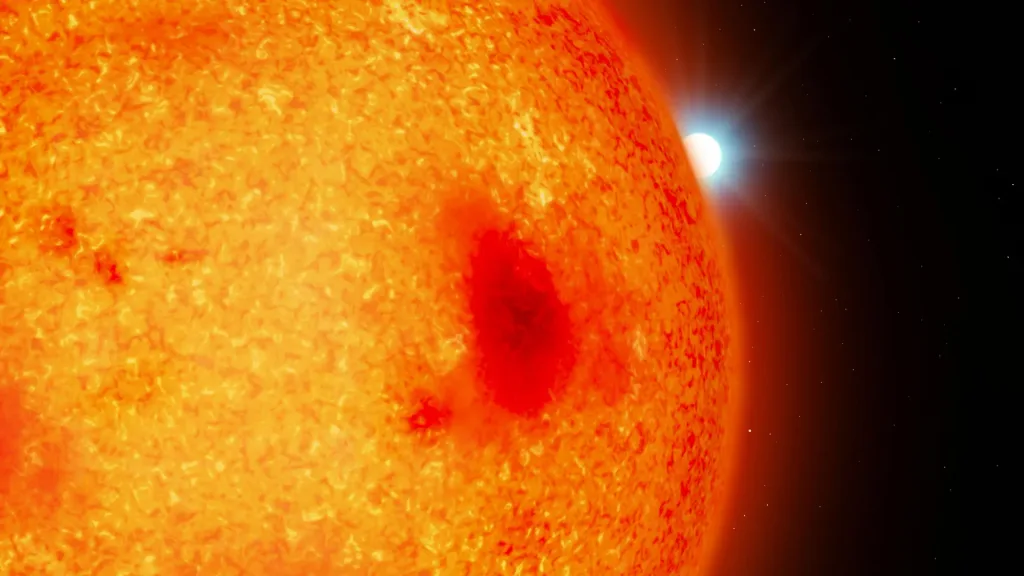
Astronomers just found four hidden white dwarf stars near Earth.
Hubble Separates the Hidden Stellar Remnants
To solve the mystery, the research team used the Space Telescope Imaging Spectrograph aboard Hubble. The instrument observed each system at near-ultraviolet wavelengths.
Cool white dwarfs can be extremely difficult to isolate in visible light. However, their ultraviolet contribution may stand out more clearly against a red-dwarf companion.
The researchers compared the Hubble spectra with white-dwarf atmosphere models. They also used spectra from similar red dwarfs as reference points.
This approach allowed them to subtract much of the visible star’s contribution. They then isolated the ultraviolet continuum produced by each white dwarf.
The process required careful calibration. Activity from the red dwarfs created several emission features that could distort the results. The team masked those features before fitting the final models.
Hubble confirmed white-dwarf temperatures between roughly 5,300 and 6,300 kelvins. Estimates based only on ultraviolet photometry had placed some temperatures about 5% to 8% higher.
That difference highlights the value of spectroscopy. A single ultraviolet brightness measurement can mix together white-dwarf light and red-dwarf activity. A spectrum reveals how that light changes across wavelengths.
The findings provide the first direct spectroscopic confirmation of all four white dwarfs.
G 203-47 Presents an Unexpected Mystery
Among the four systems, G 203-47 stands out.
It lies about 7.6 parsecs, or nearly 25 light-years, from Earth. Its unusual radial motion revealed an unseen companion more than two decades ago.
Hubble has now confirmed that companion as a white dwarf. The object ranks as the ninth-closest known white dwarf to the Sun.
The system also challenges expectations about stellar rotation.
The red dwarf completes one orbit around the white dwarf every 14.9 days. Yet several measurements suggest that it may take more than 100 days to rotate around its own axis.
A tentative analysis of MEarth observations produced a rotation period of about 126 days. Other indicators also support a period longer than 100 days. However, researchers have not yet measured an exact value.
Such a large difference means the system is probably not tidally locked.
In many close binaries, repeated gravitational interactions gradually synchronize a star’s rotation with its orbital period. G 203-47 appears to have avoided that outcome despite its compact orbit.
Researchers suggest that the system may have passed through a relatively brief common-envelope phase. That interaction may not have transferred enough angular momentum to synchronize the red dwarf.
What the Common-Envelope Phase Can Reveal
The white dwarf in each system was once a normal star. As it aged, it expanded into a red giant.
Its outer atmosphere eventually surrounded both stars. The companion then moved through this shared envelope, creating drag and causing the pair to spiral closer together.
Eventually, the envelope dispersed. The original star’s exposed core remained behind as a white dwarf, while the red dwarf survived in a much tighter orbit.
Astronomers call these objects post-common-envelope binaries.
The common-envelope stage plays a major role in the evolution of close stellar systems. Yet it happens quickly on astronomical timescales and remains difficult to observe directly.
Nearby surviving pairs give researchers a way to reconstruct the process. Their orbital periods, temperatures, masses, and rotation rates preserve evidence from their earlier evolution.
G 203-47 suggests that common-envelope interactions do not always produce the same result. Some systems may experience longer and more intense interactions. Others may pass through the stage more quickly.
More Hidden White Dwarfs May Remain Nearby
The four discoveries also improve estimates of the local white-dwarf population.
Binary-population models predicted about 4.4 post-common-envelope systems containing white dwarfs and low-mass stars within 20 parsecs. Finding four agrees closely with that prediction.
Using the updated sample, the researchers calculated a local white-dwarf density of about 5.2 white dwarfs per 1,000 cubic parsecs.
However, the nearby stellar census remains incomplete.
Only about 30% of red dwarfs within 20 parsecs have received systematic radial-velocity monitoring. The remaining stars may conceal additional compact companions.
The study estimates that full surveys could uncover another nine or ten nearby post-common-envelope binaries. Detecting them will require repeated velocity measurements followed by ultraviolet spectroscopy.
Hidden White Dwarfs Near the Sun Reshape the Local Census
The confirmation of four hidden white dwarfs near the Sun shows that proximity does not always make an object easy to detect.
Bright companions can conceal compact stars, while flares can confuse ultraviolet measurements. Astronomers must combine orbital motion, precise spectra, and carefully selected wavelengths to reveal the full system.
These discoveries support current estimates of nearby binary populations. At the same time, G 203-47 raises fresh questions about common-envelope evolution and tidal locking.
Our stellar neighborhood may appear familiar, but it is not yet fully mapped. More hidden remnants may still be orbiting stars that look ordinary at first glance.
Main Sources:
University of Warwick – Astronomers spot four white dwarfs hiding under our noses:
https://warwick.ac.uk/news/pressreleases/dead-stars-in-our-cosmic-backyard/
Monthly Notices of the Royal Astronomical Society – Direct detections of white dwarfs in four WD+dM post-common-envelope binaries within 20 pc:
https://academic.oup.com/mnras/article/550/2/stag1195/8733147
arXiv research paper:
https://arxiv.org/abs/2607.11320