BY:SpaceEyeNews.
Some black holes detected through gravitational waves may have experienced more than one merger. Instead of forming directly from a single collapsing star, they could be the remnants of earlier black hole pairings.
A new population study suggests that hierarchical black hole mergers may account for a meaningful share of the systems observed by LIGO, Virgo, and KAGRA. Researchers estimate that around 14 percent of merging black holes could include at least one object produced by a previous merger.
The finding does not identify every recycled black hole individually. Instead, scientists studied patterns across the wider population. Mass, spin, and orbital motion all provided clues about how these objects may have formed.
What Are Hierarchical Black Hole Mergers?
Most stellar-mass black holes begin with the collapse of massive stars. Astronomers often describe these objects as first-generation black holes.
However, black holes do not always remain isolated. Two may form a pair, spiral toward each other, and combine. Their merger creates a larger remnant.
That remnant becomes a second-generation black hole. If it later joins another companion, the process can happen again. Scientists call this repeated growth hierarchical merging.
Each merger increases the remnant’s mass. It also changes its spin. As a result, later-generation black holes can carry features that differ from objects formed directly through stellar evolution.
Researchers have discussed this pathway for years. Yet gravitational-wave catalogs now contain enough events for scientists to search for it across an entire population.
Dense Environments May Support Repeated Mergers
Hierarchical black hole mergers probably require crowded environments.
Globular clusters contain large numbers of stars packed into relatively small regions. Nuclear star clusters near galactic centers can become even denser. Disks around active galactic nuclei may also bring black holes close together.
Inside these environments, black holes can encounter new companions after an earlier merger. Gravity may then pull the objects into new binary systems.
Still, repeated merging is not guaranteed.
A black hole merger can give the final remnant a recoil known as a gravitational kick. The effect comes from gravitational waves carrying momentum away unevenly.
A strong kick may eject the black hole from its host cluster. In that case, it would lose the chance to merge again in the same environment.
Therefore, evidence for a later-generation black hole may also reveal information about its birthplace. The host system must have been dense enough to produce new pairings and massive enough to retain the remnant.
Spin Can Reveal a Black Hole’s Past
Spin provides one of the most useful clues to black hole ancestry.
A black hole formed by an earlier merger should rotate rapidly. Simulations show that remnants created from two slowly spinning black holes often reach a dimensionless spin near 0.69. This equals roughly 70 percent of the maximum allowed value.
That prediction does not mean every fast-spinning black hole has merged before. Stellar evolution and interactions inside ordinary binary systems can also generate spin.
Scientists therefore look for several features at once.
A black hole becomes a stronger hierarchical-merger candidate when it has a high mass, rapid spin, an unequal partner, and a spin direction tilted relative to the orbit.
The combined pattern matters more than any single measurement.
Recent LIGO–Virgo–KAGRA studies have highlighted unusual systems with unequal masses and clearly measured spins. Some show the types of features expected when one member of the pair came from a previous merger.
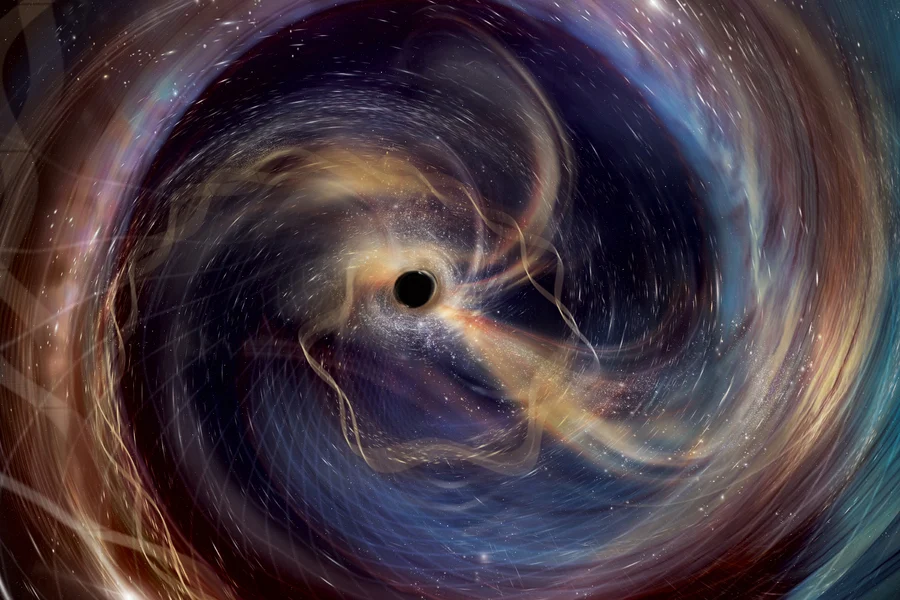
Black Hole Collisions Tell a Tale of Repeating Mergers.
Orbital Wobbling Strengthens the Evidence
Black hole spins do not always point in the same direction as the pair’s orbital motion.
When the spins tilt away from the orbital axis, the entire system can wobble while the black holes spiral inward. Astronomers call this motion precession.
Precession changes the gravitational-wave signal. The wave pattern rises and falls in a way that reflects the changing orientation of the orbit.
Scientists can use this information to estimate the direction and strength of the black holes’ spins. They can also study how the masses differ.
The new analysis focused on patterns involving effective spin and precessing spin. Together, these measurements allowed researchers to search for a subpopulation that matched predictions for hierarchical black hole mergers.
This approach differs from declaring that one event has a proven history. Instead, it asks whether the catalog contains a population whose shared properties point toward repeated mergers.
About 14 Percent May Have Merged Before
The research team examined 153 binary black hole merger signals associated with the GWTC-4.0 dataset.
Their model found evidence for distinct groups connected to mass and spin. Based on that distribution, the researchers estimated that around 14 percent of merging black holes may come from a repeated-merger pathway.
This percentage remains a statistical population estimate. It does not mean that scientists have confirmed a previous merger for exactly 14 percent of individual detections.
The analysis also revealed interesting mass patterns.
Black holes near 10 and 30 times the Sun’s mass appeared more closely linked to first-generation formation. Meanwhile, objects near 20 solar masses and those around 40 solar masses or above showed stronger signs of later-generation origins.
Researchers also found a transition above roughly 45 solar masses. That region has special importance because standard stellar evolution may struggle to produce black holes there directly.
Repeated Mergers Could Explain Unusual Masses
Very massive stars do not always leave very massive black holes behind.
At certain masses, processes related to electron–positron pair production can destabilize a star. The resulting event may remove much of the star’s mass or disrupt it entirely.
This creates a predicted shortage, often called the pair-instability mass gap. Black holes within part of this range should be difficult to form through ordinary stellar collapse.
Hierarchical black hole mergers offer another route.
Two lower-mass black holes can merge and produce a remnant inside or above the expected gap. That object may then merge again, creating an even heavier black hole.
This idea could explain some of the unusually massive objects found in gravitational-wave catalogs. However, mass alone cannot prove a hierarchical origin.
Uncertainties in stellar evolution remain. Other environments and formation channels may also create heavy black holes. Scientists must combine mass measurements with spin, orbital tilt, and population statistics.
What the Findings Mean for Black Hole Evolution
Gravitational-wave astronomy has moved beyond simply counting mergers.
Researchers can now compare the properties of hundreds of systems and begin reconstructing how different black hole populations formed. Each new detection improves the statistical picture.
Evidence for hierarchical black hole mergers also gives astronomers a way to study environments that may remain invisible through ordinary telescopes.
A later-generation black hole could point toward a dense star cluster, a galactic nucleus, or another region where repeated interactions occur. Its mass and spin preserve part of that environmental history.
Future catalogs will test whether the estimated 14 percent fraction remains stable. Improved detectors should also measure precession and spin more accurately.
Conclusion
Hierarchical black hole mergers may explain why some detected black holes appear unusually massive, rapidly spinning, or paired with much smaller companions.
The latest analysis suggests that a notable minority of merging black holes may already be products of earlier mergers. Scientists reached that conclusion by studying shared patterns in mass, spin, and orbital precession.
The evidence remains statistical rather than definitive for every event. Even so, it shows how gravitational waves can reveal more than a single merger. They can help astronomers trace black hole family histories and understand how these objects grow across the Universe.
Main Sources:
MIT News — Many black holes had past lives, new research shows
https://news.mit.edu/2026/many-black-holes-had-past-lives-new-research-shows-0707
LIGO Scientific Collaboration — GWTC-5.0 science summary
https://ligo.org/science-summaries/o4b_catalog_omnibus/
LIGO Scientific Collaboration — GWTC-4.0 catalog announcement
https://ligo.org/new-catalog-more-than-doubles-the-number-of-gravitational-wave-detections-made-by-ligo-virgo-and-kagra-observatories/
Research Paper — Signatures of a subpopulation of hierarchical mergers in the GWTC-4 gravitational-wave dataset
https://arxiv.org/abs/2601.07908