
BY:SpaceEyeNews.
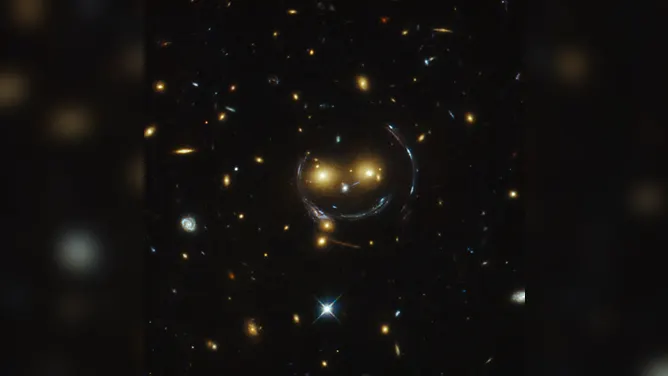
The Hubble smiley face looks almost too familiar for something so far beyond Earth. Two orange galaxies resemble bright eyes. A smaller white galaxy suggests a button nose. Below them, a curved streak of light completes the cheerful expression. Yet this extraordinary scene reveals something deeper than a chance resemblance. Gravity bends light across space, turning a galaxy cluster into a natural cosmic lens.
The cluster carries the name SDSS J1038+4849. Its apparent expression offers an accessible introduction to gravitational lensing, one of astronomy’s most useful phenomena. However, the image also deserves careful context. NASA published this Hubble view in February 2015, so readers should understand it as an established observation.
What Creates the Hubble Smiley Face?
At first glance, the picture resembles a face drawn against a dark background. Look closer, however, and its features tell different stories.
The two orange “eyes” are individual galaxies. Each contributes a concentrated patch of light that helps create the familiar expression. Between them sits the smaller, bright object that resembles a nose.
The curved smile has a different origin. It comes from light that gravity has distorted along its journey toward Earth. The surrounding arcs also help suggest the outline of a head.
This distinction matters. The image does not show one enormous object with facial features. Instead, separate galaxies and distorted background light combine within our line of sight. Their apparent arrangement creates the face we recognize.
How Gravitational Lensing Bends the View
Light usually seems to travel straight toward us. Around sufficiently massive objects, however, the geometry of space changes its path.
Einstein’s general relativity describes gravity through the curvature of spacetime. A massive galaxy cluster curves its surroundings, influencing the route that passing light follows.
A Natural Magnifying Glass
Imagine looking through a piece of curved glass. Objects behind it may appear stretched, enlarged, or displaced. A gravitational lens produces comparable visual effects, although curved spacetime replaces the glass.
In this scene, the foreground mass alters our view of more distant sources. Their light reaches Hubble with shapes that differ from their original appearance.
Consequently, an arc does not necessarily reveal a galaxy’s actual structure. It may instead reveal how gravity has reshaped its image. That difference separates the appearance on a telescope’s detector from the object that emitted the light.
Why the Smile Forms an Arc
Strong gravitational lensing can stretch background images into conspicuous curves. Those curves help create the smiling expression in this particular view.
The result depends on where the light source, intervening mass, and observer sit relative to one another. Change that alignment, and the apparent pattern changes too.
Therefore, the smile reflects a viewing geometry as well as the presence of enormous mass. Both ingredients help explain the scene. esahubble.org
The Einstein Ring Connection
NASA describes the ringlike structure in this image as an Einstein ring. This feature takes its name from the scientist whose theory explains the bending of light.
With a suitable alignment, a gravitational lens can spread a background source’s image around the intervening mass. A highly symmetrical arrangement can produce a ring.
Here, the surrounding curved light contributes to the impression of a rounded face. The brighter lower arc supplies the recognizable grin.
Understanding this geometry makes the image more remarkable. What looks like a playful outline also traces the influence of gravity across space. Astronomers can study such patterns rather than treating them as decorative features.
Why Astronomers Study Cosmic Lenses
The Hubble smiley face attracts attention because of its appearance. Its scientific value comes from the physical process behind that appearance.
Gravitational lensing can magnify distant objects, helping astronomers examine sources that would otherwise prove harder to study. The foreground cluster effectively assists the telescope.
However, magnification also brings distortion. Researchers must account for the lens before interpreting the background object’s shape.
By modeling lensing effects, astronomers can investigate the relationship between the intervening mass and the observed arcs. Hubble’s sharp views provide valuable details for that work.
This creates an unusual opportunity. Something between us and a distant galaxy can improve the view, even while changing its appearance. Gravity becomes part of the observing process.
An Older Hubble Image With Lasting Appeal
The image’s publication history helps separate renewed attention from a new observation. NASA released its explanation on February 9, 2015.
Hubble studied this target using its Wide Field and Planetary Camera 2 and Wide Field Camera 3. The observations formed part of a survey of strong gravitational lenses.
A version of the image also appeared in Hubble’s Hidden Treasures image processing competition through participant Judy Schmidt.
These details add context without reducing the picture’s appeal. An older telescope image can still introduce new audiences to an unfamiliar scientific idea. science.nasa.gov
Why the Sun’s Smile Is Different
The comparison with a smiling Sun offers another appealing visual, but the underlying science differs.
NASA’s Solar Dynamics Observatory recorded a face-like arrangement on October 26, 2022. Dark regions called coronal holes created that expression in ultraviolet imagery.
Those features did not result from gravitational lensing or an eclipse creating a face. The resemblance connects the pictures visually, while their physical explanations remain distinct.
Keeping that distinction clear helps readers appreciate both observations accurately. svs.gsfc.nasa.gov
What the Hubble Smiley Face Really Shows
The Hubble smiley face turns a difficult concept into something instantly recognizable. Galaxies supply the bright points, while curved background light supplies the smile.
Behind that simple appearance lies a powerful lesson: the universe can alter the images that reach our telescopes. Understanding those changes helps astronomers look farther and interpret what they see.
The cheerful pattern catches our attention. The bending of spacetime gives it lasting scientific meaning.
Main sources:
NASA — Hubble Sees a Smiling Lens:
https://science.nasa.gov/missions/hubble/hubble-sees-a-smiling-lens/
ESA/Hubble — A Smiling Lens:
https://esahubble.org/images/potw1506a/
NASA — When Coronal Holes Are Smiling:
https://svs.gsfc.nasa.gov/5102/