
BY:SpaceEyeNews.
Tiny magnetic fields from the early universe could help explain the Hubble tension, a stubborn mismatch in cosmic expansion measurements. Their influence may have changed how hydrogen formed, altering the ancient light scientists use to reconstruct cosmic history.
Researchers have tested this possibility with detailed simulations, moving beyond earlier simplified calculations. Their results suggest that primordial magnetism remains a viable explanation worth investigating.
The appeal reaches beyond expansion alone. These fields could also help explain the origins of magnetism across galaxy clusters. However, the evidence remains preliminary, and scientists have not confirmed a solution.
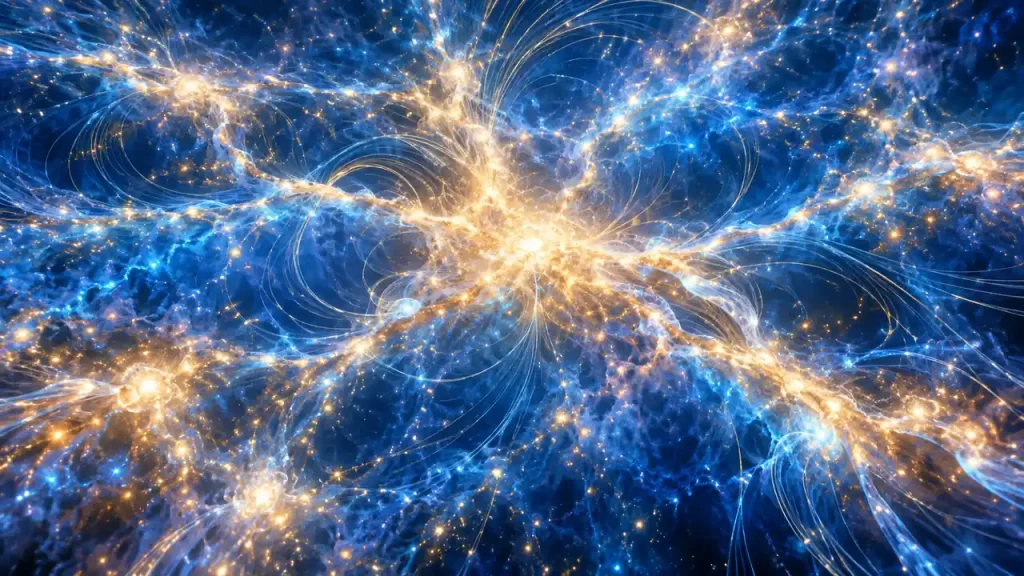
Hubble Tension: A Clue in Ancient Magnetic Fields.
Why the Hubble Tension Still Matters
Measurements of the universe’s expansion continue to produce conflicting answers. Under the standard cosmological model, observations of the cosmic microwave background suggest roughly 67 kilometers per second per megaparsec.
Meanwhile, the Cepheid-calibrated distance ladder gives a value near 73. This approach links nearby stellar distances to more distant Type Ia supernovae.
Both methods estimate today’s expansion rate. The disagreement does not simply reflect how expansion changed between the early universe and the present. keckobservatory.org
Instead, it raises questions about measurements, assumptions, and the physics connecting ancient light with today’s cosmos. The magnetic-field hypothesis focuses on that early connection.
That makes the question more specific than whether the universe expands faster than expected. Researchers are asking whether their treatment of early matter misses an effect that changes the answer.
How Primordial Magnetic Fields Could Change the Answer
Small Clumps, Faster Hydrogen Formation
Before neutral hydrogen became widespread, the universe contained a hot plasma of charged particles. Magnetic forces could have redistributed this material, creating small regions with higher and lower densities.
Within denser patches, electrons and protons could meet more readily and form neutral hydrogen. That would change the overall pace of recombination, the transition that allowed ancient light to travel freely.
The proposed effect therefore concerns how matter behaved before the universe became transparent. Even extremely weak magnetism could matter during this sensitive period.
Recalibrating the Cosmic Ruler
Recombination helps establish the relationship between patterns in the microwave background and their physical scale. Cosmologists use that relationship as part of a cosmic ruler.
Changing the timing can change the ruler’s calibration. Consequently, a model that includes magnetic effects can infer a higher present-day expansion rate from the observations.
This is the crucial link to the Hubble tension. The proposal changes the interpretation of early-universe evidence, rather than suggesting magnetism directly drives galaxies apart today. www6.slac.stanford.edu
What the Detailed Simulations Reveal
Moving Beyond Simplified Models
Karsten Jedamzik, Levon Pogosian, and Tom Abel investigated the idea using results from three-dimensional simulations of magnetized plasma.
Their analysis incorporated detailed hydrogen formation calculations and the movement of radiation through the gas. These processes matter because radiation can influence how quickly hydrogen forms and remains neutral.
Earlier simplified models had already suggested a possible connection. The more detailed approach tests whether that connection survives a more realistic treatment of the early universe.
This distinction matters because clumping alone does not capture every interaction. Following both the plasma and radiation gives scientists a stronger basis for calculating the overall hydrogen formation history.
The study appeared online in Nature Astronomy on December 12, 2025, before its February 2026 journal issue. www.nature.com
Checking Predictions Against Observations
The researchers translated their simulated hydrogen formation histories into predictions for the cosmic microwave background. They then compared those predictions with astronomical measurements.
Their analysis also included combinations of galaxy-clustering distance measurements and Type Ia supernova data. These additional checks help assess whether the explanation works across different observations.
An adjustment cannot succeed merely by raising the inferred expansion rate. It must also remain compatible with the detailed patterns that astronomers measure.
A Magnetic Hint, Not a Confirmed Discovery
The analysis favors magnetic strengths of approximately five to ten pico-Gauss, expressed as present-day values. These numbers do not describe the fields’ strength immediately after the Big Bang.
However, the strength of the preference changes with the datasets. The published abstract reports roughly 1.8 standard deviations for Planck and DESI together.
Adding SH0ES-calibrated supernovae raises the preference to approximately three standard deviations. That difference matters: the strongest hint depends partly on including the distance measurements associated with the higher expansion estimate. www.nature.com
These results support further investigation, but they do not establish primordial magnetism as a detected cosmic ingredient. Nor do simulations independently prove that the proposed fields existed.
Instead, they show that this particular magnetic explanation can fit important observations while shifting the inferred expansion rate upward.
Could Ancient Magnetism Explain a Second Mystery?
Magnetic fields also thread galaxies and galaxy clusters. Scientists continue to investigate how those extensive fields began and developed.
Primordial fields offer one possible starting point. Magnetism inherited from the early universe could supply seeds for the fields associated with later cosmic structures.
Intriguingly, the strengths favored in this analysis align with those relevant to a primordial origin for cluster magnetism. That overlap gives researchers another reason to take the hypothesis seriously. www6.slac.stanford.edu
Still, a shared numerical range does not establish a common origin. Scientists must test the proposed connection against observations of both early conditions and later structures.
What Could Test the Hubble Tension Explanation?
Sharper measurements of microwave background temperature and polarization could help distinguish magnetic effects from other explanations.
At the same time, theoretical predictions must match the increasing precision of those observations. Researchers need to test how robustly their conclusions survive different datasets and modeling assumptions.
Future results could strengthen the magnetic interpretation. Alternatively, they could restrict how much primordial fields contributed to recombination. Either outcome would sharpen the search for an explanation.
A Small Clue With Major Implications
The Hubble tension may contain a clue to physics missing from our picture of the early universe. Ancient magnetic fields offer a concrete possibility: subtle changes in hydrogen formation could affect the expansion rate we infer today.
For now, the idea remains promising rather than proven. Its value lies in predictions that increasingly precise observations can test.
Main sources:
- Nature Astronomy — Hints of primordial magnetic fields at recombination and implications for the Hubble tension
- SLAC National Accelerator Laboratory — Primordial magnetic fields could resolve the Hubble tension and other cosmic mysteries
- W. M. Keck Observatory — Astronomers Sharpen the Universe’s Expansion Rate