
BY:SpaceEyeNews.
Introduction
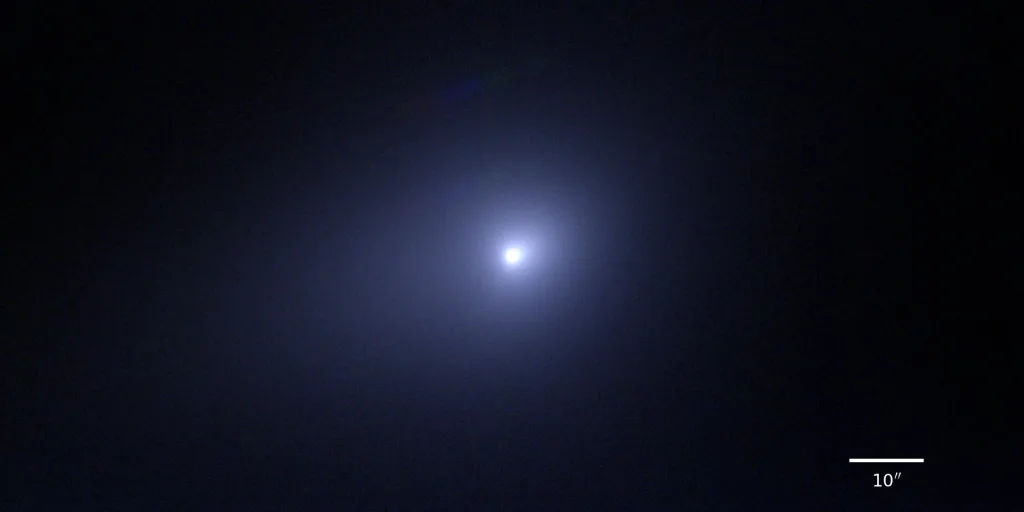
The interstellar comet 3I/ATLAS composition change is offering a rare, real-time glimpse inside an object that formed beyond our solar system. Unlike familiar comets, this visitor arrived from another star system, carrying pristine material shaped under different cosmic conditions. Recent observations using the Subaru Telescope revealed an unexpected shift in its chemical signature after its closest pass to the Sun. This shift is not a minor detail. It points to deeper structural differences within the comet itself. More importantly, it provides a direct window into how planetary systems form across the galaxy.
Interstellar Comet 3I/ATLAS Composition Change Begins With a Rare Opportunity
A unique interstellar target
The interstellar comet 3I/ATLAS composition change begins with the rarity of 3I/ATLAS. This object is not bound to our Sun. It formed in a distant stellar system and traveled across interstellar space before entering ours. That journey alone makes it scientifically valuable. However, the true opportunity lies in how and when it was observed.
Astronomers captured the comet shortly after perihelion. At this stage, solar heating intensifies. As a result, deeper layers inside the nucleus begin to release gas. This process exposes material that remained hidden for most of the comet’s journey. The surrounding coma becomes a dynamic record of that internal activity.
Precision observation from the ground
Using multi-band imaging, researchers examined the comet across different wavelengths. Each band revealed distinct components of the coma. When combined, these observations produced a detailed chemical profile.
Rather than relying on direct sampling, which remains out of reach, scientists analyzed the gases escaping from the nucleus. This approach draws on decades of comet research within our solar system. Applying it to an interstellar object marked a significant step forward.
Why timing changed the outcome
Earlier measurements from space telescopes, taken before perihelion, suggested a higher ratio of carbon dioxide to water. The new observations tell a different story. This contrast defines the interstellar comet 3I/ATLAS composition change.
The difference reflects a physical transformation. As solar heat penetrated the nucleus, new materials became active. These materials altered the chemical balance of the coma, revealing a deeper layer of the comet’s structure.
Interstellar Comet 3I/ATLAS Composition Change Reveals Evolving Chemistry
A clear chemical shift
The defining result is the change in the CO₂ to H₂O ratio. After perihelion, the ratio dropped. Water became relatively more dominant in the coma.
This shift is not subtle. It indicates that the comet’s internal composition differs from its surface. The interstellar comet 3I/ATLAS composition change therefore reflects layered chemistry rather than a uniform structure.
Surface versus interior layers
Initially, only surface materials contribute to the coma. These outer layers have experienced long-term exposure to radiation and interstellar conditions. Over time, they evolve chemically.
As heating increases, deeper layers begin to release gas. These regions preserve earlier conditions from the comet’s formation. The observed shift captures the transition between these layers.
Confidence in the data
Researchers confirmed that the results are not due to measurement inconsistencies. The analytical techniques used in this study are well established. They have been tested extensively on comets within our solar system.
Consistency across multiple wavelengths strengthens the conclusion. Each dataset supports the same trend. This alignment reinforces the interpretation of a real chemical evolution.
A dynamic interstellar object
This finding reshapes expectations. Interstellar comets are not static relics. Instead, they evolve as they interact with their environment. The interstellar comet 3I/ATLAS composition change demonstrates that internal processes can rapidly alter observable chemistry.
Interstellar Comet 3I/ATLAS Composition Change Offers Clues to Alien Systems
Comets as records of planetary formation
Comets preserve the raw materials from which planets form. Their composition reflects the conditions present during the early stages of a planetary system. For this reason, they serve as valuable records of cosmic history.
Since 3I/ATLAS originated beyond our solar system, it provides a rare comparison point. The interstellar comet 3I/ATLAS composition change highlights differences that may not exist in local comets.
Layered formation history
The variation between surface and interior suggests a complex formation process. Each layer may represent a different environment within the comet’s original system. Temperature changes, migration patterns, and material mixing could all play a role.
This layered structure supports modern models of planetary formation. These models propose that small bodies form through multiple stages rather than a single uniform process.
Comparing cosmic environments
For the first time, scientists can compare comets from inside and outside our solar system using similar methods. This comparison offers new insight into how common certain chemical signatures may be.
The interstellar comet 3I/ATLAS composition change becomes a reference point. It helps determine whether our solar system follows typical patterns or stands apart.
A growing field of discovery
New survey telescopes will soon expand the search for interstellar objects. Detection rates are expected to increase significantly. Each new discovery will add context to current findings.
As the dataset grows, patterns will emerge. These patterns will refine our understanding of planetary system diversity across the galaxy.
Interstellar Comet 3I/ATLAS Composition Change Signals a New Era
From rare detection to structured science
Interstellar objects were once rare events. Now, they are becoming part of systematic research. The interstellar comet 3I/ATLAS composition change marks a turning point in this transition.
Scientists can now apply established analytical methods to these objects. This creates a consistent framework for studying their properties.
Advancing observational capabilities
Next-generation telescopes will improve detection sensitivity. Wider sky coverage will allow earlier identification of incoming objects. Earlier detection extends observation time and improves data quality.
This progress will enable more detailed tracking of chemical evolution, similar to what has been achieved with 3I/ATLAS.
The rise of comparative comet science
A new discipline is emerging. Researchers are beginning to compare comet characteristics across different star systems. This approach expands beyond traditional solar system studies.
The interstellar comet 3I/ATLAS composition change serves as an early benchmark. It demonstrates how comparative analysis can reveal deeper insights into planetary formation.
Long-term scientific impact
Understanding comet composition contributes to broader questions about the universe. These include how planetary systems form and how frequently Earth-like conditions may arise.
Each interstellar object provides a new piece of evidence. Over time, these pieces will form a clearer picture of our place in the galaxy.
Conclusion
The interstellar comet 3I/ATLAS composition change represents a major step forward in the study of objects from beyond our solar system. By tracking chemical shifts over time, scientists gained direct insight into the comet’s internal structure. This approach transforms a distant visitor into a source of detailed scientific evidence.
Looking ahead, more interstellar discoveries will expand this field. Each new object will refine current models and deepen our understanding. The key question remains. Are these objects typical examples of planetary systems, or do they reveal entirely new possibilities?
Sources
https://phys.org/news/2026-04-subaru-telescope-captures-comet-3iatlas.html
https://subarutelescope.org/en/news/pressrelease/2026/04/07/ (Subaru Telescope official release)
https://iopscience.iop.org/journal/1538-3881 (The Astronomical Journal)