BY:SpaceEyeNews.
Introduction: A Visitor From Deep Time
Interstellar Comet 3I/ATLAS is not just another object passing through our Solar System. It is a relic from a distant era, possibly formed up to 11 billion years ago. That places it at more than twice the age of our Sun. Even more striking, its chemical signature points to an origin in an environment far colder than anything seen in our cosmic neighborhood. This discovery offers a rare opportunity to study the building blocks of planetary systems from a time when the galaxy itself was still taking shape.
Interstellar Comet 3I/ATLAS: A Rare Cosmic Visitor
Only the Third Confirmed Interstellar Object
Interstellar Comet 3I/ATLAS joins a very short list of known interstellar visitors. Only two others have been confirmed before it. Each of these objects carried material from beyond our Solar System, but this one stands apart. Its age and composition suggest it formed under conditions very different from those that shaped our own planetary system.
Astronomers detected the comet early enough to track it across the inner Solar System. This allowed multiple observatories to study it as it moved along its path.
Trajectory, Size, and Speed
The journey of Interstellar Comet 3I/ATLAS took it past Mars before it reached its closest approach to Earth. It then continued outward, moving beyond Jupiter and leaving the Solar System for good.
Its size remains uncertain but falls between about 440 meters and 5.6 kilometers across. This range reflects the limits of current observations. Its speed, however, leaves no doubt about its origin. Traveling at roughly 137,000 miles per hour, it moves too fast to be bound to the Sun. This confirms it arrived from interstellar space.
Why Interstellar Objects Matter
Objects like Interstellar Comet 3I/ATLAS are rare and scientifically valuable. They carry material formed in distant environments that cannot be studied directly. Each one acts as a sample from another part of the galaxy. By examining them, scientists can compare how different star systems form and evolve.
Yet, the most important insight from this comet comes not from its motion, but from its chemistry.
Interstellar Comet 3I/ATLAS and the Heavy Water Breakthrough
A Chemical Signature Frozen in Time
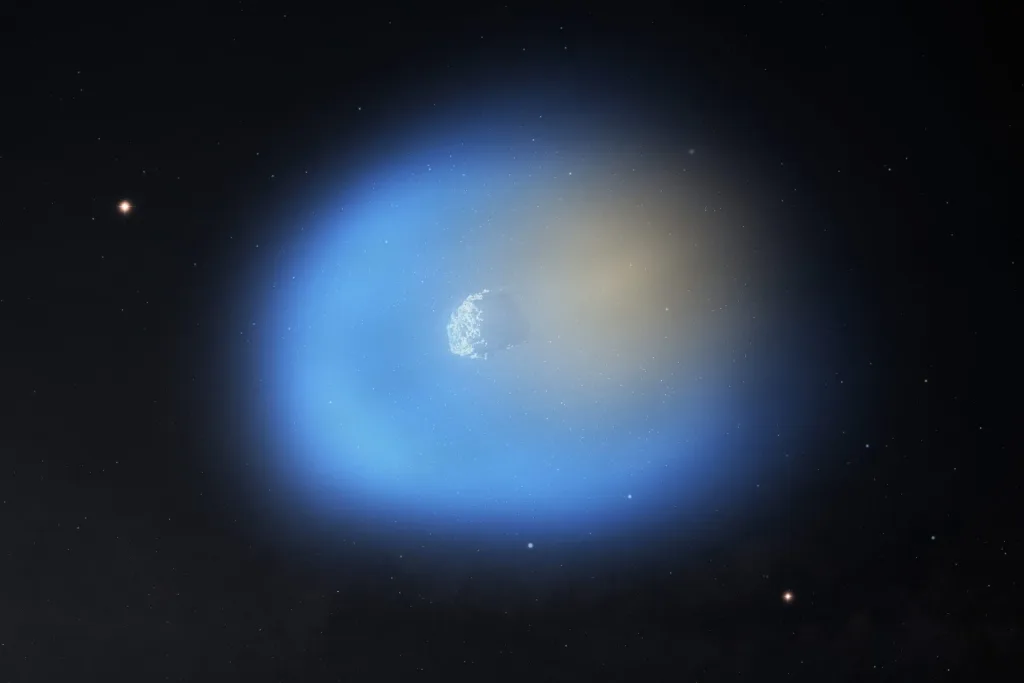
Detailed observations revealed that Interstellar Comet 3I/ATLAS contains an unusually high amount of deuterium in its water. Deuterium is a heavier form of hydrogen. When it combines with oxygen, it forms semi-heavy water, known as HDO. This molecule provides a clear record of the conditions in which the comet formed.
What Makes This Discovery Unique
The level of deuterium found in Interstellar Comet 3I/ATLAS is extraordinary. Its water contains more than 30 times the amount of deuterated molecules found in Earth’s oceans. This difference points directly to a much colder formation environment.
In extremely cold regions, deuterium becomes more concentrated in ice. That means the comet formed in a place where temperatures remained very low for extended periods. This is far colder than the regions where most Solar System objects originated.
Comparing With Our Solar System
Comets within our Solar System also contain deuterium, but at much lower levels. This contrast reveals a key difference in formation conditions. Our Solar System formed in a relatively warmer and more active environment. In contrast, Interstellar Comet 3I/ATLAS appears to have formed in a quieter and colder region.
This chemical evidence shifts the focus from where the comet traveled to where it began.
A Cold Birthplace Before Star Formation
Formed in an Isolated Region
The composition of Interstellar Comet 3I/ATLAS suggests it originated in a cold and isolated part of the galaxy. In such regions, there are few nearby stars to provide heat. This allows ice-rich material to preserve high levels of deuterium.
This scenario differs from the formation of our Sun. The Sun likely formed in a dense cluster of young stars. That environment introduced more heat and radiation, which reduced deuterium levels in surrounding material.
Possibly Older Than Its Own Star System
One of the most intriguing possibilities is that Interstellar Comet 3I/ATLAS formed before its own star system fully developed. If true, it represents material from a stage before planets even existed.
This makes the comet a direct link to the earliest phases of cosmic evolution. It preserves conditions from a time when the building blocks of stars and planets were still coming together.
A Window Into Early Galaxy Chemistry
The high deuterium content offers insight into the chemical conditions of the early galaxy. It suggests that cold, isolated regions played a significant role in shaping the diversity of planetary systems.
Objects like Interstellar Comet 3I/ATLAS serve as natural records of these environments. By studying them, scientists gain a clearer picture of how different regions of the galaxy evolved over time.
Why Interstellar Comet 3I/ATLAS Matters for Future Science
Advancing Observational Capabilities
The study of Interstellar Comet 3I/ATLAS shows the power of modern astronomy. Observations from both ground-based and space-based instruments allowed scientists to analyze its structure and composition in detail.
This approach demonstrates how coordinated observations can unlock new insights about distant objects.
Improving Detection and Tracking
Early detection played a key role in studying this comet. The sooner astronomers identify interstellar objects, the more time they have to observe them. Future surveys will likely increase the number of discoveries.
As detection systems improve, scientists may be able to track these objects even earlier in their journey.
Toward Future Exploration
Looking ahead, space agencies may consider missions to intercept interstellar objects. Such missions could collect direct samples, offering deeper insight into their composition.
While these missions remain in development, discoveries like Interstellar Comet 3I/ATLAS highlight their potential value.
Refining Planet Formation Models
The data from this comet helps refine current models of planetary formation. It shows that conditions across the galaxy vary more than previously thought. Some systems form in warm, active environments. Others develop in cold, isolated regions.
Understanding these differences is essential for building a complete picture of how planetary systems emerge.
Conclusion: A Frozen Message From the Early Universe
Interstellar Comet 3I/ATLAS is more than a passing object. It is a preserved fragment of the early universe. Its age, combined with its unique chemical signature, offers a rare glimpse into conditions that existed long before our Solar System formed.
As more interstellar objects are discovered, each will add new pieces to this cosmic puzzle. For now, Interstellar Comet 3I/ATLAS stands as one of the clearest examples of how much history can be carried by a single traveler from the depths of space.