BY:SpaceEyeNews.
🚀 Introduction — A Time Capsule From the Early Galaxy
The interstellar comet 3I ATLAS has given scientists a rare look into the early Milky Way. This object may be up to 11 billion years old, far older than the Sun. Its chemical signature points to a cold, isolated region of the galaxy. That alone makes it extraordinary.
For researchers, this comet is not just passing through. It preserves material from a time when the galaxy was still evolving. Studying it helps scientists understand how early planetary systems began to form under very different conditions.
🌌 A Visitor From a Distant Past
The object known as 3I/ATLAS is only the third confirmed interstellar visitor detected in our solar system. Unlike typical comets, it does not orbit the Sun. Instead, it follows a one-way path through our cosmic neighborhood.
It passed near Mars in late 2025 and reached its closest point to Earth in December. Now, it is moving beyond Jupiter at around 220,000 kilometers per hour. It will not return.
Observations place its nucleus between 440 meters and 5.6 kilometers in size. While small, it carries enormous scientific value.
A Different Birth Environment
Evidence suggests this comet formed in a cold and isolated part of the Milky Way. That environment differs greatly from where our solar system formed.
The Sun likely formed in a dense cluster of stars. In such regions, heat and radiation shape nearby material. In contrast, an isolated region remains colder and more stable. That allows primitive materials to survive.
Because of this, the interstellar comet 3I ATLAS may preserve some of the earliest building blocks in the galaxy.
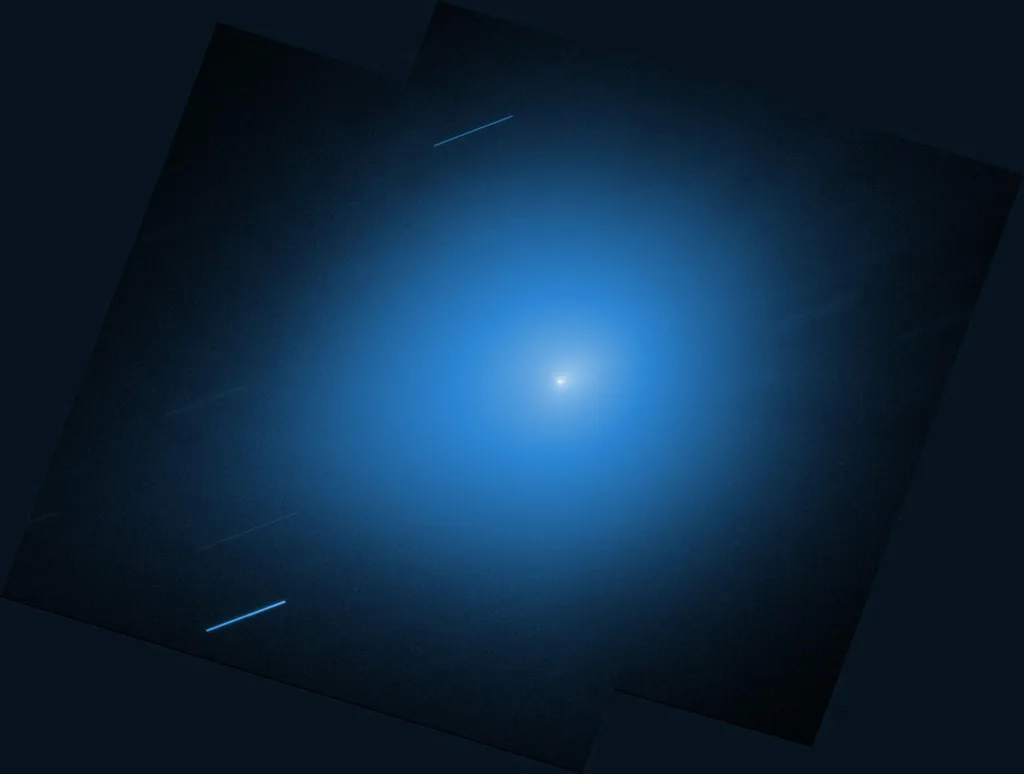
🧊 The Chemical Clue Behind Its Origin
The most important discovery comes from the comet’s composition. Scientists detected high levels of deuterium, a heavier form of hydrogen, in its water.
A Signature of Extreme Cold
Deuterium forms more easily in very cold environments. High concentrations point to formation under low temperatures. In this case, the levels exceed those found in most solar system comets.
That suggests the comet formed in a region that was:
- Extremely cold
- Far from strong stellar radiation
- Less influenced by nearby stars
Reading the Record
This chemical signature acts like a record of the comet’s past. By studying it, scientists can reconstruct early conditions in the galaxy.
Observations from instruments such as the Atacama Large Millimeter/submillimeter Array and the Hubble Space Telescope made this analysis possible.
🌠 What This Means for Planet Formation
The discovery reshapes how scientists think about planet formation. It shows that planetary systems can form under a wider range of conditions than previously believed.
Comparing Formation Environments
Our solar system formed in a crowded region filled with young stars. That environment influenced temperature and chemistry.
In contrast, this comet likely formed near a more isolated star. Such environments have:
- Lower temperatures
- Minimal external influence
- Slower chemical processes
These differences can lead to very different planetary systems.
Expanding the Model
This finding suggests that planet formation is not limited to dense stellar clusters. It can also occur in quieter regions of the galaxy.
The interstellar comet 3I ATLAS provides direct evidence of this diversity. It shows that early planetary materials can form and survive in extreme cold.
🔭 A Rare Class of Visitors
Interstellar objects are extremely rare. Before this discovery, only two had been confirmed:
- Oumuamua
- 2I/Borisov
Each object revealed new details about distant regions of the galaxy. However, this comet stands out because of its age and composition.
It appears to be older than previous interstellar visitors. Its chemical profile also points to colder origins. Together, these features make it one of the most informative objects observed.
🚀 A One-Time Observation Window
The study of this comet depended on timing. It was detected early enough for detailed observation.
A Limited Opportunity
Scientists tracked it as it passed through the solar system. Multiple observatories collected data during this period. Once it moved beyond Jupiter, observation became far more difficult.
Now, the comet is leaving permanently. It will continue its journey through interstellar space.
The Need for Early Detection
This case highlights the importance of detecting such objects early. Faster detection allows for longer observation and better analysis.
Future missions and surveys will aim to identify more interstellar visitors. Each new object offers another chance to study the galaxy’s past.
🧠 Conclusion — A Messenger From the Early Galaxy
The interstellar comet 3I ATLAS offers a rare glimpse into the early Milky Way. Its age and composition provide direct evidence of conditions that shaped the galaxy billions of years ago.
This discovery expands our understanding of planet formation. It shows that planetary systems can emerge in a wider range of environments than once thought.
As detection technology improves, more interstellar objects will likely be found. Each one will add new insights into how the galaxy evolved. For now, this comet stands as a valuable link to the distant past.
🔗 Main Sources:
AP News report: https://apnews.com/article/interstellar-comet-atlas-astronomy-galaxy-solar-system-319dcf890b07c5f00fefa82075e81f62
Nature Astronomy study (as referenced in AP News)
NASA / ESA Hubble observations via STScI
NASA Hubble Space Telescope: https://hubblesite.org ALMA Observatory: https://www.almaobservatory.org