
BY:SpaceEyeNews.
The discovery of interstellar comet 3I/ATLAS has become even more extraordinary. Scientists recently confirmed that the object was hiding inside telescope images taken days before its official discovery. The finding has sparked major excitement across the astronomy community. It also highlights the enormous power of the new Vera C. Rubin Observatory.
Researchers now believe this ancient visitor from another star system may help transform the future of interstellar astronomy. The comet is not only one of the rarest objects ever detected inside our solar system, but it may also be among the oldest.
The story became even more fascinating after astronomers realized Rubin Observatory had already photographed the object long before anyone noticed it.
Rubin Observatory Almost Discovered Interstellar Comet 3I/ATLAS First
The official discovery of interstellar comet 3I/ATLAS happened on July 1, 2025. The object was identified by the Asteroid Terrestrial-impact Last Alert System, better known as ATLAS.
However, scientists later uncovered something unexpected.
The Rubin Observatory had already captured the comet on June 20, 2025. That was nearly ten days before the official announcement. At the time, the observatory had just entered its science validation phase. Engineers were still calibrating instruments and testing systems before full operations began.
A research team led by Colin Orion Chandler from the University of Washington searched through Rubin’s early commissioning data. They discovered that the comet appeared in images from Rubin’s very first night of test observations.
That finding changed the entire timeline of the discovery.
Why Rubin Observatory Missed the Discovery
The reason Rubin Observatory did not officially discover the comet comes down to timing.
During the early validation phase, Rubin’s automated data-processing pipeline was not fully operational. Modern observatories rely heavily on software systems that quickly scan incoming images for moving objects and unusual activity.
Rubin’s hardware was already powerful enough to see the comet. The software infrastructure simply was not ready yet.
Scientists had to create a custom pipeline afterward to analyze the early data manually. Once they completed that process, they realized Rubin had actually observed interstellar comet 3I/ATLAS multiple times before ATLAS announced the discovery.
The observatory continued imaging the object several more times between June and July 2025.
The discovery demonstrates how advanced Rubin Observatory already was even before entering full science operations.
The Comet Already Showed Strong Activity
The Rubin images revealed another important detail.
The comet was already highly active before its official discovery. Astronomers could clearly see a glowing coma surrounding the object. A coma forms when ice inside a comet heats up near the sun and releases dust and gas into space.
That means interstellar comet 3I/ATLAS was not a quiet or inactive object drifting unnoticed through the solar system. It was already producing visible material that telescopes could detect.
The images provided scientists with valuable early information about the comet’s behavior.
Researchers believe these observations may help improve future detection systems for interstellar objects.
Interstellar Comet 3I/ATLAS Is Extremely Rare
Only a handful of confirmed interstellar objects have ever entered our solar system.
Before this discovery, astronomers had identified:
- ʻOumuamua in 2017
- 2I/Borisov in 2019
Now, interstellar comet 3I/ATLAS has joined that exclusive list.
These objects are important because they formed around other stars. Unlike asteroids and comets native to our solar system, interstellar objects carry material from distant planetary systems.
Scientists can study them to learn how other star systems formed and evolved.
That makes every detection extremely valuable.
An Ancient Visitor From Deep Space
Astronomers estimate that interstellar comet 3I/ATLAS is traveling at around 140,000 miles per hour, or about 61 kilometers per second.
Its enormous speed strongly suggests the object did not originate in our solar system.
Researchers also believe the comet may be between 7 and 12 billion years old. If correct, that would make it older than Earth itself.
Over billions of years, the comet likely passed near many stars. Those gravitational encounters probably accelerated it across interstellar space before it eventually entered our solar system.
Scientists believe the object may preserve ancient chemical material from a completely different stellar environment.
That possibility is driving enormous scientific interest.
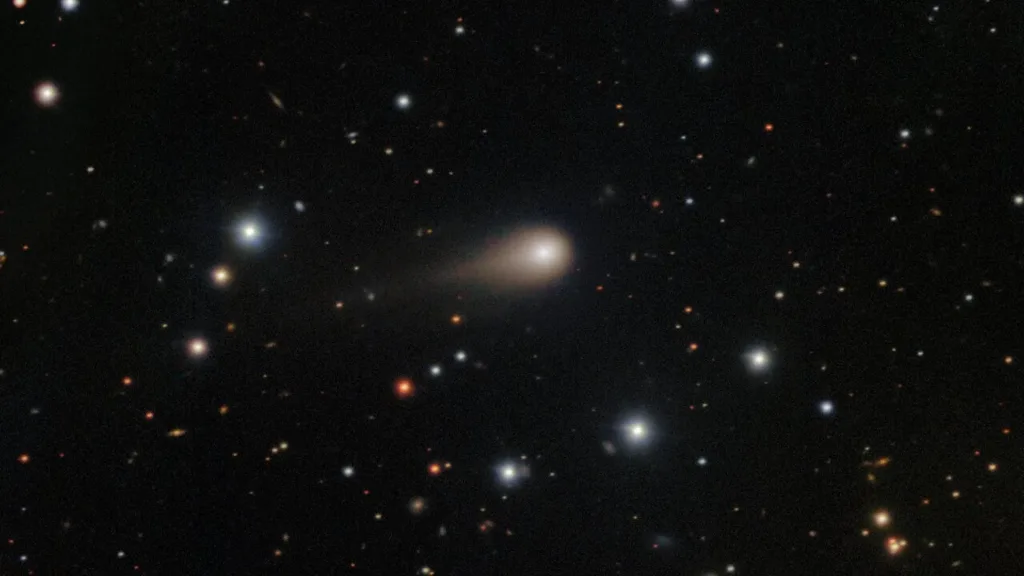
Spacecraft Studied Interstellar Comet 3I/ATLAS Together
Ground telescopes were not the only instruments studying the comet.
Two major spacecraft also joined the effort:
- JUICE
- Europa Clipper
Both spacecraft are currently traveling toward Jupiter. During late 2025, they coordinated observations of the comet while it passed through the inner solar system.
The geometry created a unique scientific opportunity.
JUICE observed the comet’s dayside, while Europa Clipper viewed the nightside. Together, they provided a broader picture of the gases escaping from the comet’s nucleus.
Their ultraviolet instruments detected hydrogen, oxygen, and carbon released from the object.
The Chemistry of Interstellar Comet 3I/ATLAS Looks Unusual
Scientists noticed something particularly interesting in the data.
The comet showed unusually high carbon abundance compared with many comets from our own solar system. Researchers also found evidence of elevated carbon dioxide levels.
Earlier observations from the James Webb Space Telescope had already hinted at this unusual chemistry.
These findings matter because chemical composition can reveal where and how a comet formed.
Researchers now suspect the comet formed in a very different planetary system from ours.
By comparing the ratios of water ice and carbon dioxide ice, scientists can study similarities and differences between alien star systems and the solar system.
That turns interstellar comet 3I/ATLAS into something much bigger than a passing visitor. It becomes a time capsule from another region of the galaxy.
Rubin Observatory Could Revolutionize Interstellar Astronomy
The discovery also highlights the future importance of Rubin Observatory itself.
The facility was designed to conduct the Legacy Survey of Space and Time, often called LSST. Over ten years, Rubin will repeatedly scan the night sky with incredible sensitivity.
Scientists expect the observatory to discover:
- millions of asteroids,
- thousands of comets,
- exploding stars,
- and many short-lived cosmic events.
Researchers also estimate Rubin could detect roughly one interstellar object every year.
That would completely transform this field of astronomy.
Until now, interstellar discoveries have been extremely rare. Scientists usually had very little time to study them before they disappeared into deep space again.
Rubin Observatory could change that situation dramatically.
A New Era of Interstellar Discovery May Be Starting
Astronomers now believe humanity may be entering a new phase of space exploration.
Instead of discovering interstellar visitors once every several years, future observatories may detect them regularly.
That would allow scientists to compare many objects from different star systems. Over time, researchers could build a much larger understanding of how planetary systems form across the galaxy.
Future missions may even attempt close flybys or interception missions for these objects.
Some scientists have already discussed the possibility of rapidly launching spacecraft toward future interstellar visitors.
The more early detections astronomers achieve, the more realistic those missions become.
That is one reason why Rubin Observatory’s early images of interstellar comet 3I/ATLAS generated so much excitement.
Interstellar Comet 3I/ATLAS May Only Be the Beginning
There is a remarkable irony at the center of this story.
One of the world’s newest observatories had already seen the comet before anyone officially knew it existed.
Rubin Observatory almost became the first facility to discover interstellar comet 3I/ATLAS. Even though it missed official credit, the event proved the observatory’s enormous potential.
The comet itself also continues to fascinate scientists. Its age, chemistry, speed, and origin make it one of the most important interstellar discoveries ever studied.
Most importantly, the discovery suggests that many more interstellar objects may soon follow.
Humanity is no longer waiting decades between encounters with visitors from other star systems. Thanks to next-generation observatories and coordinated spacecraft observations, astronomers may soon track these cosmic travelers on a regular basis.
And somewhere inside future telescope data, another ancient visitor could already be waiting to be discovered.
Main Sources:
- Space.com article about 3I/ATLAS
- Vera C. Rubin Observatory official website
- NASA Europa Clipper mission
- ESA JUICE mission