
BY:SpaceEyeNews.
Isolated black holes may represent the overwhelming majority of stellar-mass black holes in the Milky Way. Yet astronomers have detected only a tiny number of possible examples.
A new simulation suggests that roughly 91% of the galaxy’s stellar-mass black holes now exist without a companion. These objects produce little or no detectable light. As a result, they remain hidden unless their gravity affects a visible background object.
The findings could transform our understanding of the Milky Way’s black-hole population. However, the research remains a simulation-based prediction rather than a completed observational census.
Isolated Black Holes Could Be the Galactic Majority
Astronomers have traditionally found stellar-mass black holes in binary systems. In these systems, a black hole orbits another star.
The companion may reveal the black hole through its unusual motion. Material pulled from the star can also heat up and produce detectable X-rays.
That discovery method creates an obvious selection effect. Black holes with visible companions are easier to identify, even if they represent only a small part of the total population.
Researchers led by Tom Wagg of the Flatiron Institute explored this problem in a study titled Charting the Galactic Underworld I. The team published the work as an arXiv preprint on July 24, 2026.
Their reference model estimates that about 170 million stellar-mass black holes have formed in the Milky Way. Around 91% now travel alone, while roughly 3% have escaped the galaxy entirely.
The total number remains uncertain. Across 32 different model variations, the estimate changed by roughly an order of magnitude. Therefore, the 170 million figure should not be treated as an exact count.
Simulating the Milky Way’s Hidden Population
The team used a simulation framework called cogsworth. It combines models of stellar evolution, binary interactions, and galactic dynamics.
Rather than placing black holes inside a fixed version of the Milky Way, the researchers modelled how the galaxy changed over time. They followed stars as they formed, evolved, interacted, and reached the final stages of their lives.
The simulation also tracked the movement of black holes through the galaxy’s gravitational field. This step matters because black holes can receive sudden changes in velocity when they form.
Researchers often call these changes natal kicks. Their strength can influence whether a black hole remains near its birthplace, leaves a binary system, or escapes the Milky Way.
Why So Many Black Holes End Up Alone
Several processes can produce isolated black holes.
Some begin with stars that were already alone. Others emerge after two stars in a binary merge. A binary can also separate when one star collapses and the system loses mass or receives a natal kick.
The study predicts that around 10 million black holes still belong to binary systems. Yet most of their companions are other black holes or white dwarfs.
Only about 100,000 may retain a luminous stellar companion. That figure helps explain why the observable sample could differ greatly from the true population.
In other words, the systems astronomers currently study may not represent the typical Milky Way black hole.
A Wider Galactic Distribution Than Visible Stars
The simulation also predicts where these unseen objects may be located.
According to the researchers, black holes form a more diffuse population than visible stars. Their distribution extends farther above and below the Milky Way’s main disk.
The team estimates a vertical scale height about 2.5 times larger than that of visible stars. Natal kicks and disrupted binaries can move black holes onto wider galactic paths. Billions of years of motion then spread them across a thicker region.
Black-hole mass may also affect location. The simulation places the most massive examples closer to the galactic plane.
That pattern depends strongly on how models describe stellar collapse and natal kicks. Future observations could therefore test both black-hole demographics and the physics behind their formation.
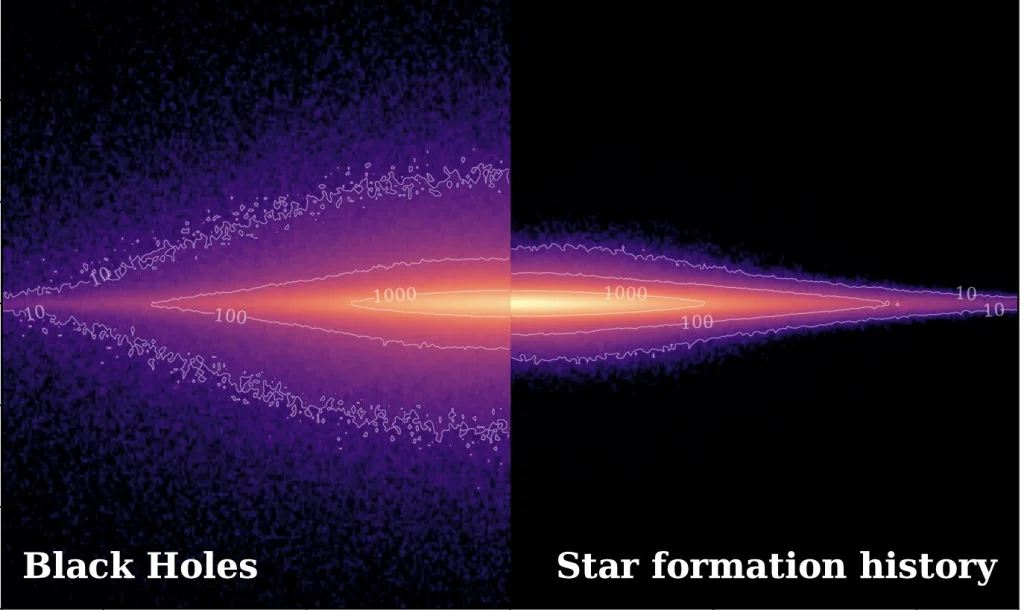
Simulations hint at a hidden population of companionless black holes.
How Astronomers Can Find Isolated Black Holes
Since isolated black holes usually lack bright companions, astronomers need indirect detection methods.
The leading method is gravitational microlensing. It occurs when a foreground object passes in front of a more distant star from Earth’s viewpoint.
The foreground object’s gravity bends and magnifies the background star’s light. Astronomers can then measure the temporary brightening and the small apparent shift in the star’s position.
A black hole can create a particularly long microlensing event because of its high mass. Detailed observations may reveal the lens’s mass, motion, and distance.
NASA’s Hubble Space Telescope has already examined an isolated compact-object candidate through astrometric microlensing. One research team estimated a mass of around seven Suns. Another found a lower range that could indicate either a black hole or a neutron star.
The case shows both the promise and difficulty of the technique. Astronomers must monitor crowded star fields for long periods. They also need highly precise measurements to separate black holes from other dark objects.
Roman Could Reveal Hundreds of Hidden Black Holes
NASA’s Nancy Grace Roman Space Telescope could dramatically expand the available sample.
Roman’s Galactic Bulge Time-Domain Survey will repeatedly monitor dense regions near the Milky Way’s center. Its wide field of view will allow it to track huge numbers of stars at once.
NASA expects the survey to identify hundreds of stellar-mass black holes. Microlensing depends on gravity rather than emitted light, so Roman can detect black holes without visible companions.
Gaia Data Release 4 could provide complementary information. The European Space Agency plans to release it on December 2, 2026. Gaia’s precise stellar positions and motions may help researchers identify unusual binary systems and refine microlensing measurements.
Spectroscopic surveys will add another layer. They can measure stellar velocities and reveal stars moving under the influence of unseen companions.
Why the Hidden Population Matters
A larger sample of isolated black holes would help astronomers study how massive stars end their lives.
Researchers could compare observed black-hole masses, speeds, and locations with competing models. This comparison may reveal how often stars form black holes, how strong natal kicks are, and how binary interactions affect the final result.
The new simulation already shows that black-hole predictions depend heavily on uncertain assumptions. Different treatments of stellar remnants and natal kicks produce different galactic populations.
That uncertainty is not a weakness alone. It gives astronomers several testable predictions.
Roman, Gaia, and ground-based surveys can compare real discoveries with the simulated map. Each detection will help narrow the range of possible formation models.
Isolated Black Holes Await a True Galactic Census
The new study suggests that astronomers may have spent decades studying an unusually visible minority.
Most stellar-mass black holes could remain alone, dark, and difficult to detect. The predicted 91% share remains model-dependent, so it does not yet represent a confirmed count.
Even so, the research gives future surveys a clearer search strategy. By combining microlensing, precise stellar motion, and spectroscopy, astronomers may finally begin a reliable census of isolated black holes.
That census could reveal how stars collapse, how compact remnants move, and how the Milky Way built its hidden population over billions of years.
Main Sources:
Original research preprint:
https://arxiv.org/abs/2607.22814
NASA — Roman Galactic Bulge Time-Domain Survey:
https://science.nasa.gov/mission/roman-space-telescope/galactic-bulge-time-domain-survey/
NASA — Hubble observations of an isolated black-hole candidate:
https://science.nasa.gov/missions/hubble/hubble-determines-mass-of-isolated-black-hole-roaming-our-milky-way-galaxy/
ESA — Gaia Data Release schedule:
https://www.cosmos.esa.int/web/gaia/release