
BY:SpaceEyeNews.
The James Webb N159 image reveals a stellar nursery behind a scene that looks ready for Halloween. Orange clouds surround pale blue cavities, while dark red threads cross the glowing landscape. Within those dense structures, young stars continue to develop.
Located about 161,000 light-years away, N159 lies in the Large Magellanic Cloud, a satellite galaxy of the Milky Way. Its appearance inspired the seasonal “cosmic cauldron” description. However, the science reaches beyond its striking colors.
Webb’s observations connect the cloud’s structure with its stellar population. They also offer clues about star formation in environments with fewer heavy elements.
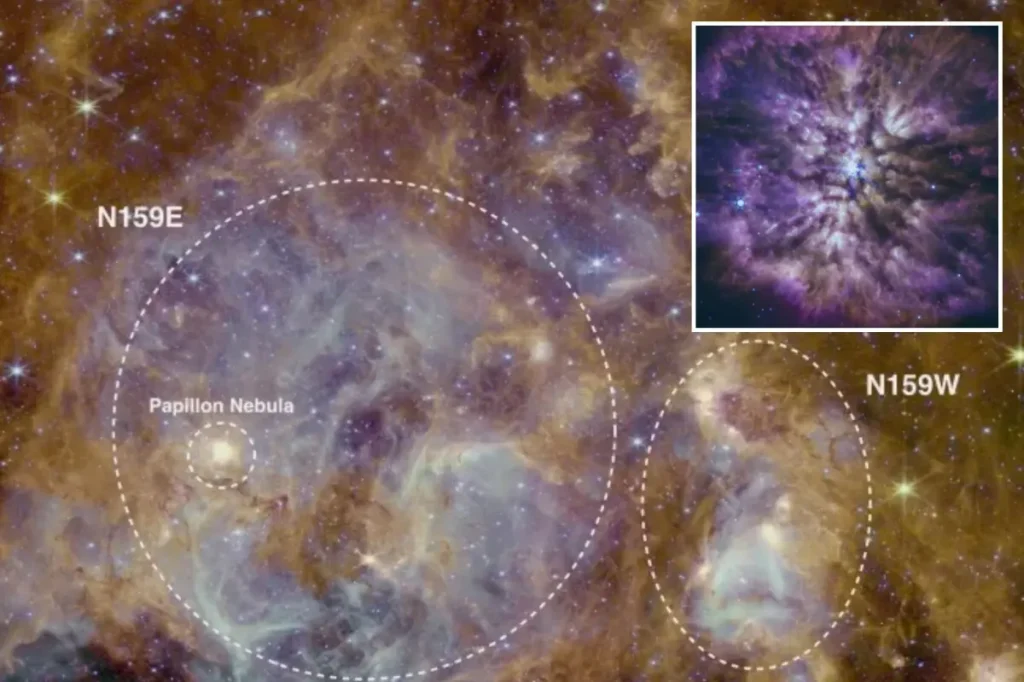
The N159 star-forming complex is seen through six of JWST NIRCam’s filters.NASA / ESA / CSA / Webb / E. Sabbi / M. Zamani, ESA & Webb / M.H. Özsaraç.
What the James Webb N159 image reveals
N159 contains a complex mixture of bright gas, dense filaments, and developing stars. Webb’s Near-Infrared Camera captures the boundaries between these different environments in remarkable detail.
The image spans roughly 230 light-years. Across that enormous field, some areas glow openly, while others conceal stars within thicker material. These differences make the scene useful for studying multiple stages of stellar development.
A familiar region with a clearer view
Astronomers already knew about N159 before this release. The new observations expand their view of its structures and stellar populations.
ESA released the image on October 22, 2026, as Webb’s Picture of the Month. NASA highlighted it on October 28. Those dates mark its public presentation, rather than the moment every observation occurred.
The release therefore brings fresh detail to an established target. Its value comes from what astronomers can distinguish within the region.
What the nebula’s colors reveal
The orange, blue, and red features carry information about the material surrounding N159’s stars. Reading those features turns a beautiful image into a guide to the cloud’s physical conditions.
Orange clouds and blue cavities
Light orange areas trace emission from polycyclic aromatic hydrocarbons. These carbon-based molecules contribute to the intricate appearance of the surrounding clouds.
Pale blue regions indicate ionized hydrogen. Massive stars supply intense ultraviolet radiation, which energizes the gas and helps produce its glow.
Together, these features show that the nebula contains distinct environments. The brighter cavities and thicker cloud boundaries tell different parts of the same story.
Red filaments and hidden stars
Dark red strands trace molecular hydrogen through the central scene. They mark dense structures where surrounding material helps shelter developing stars.
Their importance extends beyond their appearance. These filaments connect the visible landscape with the young stellar population inside it. Looking closely reveals why the cloud’s darker features deserve as much attention as its brightest regions.
How dense clouds shelter developing stars
N159’s stars develop within an environment that continually changes around them. Dense material offers temporary protection from nearby radiation and stellar winds.
That protection helps explain why young stars can remain embedded within thick structures. The surrounding cloud forms part of their immediate environment, rather than simply obscuring the view.
Meanwhile, massive stars influence nearby gas. Their radiation and winds reshape cloud boundaries, creating ridges and cavities across the region.
A temporary stage in the cloud’s evolution
The shielding structures will not remain intact forever. As surrounding material disperses, stars that once sat within dense clouds become more exposed.
Webb captures a snapshot of that changing relationship. Some stars remain wrapped in their birth environments, while others occupy more open surroundings.
This distinction gives the image its scientific depth. Astronomers can examine the stars alongside the material around them, rather than treating each as a separate subject.
Faint stars reveal different stages of development
The observations behind the James Webb N159 image reach beyond the most obvious bright sources. ESA says researchers detected faint stars with less than one-tenth the Sun’s mass.
That sensitivity expands the population available for study. A view dominated by luminous stars would reveal only part of the region’s activity.
Researchers also distinguished hotter, more developed stars from young objects that remain embedded in dense material. Comparing these groups helps them interpret how stellar development varies across N159.
The accompanying study identifies young stars through several measurements, including excess infrared emission. Some candidate young stellar objects also show evidence of water ice absorption. Their positions align with dusty filaments and molecular gas, supporting the interpretation that they remain embedded.
These measurements matter because appearance alone cannot establish a star’s developmental stage. A bright point within a cloud needs further analysis. Combining location with measured emission gives researchers stronger evidence than either clue could provide independently.
Why western N159 stands out
The western region contains a more concentrated population of young stellar objects. ESA describes this as evidence that the area occupies an earlier stage of star formation.
This does not mean the entire complex follows one synchronized timetable. Different locations show different stages within the broader process.
The comparison therefore adds context to the image. Cloud structures become more informative when astronomers can connect them with the populations they contain.
Why N159 matters for early-universe research
N159 offers another advantage: its environment differs chemically from typical star-forming regions in the Milky Way.
The Large Magellanic Cloud has a lower proportion of elements heavier than hydrogen and helium. Astronomers describe that proportion as metallicity.
This makes N159 useful for exploring star formation under conditions more similar to those found in the early universe. NASA highlights that connection as a central reason to study the region. www.nasa.gov
A comparison environment, not the first stars
The distinction matters. Webb’s N159 observations do not show the universe’s first stars forming directly.
Instead, the region provides an accessible comparison environment. Researchers can examine stellar populations and surrounding material in greater detail than a simple distant glow would allow.
Its chemistry does not make N159 an exact copy of every early stellar nursery. Nevertheless, it offers a valuable setting for investigating how stars develop beyond familiar Milky Way conditions.
The broader question concerns how well our understanding of star formation applies across different environments. Detailed observations provide evidence for addressing that question.
James Webb N159 image: beyond the Halloween scene
The James Webb N159 image draws attention through its dramatic clouds and vivid colors. Its lasting value lies in the connections those features reveal.
Dense filaments shelter developing stars. Brighter cavities show how existing stars influence their surroundings. Meanwhile, faint stellar populations help researchers distinguish different stages of development.
N159 also places those observations within a chemically different environment, strengthening its relevance to early-universe research. The result is more than a seasonal space portrait. It is a detailed view of a stellar nursery whose stars and clouds tell an evolving story together.
Main sources:
NASA — Webb Sees Turbulent Star Nursery
https://www.nasa.gov/image-article/webb-sees-turbulent-star-nursery/
ESA — Stars brewing in a nebulous cauldron
https://www.esa.int/ESA_Multimedia/Images/2026/10/Stars_brewing_in_a_nebulous_cauldron
ESA/Webb — Original image release
https://esawebb.org/images/potm2610a/
Research paper — Sequential Star-Formation and the Near-Infrared Stellar Populations within N159
https://arxiv.org/abs/2609.27126
You Might Also Like:
James Webb’s Quintet Reveals an Early Galaxy Merger
Early Universe Dust Mystery Solved by James Webb Telescope
James Webb Reveals the Surface of Super-Earth LHS 3844 b