
BY:SpaceEyeNews.
Japan’s MMX mission could answer a question that has puzzled planetary scientists for decades: where did Mars’s moons come from? The spacecraft will visit Phobos, collect surface material, and bring it back to Earth. Those samples could distinguish between two very different histories. Perhaps Mars captured wandering asteroids. Alternatively, its moons may have formed from material thrown into orbit during an ancient impact. Japan now plans to seek the evidence directly.
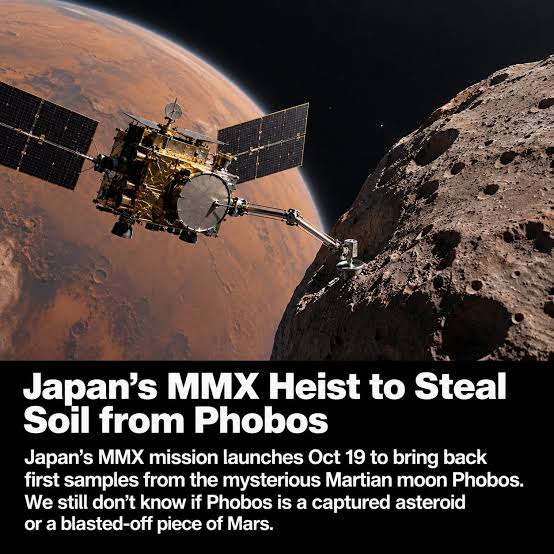
Japan’s MMX mission prepares for launch
JAXA, Japan’s space agency, leads the Martian Moons eXploration mission, known as MMX. An H3 rocket will carry the spacecraft from Tanegashima Space Center.
The scheduled launch falls on October 20, 2026, at 4:41 a.m. Japan time. That corresponds to October 19 at 10:41 p.m. in Cairo and Kyiv. These dates describe the same launch opportunity across different time zones.
After roughly a year of travel, MMX should reach Mars in August 2027. Close observations of Phobos will follow. The spacecraft will also investigate Deimos, giving scientists a broader view of the two moons.
If successful, MMX will deliver the first samples collected from a moon of another planet.
Phobos samples could reveal two different histories
Phobos and Deimos preserve clues to processes that shaped the Martian system. However, scientists still debate how those moons arrived in their present surroundings.
One explanation suggests that both began as asteroids. Mars then captured them through processes that left them orbiting the planet. Under this scenario, their material could reveal connections to bodies that formed elsewhere in the Solar System.
Another explanation links their origins to an ancient impact on Mars. Material entered orbit and eventually gathered into moons. Samples with the expected chemical and mineral signatures could strengthen that explanation.
Why a few Martian grains would not settle everything
The answer requires more than spotting material that resembles Mars.
Over billions of years, material ejected from the planet could have reached Phobos. Its surface may therefore contain Martian grains regardless of how the moon originally formed.
Researchers must examine the samples together with MMX’s observations. That combined evidence should help them separate the moon’s original ingredients from material that arrived later.
Landing on Phobos presents an unusual challenge
Weak gravity might sound helpful for a spacecraft landing. On Phobos, however, it makes reliable surface contact and movement difficult.
ESA offers a striking comparison. The 25-kilogram Idefix rover would exert about the same weight there as a 15-gram object on Earth. Its mass would still remain 25 kilograms.
Engineers must account for that environment when planning how equipment touches the ground and moves across it. A successful arrival alone will not complete the task. The mission must also operate reliably on unfamiliar terrain.
Idefix will investigate the surface first
France’s CNES and Germany’s DLR developed Idefix to explore Phobos before the main spacecraft lands.
The rover will study surface conditions and material properties. These observations will support the larger mission’s landing preparations and help scientists understand the ground they intend to sample.
Meanwhile, MMX will survey possible landing locations from nearby.
How Japan’s MMX mission will collect samples
The collection target is at least 10 grams of material. That small quantity must represent a world scientists have never sampled directly.
Before landing, the spacecraft will examine candidate locations closely. Images and scientific measurements will help the team assess the terrain and its composition.
MMX will use a quasi-satellite orbit to remain near Phobos. In practical terms, it will follow a path around Mars similar to the moon’s own path. This arrangement supports extended observations.
Two methods for gathering material
The spacecraft carries complementary sampling systems.
A corer will collect material from a shallow depth beneath the surface. A second system will use pressurized gas to lift surface grains into a container.
Together, these approaches allow the mission to collect material in different ways. The main spacecraft will gather the samples for Earth return, while Idefix supports surface exploration.
Bringing Phobos material back to Earth
The mission’s scientific payoff depends on returning its collection safely. Current plans target a sample delivery in 2031, with capsule recovery in Australia.
After recovery, the material will travel to Japan for handling and scientific study. Researchers can then investigate its composition using laboratory equipment beyond what a spacecraft can practically carry.
Returning samples also allows scientists to study actual grains rather than relying entirely on measurements transmitted from space. Different analyses can address complementary questions about the material and its history.
These will be samples collected on Phobos, even if some grains originally came from Mars. That distinction matters when describing the mission’s achievement.
The journey therefore connects two demanding goals: operating beside a small Martian moon and delivering physical evidence to laboratories on Earth.
Building on Japan’s sample-return experience
Japan enters this mission with experience from Hayabusa and Hayabusa2. Those spacecraft returned material from the asteroids Itokawa and Ryugu.
MMX extends that expertise to the Martian system. The mission combines a longer interplanetary expedition with close observations, surface operations, sampling, and Earth return.
International partners also contribute equipment, expertise, and operational support. ESA supplies communications hardware and assistance through its Estrack ground network.
However, earlier successes do not guarantee this mission’s outcome. Phobos presents its own environment, and each stage must work before researchers can examine the returned material.
A small sample with a major scientific purpose
Japan’s MMX mission could turn a longstanding debate into a question scientists can test with physical evidence. Its planned collection may reveal whether Phobos preserves captured asteroid material or ingredients connected to Mars itself.
For now, launch marks the beginning. The decisive work will continue through exploration, sampling, and laboratory analysis, where a few grams could clarify the history of an entire planetary system.
Main sources:
- JAXA — MMX mission overview and mission flow
- ESA — MMX factsheet
- ESA — MMX launch and exploration timeline
- Universe Magazine — Japan to launch a probe carrying soil samples from Phobos.