
BY:SpaceEyeNews.
The Juice Earth flyby has given Europe’s Jupiter mission a crucial change of direction, with very little fuel consumption. On September 28, 2026, the spacecraft passed above the Indian Ocean, using Earth’s gravity to reshape its orbit around the Sun. The encounter also offered scientists a valuable rehearsal for exploring Jupiter’s icy moons. With another Earth visit still ahead, this maneuver connects today’s navigation work with the mission’s future discoveries.
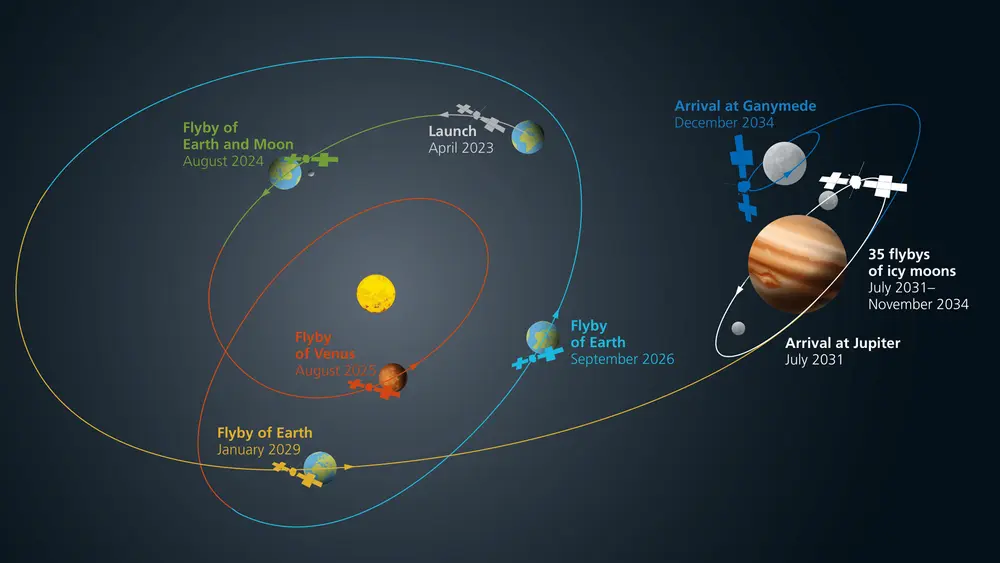
The journey – from Earth to Jupiter in a roundabout way.
What the Juice Earth Flyby Changed
Juice reached its closest point to Earth at 11:45 UTC, approximately 8,640 kilometers above the surface. Earth’s gravity bent its trajectory by around 20 degrees and increased its speed by roughly 3.5 kilometers per second. www.esa.int
That figure describes the speed increase, rather than the spacecraft’s total speed. The encounter changed how Juice travels around the Sun, placing it on a more elongated orbit.
This new path will bring the probe back to Earth for another carefully timed encounter. That final gravity assist, scheduled for January 2029, will send it toward its rendezvous with Jupiter.
The approach angle mattered as much as the distance. Controllers needed Juice to meet Earth at the right position and velocity. Otherwise, the resulting orbit would not match the mission’s planned route.
Why Juice Takes the Longer Route
A shorter journey would require much more energy at launch. Juice would also need enough fuel to slow down and enter orbit when it reached Jupiter.
Instead, mission planners chose a route that uses several gravitational encounters. These passages change the spacecraft’s motion while limiting the need for engine burns.
During August 2024, Juice completed the first combined lunar-Earth gravity assist. That encounter slowed the spacecraft and directed it toward Venus. The subsequent Venus flyby bent its route again and added speed.
Each encounter therefore has a specific role. Together, they build the conditions needed for Jupiter arrival while preserving propellant for later operations.
Saving Fuel for the Destination
The benefit extends beyond simply reaching the giant planet. Juice needs fuel to enter Jupiter’s orbit and later transfer into orbit around Ganymede.
Preserving that supply during the cruise supports the observations that give the mission its scientific purpose. Travel time is part of the trade-off.
The September encounter does not send Juice straight to Jupiter. Its immediate job is to prepare the next Earth meeting. That distinction explains why a successful speed increase still leaves several years of travel before the spacecraft reaches the giant planet.
Precision Navigation Before the Encounter
Controllers began the flyby navigation campaign on August 17. They reserved six opportunities for small trajectory adjustments as the spacecraft approached Earth.
Only one correction was necessary ahead of the encounter, about four weeks before closest approach. That small adjustment placed Juice on the required path.
This efficiency reflects the accuracy of the navigation work. The spacecraft still depended on careful tracking and precise predictions of its motion.
Teams also reserved a final emergency correction opportunity. It would allow intervention if a serious navigation problem or potential satellite collision required action. Reserving that window was a precaution, rather than evidence of an actual emergency.
Nearly Nine Hours on Batteries
Earth’s shadow created another challenge. Juice spent approximately eight hours and 39 minutes without sunlight before its closest approach.
Its solar panels could not generate power during that period, leaving the spacecraft dependent on batteries. Controllers therefore prioritized the most important instrument observations.
The task required balancing scientific opportunities against available energy. Scheduling mattered because every observation had to fit the spacecraft’s operating limits.
Earth and the Moon Provide a Science Rehearsal
The Juice Earth flyby also supports an observation campaign running from September 23 to October 3. All ten science instruments participate, although their operating schedules differ.
Earth and the Moon offer familiar targets for checking performance. Scientists can compare measurements with existing knowledge, refine instrument settings, and improve their analysis tools.
Those checks help teams prepare for observations around Jupiter, where opportunities will follow tightly planned schedules. Finding operational issues during the cruise gives them time to adjust procedures.
This encounter also offers more freedom to point the spacecraft than the combined flyby in 2024. Back then, the lunar passage had to set up an Earth encounter the following day.
Testing Navigation With the Moon
Juice’s navigation camera observes the Moon’s horizon to test an optical navigation technique. The goal is to improve positioning accuracy during future flights between Jupiter’s moons.
Meanwhile, two monitoring cameras document the Earth encounter. Their scheduled imaging continues through September 29, providing views of the spacecraft’s departure. www.esa.int
A Valuable Passage Through Earth’s Magnetotail
Beyond the images, Juice has an opportunity to investigate Earth’s magnetic environment. Its route carries it through the magnetotail, which stretches away from the Sun.
This region responds to the flow of charged particles from our star. Measurements there can help scientists examine how magnetic fields and particles behave far from Earth.
Juice’s observations can complement measurements from the European-Chinese Smile mission closer to our planet. Together, these different viewpoints offer a way to connect distant magnetotail activity with conditions near Earth’s poles.
The scientific results will take time. Teams must receive and evaluate the observations before drawing conclusions. ESA expects to release instrument images and spectra in the coming weeks, including views from Juice’s JANUS camera. www.esa.int
What Comes After the Juice Earth Flyby?
Juice will return for its final Earth gravity assist in January 2029. Its planned arrival at Jupiter follows in July 2031, with Ganymede orbit targeted for 2034.
Those milestones explain why this encounter matters years before the main exploration begins. The Juice Earth flyby conserves fuel, sharpens navigation, and gives instrument teams practical experience.
For now, the spacecraft leaves familiar surroundings with a revised orbit and fresh observations. Its latest visit brings the mission another step toward examining Jupiter and its remarkable icy moons.
Main sources:
- ESA, September 28, 2026: Successful Earth flyby improves Juice’s course to Jupiter
- ESA, September 21, 2026: Juice to fly past Earth for third gravity assist
- Universe Magazine: ESA’s Juice probe completed its penultimate maneuver on the way to the Jupiter system