BY:SpaceEyeNews.
Introduction — The Jupiter and Saturn Moon Mystery
The Jupiter and Saturn moon mystery has challenged scientists for decades. Both planets formed in the same region and share similar sizes. Yet their moon systems look completely different.
Jupiter hosts more than 100 moons. Among them, four large bodies dominate the system. In contrast, Saturn has over 280 moons, but one object stands above the rest. Titan defines its entire structure.
So why did two similar planets evolve in such different ways?
Now, researchers offer a compelling answer. According to new findings, magnetic fields played a decisive role. As a result, early conditions around each planet shaped the survival of their moons.
A New Model Behind the Jupiter and Saturn Moon Mystery
Building a Unified Explanation
For years, scientists approached the Jupiter and Saturn moon mystery using separate models. However, those models could not explain both systems at once. As a result, the full picture remained incomplete.
Now, a unified model changes that. Researchers combined internal planetary evolution with disk behavior. In addition, they included magnetic field development as a core factor.
This approach focuses on three elements:
- Internal heat and structure
- Magnetic field strength
- Disk dynamics around each planet
Together, these factors explain how similar planets followed different evolutionary paths.
Why a Unified Model Matters
Planetary science faces a clear limitation. We only observe one Solar System. Therefore, testing formation theories remains difficult.
However, moon systems provide a solution. They form quickly and preserve early conditions. In fact, they act as natural records of planetary history.
Because of this, the new model offers more than a simple explanation. It creates a framework for studying distant planetary systems as well.
Magnetic Fields and the Jupiter and Saturn Moon Mystery
Jupiter’s Magnetic Advantage
Jupiter developed a strong magnetic field early in its evolution. As a result, its surrounding environment changed dramatically.
Specifically, this field created a magnetospheric cavity within the circumplanetary disk. This cavity acted as a barrier. In turn, it slowed inward movement of material.
When forming moons migrated through the disk, they encountered this boundary. Consequently, their motion stopped. Instead of falling inward, they stabilized in orbit.
Because of this protection, large moons survived. Io, Europa, and Ganymede remained intact and formed a compact system.
Saturn’s Missing Barrier
In contrast, Saturn followed a different path. Its magnetic field remained weaker during early formation. Therefore, no cavity formed in its disk.
Without this barrier, material kept moving inward. As a result, forming moons struggled to survive. Many likely merged or disappeared over time.
Eventually, only a few stable bodies remained. Among them, Titan became the dominant moon. Meanwhile, the rest of the system stayed smaller and more dispersed.
A Small Difference, A Massive Outcome
At its core, the Jupiter and Saturn moon mystery depends on one factor. Magnetic field strength determined whether moons could survive.
Previously, scientists focused mainly on gravity. However, this new insight shifts attention to magnetic effects. In fact, magnetic fields now appear essential to understanding moon formation.
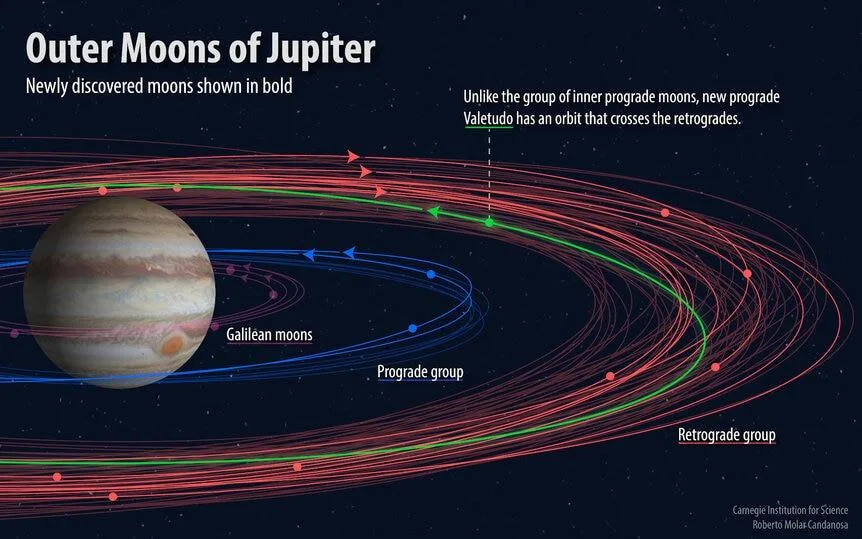
Recreating the Jupiter and Saturn Moon Mystery Through Simulation
Inside the Computational Models
To test this theory, researchers built advanced simulations. These models recreated the early evolution of both planets. At the same time, they tracked key physical changes.
They simulated:
- Internal temperature evolution
- Magnetic field growth
- Disk structure over time
As these factors interacted, the system evolved step by step. Consequently, scientists could observe how each variable influenced the outcome.
Tracking Moon Formation Step by Step
Beyond disk modeling, the team used N-body simulations. These calculations follow how objects move and interact under gravity.
Through this method, researchers tracked moon formation in detail. They observed how moons migrated, interacted, and stabilized.
In addition, they examined how disk conditions influenced survival. This combination created a complete picture of the process.
What the Simulations Revealed
The results showed a consistent pattern. Strong magnetic fields created cavities. As a result, those cavities stabilized moon orbits.
On the other hand, weak magnetic fields produced no such protection. Therefore, inward migration continued without interruption.
Ultimately, this explains both planetary systems using the same physics. The Jupiter and Saturn moon mystery now fits within a single model.
Beyond the Solar System — New Predictions
Predicting Moon Systems Around Distant Worlds
Importantly, this model extends beyond our Solar System. It provides predictions for gas giants orbiting other stars.
For example, Jupiter-like planets may develop strong magnetic fields. As a result, they could host multiple large moons.
In contrast, Saturn-like planets may form weaker fields. Therefore, they are more likely to produce fewer dominant moons.
Because of this, scientists can refine their search strategies. They can focus on planets most likely to host complex systems.
Implications for Exomoon Discovery
Detecting exomoons remains a major challenge. These objects are small and difficult to observe. However, this model offers guidance.
By identifying favorable conditions, researchers can narrow their search. In turn, this improves the chances of discovery.
As telescope technology advances, these predictions will become easier to test. Eventually, future observations may confirm these patterns.
A Shift in Planetary Science
Moving Beyond Gravity-Only Models
Traditionally, models focused on gravity and disk mass. While useful, they missed important dynamics.
Now, magnetic fields take a central role. They shape how material moves within disks. Moreover, they define stable regions for moon formation.
This shift connects multiple layers of planetary science:
- Internal structure
- Magnetic field generation
- Disk evolution
- Satellite formation
Together, these elements form a complete system.
Why This Discovery Matters
The Jupiter and Saturn moon mystery highlights how small differences can create major outcomes. A change in magnetic strength produced entirely different systems.
Furthermore, this insight expands our understanding of planetary formation. It also improves how scientists study distant worlds.
Conclusion — Solving the Jupiter and Saturn Moon Mystery
The Jupiter and Saturn moon mystery now has a clear explanation. Magnetic fields shaped the early environments around these planets. As a result, they determined which moons survived.
Jupiter’s strong field created a protective boundary. In contrast, Saturn’s weaker field allowed continuous inward movement. Therefore, their systems evolved in very different ways.
Overall, this discovery offers a deeper understanding of planetary evolution. It connects internal physics with large-scale structures.
Looking ahead, future observations will test this model further. For now, it provides one of the most complete explanations for a long-standing cosmic puzzle.
Sources:
- https://scitechdaily.com/scientists-may-have-found-the-key-to-jupiter-and-saturns-moon-mystery/
- https://www.nature.com/articles (Nature journal publication by Yuri I. Fujii et al., April 2026)