BY:SpaceEyeNews.
The JWST black hole feeding cycle may explain how supermassive black holes repeatedly replenish their fuel. New observations of the galaxy NGC 4696 reveal a direct connection between vast gas filaments and a rotating disk near its central black hole.
Astronomers have searched for this connection for years. They knew that active black holes heat the gas around them. Some of that gas can later cool and form narrow filaments. However, researchers lacked clear evidence showing how those filaments deliver material into the central feeding region.
Using the James Webb Space Telescope, the team has now mapped that missing route. The result suggests that black holes may recycle part of the same gas affected by their earlier activity.
The Puzzle Behind Black Hole Feeding
Supermassive black holes do not simply consume nearby material at a constant rate. Their feeding activity can change dramatically over time.
When gas reaches the region around a black hole, it forms a rotating structure and heats up. This process powers an active galactic nucleus, or AGN. The central region can then release enormous amounts of energy through radiation and narrow jets.
Those jets heat the surrounding atmosphere and can slow the cooling of gas. As a result, the black hole limits its own food supply.
This creates a puzzle. If black hole activity prevents gas from cooling, how can the same object continue feeding and growing over long periods?
Scientists proposed that the system works as a cycle. Heated gas remains in the galaxy or cluster atmosphere. Some of it later cools, condenses and returns toward the center. Until now, the final connection between the large filaments and the black hole’s inner environment remained difficult to confirm.
Why JWST Studied NGC 4696
The research team targeted NGC 4696, the central galaxy of the Centaurus Cluster. It lies about 145 million light-years from Earth.
Its relative proximity makes it an excellent laboratory for studying black hole feedback. The galaxy contains a supermassive black hole surrounded by gas at many different temperatures. A large network of filaments also stretches across the surrounding region.
Earlier Hubble Space Telescope images revealed an unusual S-shaped swirl near the galaxy’s center. The feature appeared close to the black hole, but researchers could not fully determine its structure or motion.
JWST offered a much sharper view of the gas. Its Near-Infrared Spectrograph, known as NIRSpec, allowed scientists to study both the distribution and velocity of material around the galactic center.
The observations covered the inner region of NGC 4696 at a resolution of roughly 10 parsecs. That detail helped the team connect structures across very different scales.
JWST Black Hole Feeding Cycle Seen in Gas
JWST revealed that the central swirl is not simply an isolated cloud. Instead, it forms a rotating, multiphase circumnuclear disk.
“Multiphase” means that the structure contains gas at several temperatures and physical states. The disk spans roughly 800 light-years and surrounds the region influenced by the central black hole.
Gas inside the structure moves at speeds reaching about 600 kilometers per second. More importantly, its position and motion connect it to the larger filamentary network outside the center.
This is the study’s most important result.
The filaments and the central disk do not appear to be unrelated features aligned by chance. Their shapes and velocities suggest that they belong to one continuous flow. Gas travels inward through the extended filament network and joins the rotating disk.
That disk then acts as an intermediate reservoir. It carries material closer to the black hole and supports future feeding activity.
JWST did not watch matter cross the event horizon. The telescope instead traced the supply route leading into the black hole’s immediate environment. This distinction matters because the event horizon remains far smaller than the structures observed here.
Still, the discovery provides the long-sought link between gas cooling across thousands of light-years and black hole fueling on much smaller scales.
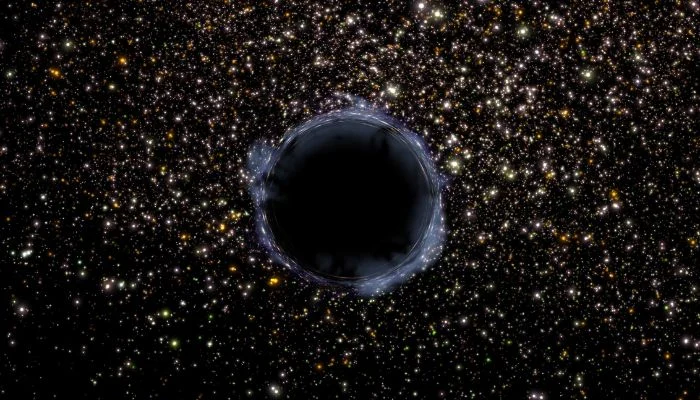
James Webb Space Telescope reveals how black holes feed themselves.
Simulations Tested the Inward Flow
A striking shape in a telescope image does not always reveal how gas truly moves. Two separate structures can sometimes overlap from our viewing angle.
To test their interpretation, the researchers compared the JWST observations with tailored magnetohydrodynamic simulations. These models track gas while accounting for gravity, pressure and magnetic fields.
In the simulation, gas cools from the hot atmosphere surrounding the galaxy. It then condenses into long, narrow filaments.
As the material moves inward, it loses angular momentum. This allows it to approach the galactic center rather than remaining in a wide orbit.
Eventually, the gas joins a rotating circumnuclear disk. The simulated disk closely resembled the structure detected by JWST. Its shape and gas motions also matched the observations.
That agreement strengthened the conclusion that the outer filaments actively supply the central disk. The feature is not merely a static ring of gas near the black hole.
A Self-Regulating Cosmic Recycling System
The findings support a repeating feedback loop.
First, gas cools and forms filaments within the galaxy cluster. Those filaments carry material toward the center. The gas then enters the circumnuclear disk and provides fuel for the supermassive black hole.
As the feeding rate increases, the black hole becomes more active. Jets release energy into the surrounding atmosphere and heat the gas.
This heating reduces further cooling. It may also interrupt the black hole’s food supply for a period.
However, not all the gas leaves the system. Some material remains in the cluster atmosphere. Over time, part of it can cool again and form new filaments.
The cycle then restarts.
This process does not mean that every particle returns to the black hole. Some gas remains hot. Other material may form stars or move away from the central region.
Even so, the JWST black hole feeding cycle shows that black hole activity can help control when and how its next supply of fuel arrives. That is why researchers describe these objects as possible cosmic recyclers.
Why This Discovery Matters
The result offers a clearer model of how supermassive black holes and galaxies evolve together.
Black holes influence the gas needed for star formation. Their jets can prevent too much material from cooling at once. Meanwhile, returning filaments can restart black hole activity.
This balance helps regulate both the galaxy and the surrounding cluster atmosphere.
Researchers have also identified a similar central structure in NGC 1275, the dominant galaxy of the Perseus Cluster. The presence of comparable systems suggests that this feeding mechanism may occur in other massive cluster galaxies.
The discovery may also improve models of black hole growth in the early universe. Astronomers have found enormous black holes less than one billion years after the Big Bang.
The new observations do not fully explain how those early objects formed so quickly. However, repeated feeding episodes could help black holes sustain their growth for longer periods.
Conclusion
The JWST black hole feeding cycle reveals a system built around cooling, inflow, activity and renewed cooling. In NGC 4696, Webb connected large gas filaments to a rotating disk near a supermassive black hole.
That connection closes an important gap in the feedback model. Black holes may heat their surroundings, pause their own feeding and later regain some of that material.
Rather than acting as simple one-way consumers, supermassive black holes appear to maintain a dynamic relationship with their galaxies. Future JWST observations will show how common this cosmic recycling process may be.
Main Sources:
Université de Montréal:
https://nouvelles.umontreal.ca/en/article/2026/07/09/how-do-supermassive-black-holes-feed-themselves
Original research paper:
https://arxiv.org/abs/2606.06620
ScienceDaily article:
https://www.sciencedaily.com/releases/2026/07/260718010156.htm