BY:SpaceEyeNews.
A new JWST black hole feeding discovery may have revealed how supermassive black holes maintain their fuel supply. The James Webb Space Telescope traced cool gas moving through a vast filament toward the center of NGC 4696. There, the material joins a rapidly rotating disk around the galaxy’s central black hole.
The finding offers a rare view of the route gas may follow before reaching a supermassive black hole. It also supports a long-standing idea. Black holes may help regulate a repeating cycle of heating, cooling and renewed feeding.
Researchers observed the center of NGC 4696 using Webb’s Near-Infrared Spectrograph, or NIRSpec. Their results appeared in The Astrophysical Journal Letters. The work connects large gas filaments with a smaller central disk for the first time in this system.
JWST Black Hole Feeding Discovery Targets NGC 4696
NGC 4696 is the dominant galaxy in the Centaurus Cluster. It lies about 145 million light-years from Earth.
The galaxy provides an ideal setting for studying black hole feedback. Its central supermassive black hole produces jets that transfer energy into the surrounding hot atmosphere. Meanwhile, a complex network of cooler gas filaments stretches across the galaxy.
Astronomers have studied those structures for years. Earlier observations from the Hubble Space Telescope revealed an unusual S-shaped swirl near the galactic center.
However, Hubble mainly showed the gas distribution. It could not provide a complete velocity map of the structure. Researchers therefore could not confirm whether the swirl was a stream, a disturbed filament or a rotating disk.
Webb changed that picture.
NIRSpec Maps Gas Near the Black Hole
The research team observed NGC 4696 for about 7.7 hours using Webb’s NIRSpec Integral Field Unit. The observations covered the inner region around the black hole at a resolution of about 10 parsecs, or roughly 30 light-years.
NIRSpec does more than capture a conventional image. It separates infrared light into individual wavelengths. This allows astronomers to examine the chemical fingerprints of gas and measure how quickly it moves.
Changes in wavelength reveal whether gas is travelling toward or away from Earth. By mapping those changes across the center of NGC 4696, the team reconstructed the movement of the glowing material.
Therefore, Webb did not photograph gas crossing the black hole’s event horizon. Instead, it produced a detailed map of the gas supply system around the black hole.
That distinction is important. The observations trace material moving toward the central region, but they do not follow individual particles into the black hole itself.
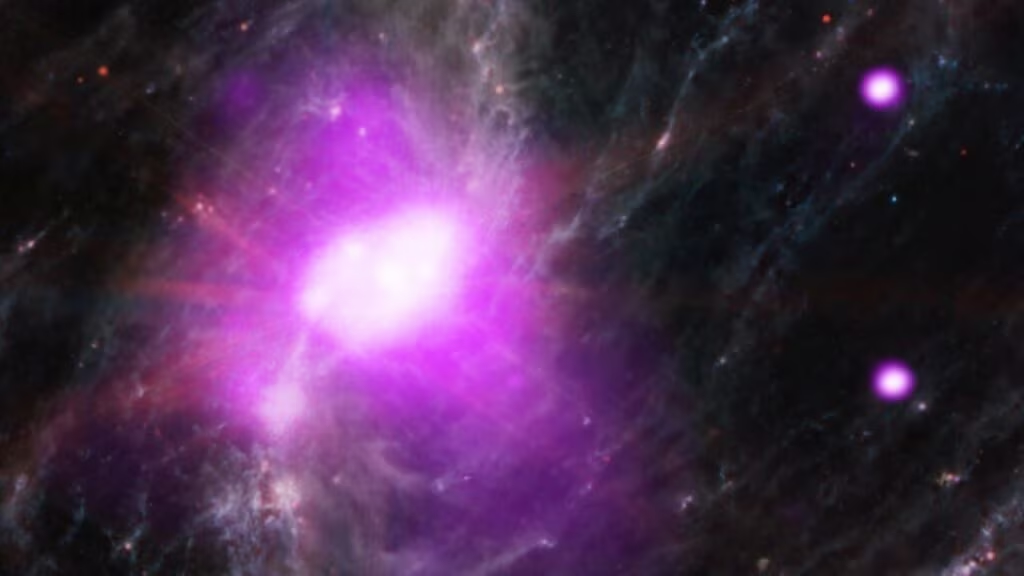
NASA captures supermassive black hole 2 million times heavier than Sun inside galaxy.
The S-Shaped Structure Is a Rotating Disk
Webb’s velocity measurements revealed that the S-shaped swirl is a rotating circumnuclear disk.
The structure measures about 250 parsecs, or nearly 800 light-years, across. Gas within the disk reaches projected speeds of up to about 600 kilometres per second. One side moves in a different direction from the other, confirming organized rotation around the galactic center.
This disk acts as an intermediate reservoir. It collects gas arriving from larger galactic scales and may help move that material closer to the supermassive black hole.
The disk also contains gas in several physical states. Astronomers describe it as multiphase because the material spans different temperatures and conditions.
Identifying the disk solves only part of the puzzle. Researchers also needed to know where its gas came from.
Webb found a likely answer.
A Giant Gas Filament Feeds the Central Disk
The most important result comes from the disk’s connection to a much larger filament.
The NIRSpec maps show that the circumnuclear disk is physically and kinematically linked to the wider filament system. In other words, the structures connect both in position and motion.
Gas appears to travel along a western filament toward the central region. Its velocity then joins the movement of the rotating disk. The research team argues that the flow moves mainly inward, rather than away from the black hole.
That connection provides a missing link between two very different scales.
Astronomers have already detected cool filaments stretching for thousands of light-years. They have also observed compact disks near active black holes. Yet directly connecting those structures has remained difficult.
The JWST black hole feeding discovery now shows how a large cooling filament may deliver material into the smaller disk surrounding the black hole.
Still, the finding requires careful wording. Webb traced gas into the circumnuclear disk. It did not directly observe the final plunge across the event horizon.
The Black Hole May Recycle Its Fuel
The observation supports a self-regulating process known as active galactic nucleus feedback.
First, activity near the black hole powers energetic jets. Those jets inject heat into the surrounding gas. This process can prevent too much material from cooling at once. It can also reduce excessive star formation in the galaxy.
However, the heating does not permanently remove every potential fuel source.
Some gas eventually loses energy and cools. It then condenses into long, narrow filaments. Portions of those filaments can move back toward the galactic center.
The gas may then enter a rotating disk, lose more angular momentum and travel closer to the black hole. Renewed feeding can power another active period and produce fresh jets.
As a result, the black hole may help create the conditions that provide its future fuel.
The word “recycling” does not mean matter escapes after entering the black hole. Nothing observed has returned from beyond the event horizon. Instead, the cycle involves gas in the surrounding galaxy. The black hole heats that gas, while some of it later cools and flows inward again.
Simulations Support the Feeding Process
The researchers compared Webb’s observations with tailored magnetohydrodynamic simulations.
These computer models included gas cooling, motion and magnetic fields. The simulated systems produced narrow filaments that condensed from a hot atmosphere. The gas then lost angular momentum and moved toward a rotating central disk.
The simulated shapes and velocities closely resembled the structures observed in NGC 4696.
Magnetic fields may play an important role in this process. They could guide cool gas while helping it shed some rotational motion. That would make it easier for the material to approach the galactic center.
However, one observation cannot prove that every supermassive black hole follows the same feeding pattern. Researchers must study more galaxies with comparable detail.
Why the JWST Discovery Matters
Black hole feedback plays a major role in models of galaxy evolution.
Jets from active black holes can influence gas cooling, star formation and the long-term growth of massive galaxies. Yet scientists have lacked a clear view of how fuel travels from large galactic structures into the black hole’s immediate surroundings.
Webb may now have captured that connection.
The study also notes a similar arrangement in NGC 1275, the central galaxy of the Perseus Cluster. Together, the two systems suggest that filament-fed circumnuclear disks could represent a common process in massive cluster galaxies.
Future Webb observations can test that possibility. They may reveal whether this feeding cycle appears across many active galaxies or only under certain conditions.
Conclusion: Webb Reveals a Route Toward the Black Hole
The JWST black hole feeding discovery does not show matter disappearing through an event horizon. Instead, it reveals something equally valuable: a likely route that gas follows toward a supermassive black hole.
Webb connected a large cooling filament to an 800-light-year-wide rotating disk inside NGC 4696. That link supports a self-regulating cycle in which black hole activity heats gas, some gas later cools, and part of it returns toward the center.
The result provides a major new piece of the black hole feedback puzzle. It may also help explain how galaxies and their central black holes evolve together over cosmic time.
Main Sources:
Université de Montréal:
https://nouvelles.umontreal.ca/article/2026/07/09/astronomie-comment-s-alimentent-les-trous-noirs-supermassifs
Published research preprint:
https://arxiv.org/abs/2606.06620
Full study text:
https://arxiv.org/html/2606.06620v1
ScienceDaily report:
https://www.sciencedaily.com/releases/2026/07/260716023601.htm