
BY:SpaceEyeNews.
The James Webb Space Telescope has found an object that could reshape ideas about the universe’s earliest giant black holes. The source, named MoM-BH*-1, existed only 660 million years after the Big Bang.
Researchers describe it as a JWST black hole star. However, it is not a conventional star with a black hole inside it. Instead, the object may contain a growing black hole wrapped in an exceptionally dense envelope of gas. That structure could reveal how black holes gained mass at remarkable speed during cosmic dawn.
JWST Black Hole Star Emerges at Cosmic Dawn
The international Mirage or Miracle survey selected MoM-BH*-1 because it appeared unusually bright, compact and red in Webb images. Follow-up spectroscopy confirmed a redshift of 7.7569. Therefore, astronomers see the object as it appeared when the universe was still very young.
Webb observed the source with its NIRCam, MIRI and NIRSpec instruments. Radiation from the central object appears to dominate the observed light. Its faint host galaxy contributes relatively little, as detailed in the peer-reviewed Nature study.
The Spectrum Behind the Black Hole Star Model
MoM-BH*-1 attracted attention because its spectrum combines features associated with stars and active black holes. The most striking feature is an enormous Balmer break.
A Balmer Break Beyond Ordinary Stars
Stellar populations can produce a Balmer break, but MoM-BH*-1 pushes far beyond normal expectations.
Using the study’s chosen wavelength windows, the team measured a break strength of about 7.7. Typical dust-free stellar populations should remain near or below three. Even a population dominated by A-type stars would struggle to reach five.
The source also shows broad hydrogen-beta emission alongside deep hydrogen-beta and hydrogen-gamma absorption. This combination does not fit an ordinary stellar population. Its broad emission and compact shape instead suggest an active black hole.
Researchers also found a possible 30% brightening over roughly two rest-frame months. That variability could support the black hole interpretation. However, different instruments recorded the measurements, so the result remains tentative.
How Dense Gas Changes Its Appearance
The research team tested almost one million simplified spectral models. Its preferred model places an accreting black hole inside dense, turbulent hydrogen gas.
In that model, the surrounding envelope extends roughly 10 to 100 astronomical units. The best-fitting version uses a hydrogen density near 100 billion particles per cubic centimeter.
The gas absorbs, scatters and reprocesses radiation from the black hole. As a result, the system develops a star-like spectrum and a remarkably deep Balmer break. The envelope acts somewhat like a stellar atmosphere, although a black hole supplies the energy.
Crucially, heavy dust does not appear to cause the red color. The model requires only slight dust attenuation. Dense gas changes the escaping light and makes the source appear red. MIT News describes this structure as a dense gas cocoon powered by a central black hole.
These values come from an idealized model, not direct measurements of the envelope. The Nature paper explicitly describes the calculation as simplified. More realistic models must test the proposed structure.
A Possible Route to Rapid Black Hole Growth
Astronomers already know of billion-solar-mass black holes that existed within the universe’s first 700 million years. Their early appearance leaves limited time for smaller seeds to grow through standard accretion.
The JWST black hole star may show how some seeds accelerated that process. A thick gas envelope can trap or redistribute radiation near a growing black hole. Gravity may then continue pulling material inward despite radiation pressure.
This process could support super-Eddington accretion, meaning growth faster than the conventional radiation-pressure limit suggests. Yet Webb did not directly measure a super-Eddington rate in MoM-BH*-1.
The object may currently experience a rapid feeding episode. Alternatively, astronomers could be seeing the remaining envelope after such an episode ended. Either possibility makes MoM-BH*-1 a valuable test case rather than a complete solution.
Its mass also remains uncertain. Different assumptions about gas scattering and emission-line widths produce estimates that differ by orders of magnitude. The paper warns that standard methods may significantly overestimate black hole masses in similar sources.
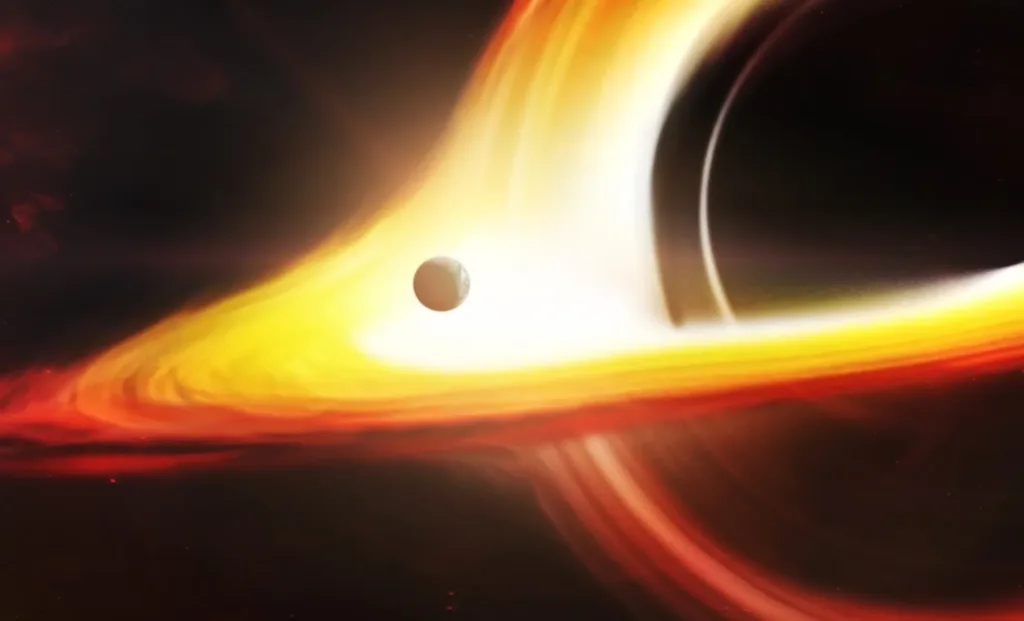
How does a supermassive blackhole form? JWST found a POSSIBLE ANSWER.
JWST Black Hole Star Connection to Little Red Dots
Webb has discovered numerous compact red sources known as little red dots. Their true nature remains one of the telescope’s most active research questions.
MoM-BH*-1 offers a relatively clean template for their central engines. Its black hole candidate outshines most of its host galaxy. Many little red dots, by contrast, combine light from a central source and surrounding stars.
A brighter galaxy lies about 60 projected kiloparsecs from MoM-BH*-1 at nearly the same redshift. Models suggest the two systems could merge in about 100 million years. When researchers combined their spectra, the result closely resembled a typical little red dot.
That match suggests some little red dots may contain black hole stars inside young galaxies. It does not prove that every red dot shares this structure. The Institute of Science and Technology Austria describes these objects as possible central engines of young quasars.
What Astronomers Must Confirm Next
Researchers now need more examples at similar redshifts. Repeated observations could confirm variability and improve estimates of the black hole’s mass.
Deeper X-ray, radio and submillimeter observations may also test the dense-envelope model. MoM-BH*-1 currently lacks an X-ray detection, although thick gas could absorb that radiation.
Scientists must also determine how frequently these objects occur. Their abundance will show whether they represent a common growth stage or a rare cosmic configuration.
Conclusion: JWST Black Hole Star Offers a Missing Stage
The JWST black hole star does not yet solve the origin of the first supermassive black holes. Still, MoM-BH*-1 provides a credible view of conditions that could support unusually rapid growth.
Its dense gas, extreme spectrum and possible connection to little red dots make it a strong candidate for a missing evolutionary stage. Future Webb observations will reveal whether this object is exceptional or part of a wider early-universe population.
Main Sources:
Nature: https://www.nature.com/articles/s41586-026-10846-4
Institute of Science and Technology Austria: https://ista.ac.at/en/news/black-hole-star-mirage-or-miracle/