BY:SpaceEyeNews.
Introduction: JWST Buckyballs Dying Star Discovery Changes the Picture
The JWST buckyballs dying star discovery reveals a scene that feels almost unreal. Roughly 10,000 light-years away, a fading Sun-like star has left behind a glowing nebula filled with strange carbon molecules. Within this cloud, a curious structure shaped like an upside-down question mark stands out.
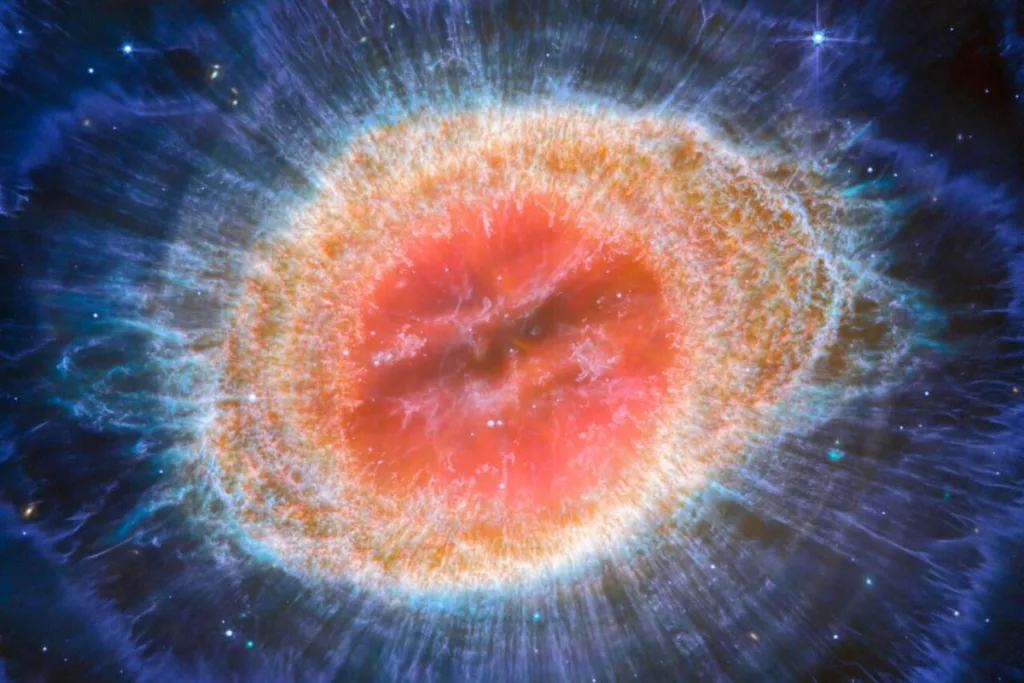
Captured by the James Webb Space Telescope, the image offers more than visual beauty. It provides the clearest view yet of how complex molecules behave in the aftermath of stellar evolution. Earlier observations hinted at these structures, but never with this level of clarity.
Now, scientists can trace how these molecules form, move, and interact with their environment. Yet the deeper they look, the more the mystery grows. The JWST buckyballs dying star system does not simply confirm existing theories. It challenges them.
JWST Buckyballs Dying Star: A Closer Look at Tc 1 Nebula
A Stellar Ending in Motion
At the center of this discovery lies the Tc 1 Nebula. This nebula formed when a Sun-like star reached the end of its life and expelled its outer layers into space. What remains is a compact white dwarf, radiating energy that illuminates the surrounding gas.
Those expanding shells tell a dynamic story. They are not static remnants. Instead, they continue to evolve, shaped by radiation, temperature shifts, and density changes.
JWST’s Infrared Advantage
This is where JWST changes everything. Its mid-infrared instruments reveal details that older observatories could not detect. By observing wavelengths between 5.6 and 25.5 microns, the telescope maps temperature gradients and chemical variations across the nebula.
Each color in the image corresponds to a physical condition. Hotter regions appear in cooler tones, while cooler gas glows in deeper reds. This layered view allows scientists to read the nebula almost like a map.
A Structure That Defies Expectation
One feature continues to draw attention. The nebula displays an unusual shape that resembles an upside-down question mark. No current model fully explains its origin.
This detail underscores a larger point. The JWST buckyballs dying star system is not just a refined observation. It reveals patterns and structures that existing theories did not predict.
JWST Buckyballs Dying Star and the Role of Carbon Molecules
A Unique Form of Carbon
At the heart of this discovery are the remarkable molecules known as Buckminsterfullerene. These hollow carbon spheres resemble tiny soccer balls, built from a precise arrangement of atoms.
Their symmetry makes them stable, yet their origin in space remains uncertain.
A Link to Cosmic Chemistry
Buckyballs belong to a wider family of organic compounds tied to complex carbon chemistry. These compounds appear in environments that range from interstellar clouds to star-forming regions.
Their presence suggests that the chemistry associated with life does not begin on planets alone. Instead, it may start in the extreme environments created by stars.
From Detection to Understanding
Earlier missions detected buckyballs, but only as faint signals. Now, JWST reveals their structure and behavior in detail. Scientists can observe how these molecules respond to radiation, temperature, and surrounding density.
This shift marks a turning point. Detection alone is no longer enough. Researchers can now study how these molecules evolve over time.
A Widespread Yet Elusive Presence
Despite appearing across many cosmic environments, buckyballs remain rare in planetary nebulas. This contrast adds another layer of complexity.
The JWST buckyballs dying star discovery shows that presence alone does not explain formation. Something in these environments either enables or suppresses their creation.
JWST Buckyballs Dying Star Mystery: What Remains Unsolved
A Rare Phenomenon
Among hundreds of known planetary nebulas, only a small number contain detectable buckyballs. This rarity stands in contrast to their presence in other cosmic settings.
Why they appear in some systems but not others remains unclear.
Layers Within Layers
JWST observations reveal that these molecules form a distinct shell around the white dwarf. In some regions, the arrangement mirrors the spherical structure of the molecules themselves.
This pattern hints at an organized formation process. Yet no current model fully reproduces it.
Unexpected Light Signatures
The mystery deepens when scientists analyze the emitted light. The infrared signals do not match theoretical predictions.
This mismatch suggests that key processes are missing from current models. It may reflect unknown reactions or incomplete laboratory data.
Searching for Answers
Researchers are now exploring several possibilities. Light-driven chemistry may play a central role. Variations in radiation fields could also influence how these molecules form and behave.
Each new observation adds detail. At the same time, it highlights how much remains unknown.
JWST Buckyballs Dying Star: From Stellar Death to Cosmic Origins
A Chemical Engine in Space
The JWST buckyballs dying star discovery reframes how we view stellar death. These environments are not just endpoints. They are active sites of chemical transformation.
As stars shed their outer layers, they create conditions where complex molecules can emerge.
Implications Beyond One Nebula
Because buckyballs connect to organic chemistry, their presence carries broader meaning. It suggests that the ingredients for life may form in diverse and extreme environments.
This perspective expands the search for life beyond planets and into the wider cosmos.
A Future Written in Light
Our Sun will follow a similar path billions of years from now. It will create its own planetary nebula and leave behind a white dwarf.
In that distant future, processes like those seen in Tc 1 may unfold within our own system.
The Next Phase of Discovery
JWST will continue to observe similar nebulae under different conditions. By comparing these environments, scientists aim to understand how radiation shapes molecular evolution.
Each new dataset brings us closer to solving the puzzle.
Conclusion: A Discovery That Expands the Unknown
The JWST buckyballs dying star discovery does more than reveal a striking nebula. It opens a new chapter in our understanding of cosmic chemistry.
For the first time, scientists can map the environment where these complex carbon molecules exist. Yet the results challenge existing theories rather than confirm them.
This tension is what makes the discovery so powerful. It shows that the universe still holds processes we do not fully grasp.
As observations continue, this system may provide the missing link between stellar evolution and the chemistry that underpins life itself.
Main Sources:
- https://www.space.com/astronomy/stars/james-webb-space-telescope-peers-into-a-dying-star-surrounded-by-mysterious-buckyballs-the-structures-were-seeing-now-are-breathtaking
- https://www.nasa.gov
- https://www.esa.int