
BY:SpaceEyeNews.
A Discovery That Should Not Exist
JWST finds a stellar bar in one of the most distant and unusual galaxies ever studied, and astronomers are now rethinking how galaxies evolved in the early universe.
The galaxy, known as GN20, appears as it existed only 1.5 billion years after the Big Bang. At that stage of cosmic history, researchers expected galaxies to be chaotic, gas-rich systems that had not yet developed many of the organized structures commonly seen today.
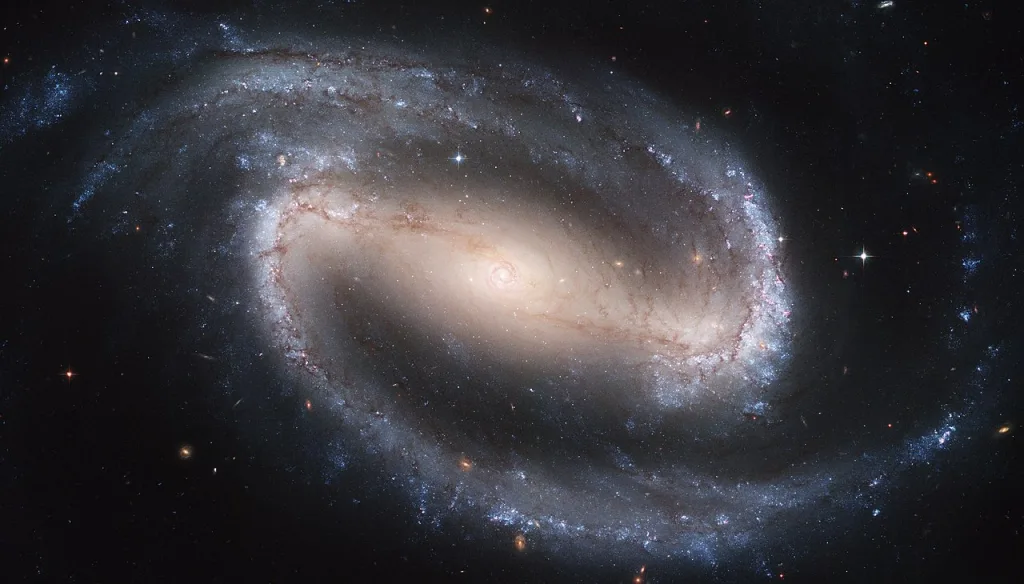
Instead, observations from the James Webb Space Telescope revealed something unexpected. GN20 contains a large stellar bar stretching across its central disk. The discovery is surprising because current models suggest that structures like this should require much more time to form.
Even more remarkable, GN20 is filled with gas and dust. Scientists long believed that such conditions would slow down or even prevent the development of strong stellar bars.
The new findings suggest that the early universe may have produced mature galactic structures far sooner than astronomers predicted.
JWST Finds a Stellar Bar Inside GN20
Looking Through the Dust
GN20 sits at a redshift of 4.055. It ranks among the most active star-forming galaxies ever observed.
For years, astronomers knew the galaxy contained enormous amounts of gas and dust. Those same materials also hid its internal structure from view.
That changed with JWST.
Using the telescope’s Near-Infrared Camera (NIRCam) and Mid-Infrared Instrument (MIRI), researchers were able to peer through the dust and study the galaxy in unprecedented detail.
The observations exposed a clearly defined stellar bar extending roughly seven kiloparsecs, or about 23,000 light-years, from end to end.
Multiple Methods Confirm the Discovery
Researchers did not rely on a single image.
They performed an isophotal analysis, which measures how brightness changes across a galaxy. The results showed a distinct elongated structure consistent with a stellar bar.
The team then applied a completely separate mathematical analysis to verify the finding.
Both approaches produced the same conclusion.
Additional observations from the Northern Extended Millimeter Array, known as NOEMA, revealed a matching bar-shaped structure within the dust distribution.
The alignment between the stellar bar and dust bar strengthened confidence that the feature is real.
Why This Stellar Bar Challenges Existing Theories
A Structure That Arrived Too Early
The discovery creates a problem for traditional galaxy evolution models.
Astronomers generally expected stellar bars to form gradually over billions of years. These structures emerge as stars within a galactic disk settle into stable patterns and begin redistributing mass toward the center.
GN20 should not have had enough time to complete that process.
Yet the galaxy already hosts a large and well-developed bar despite its young age.
That alone makes the discovery noteworthy.
Gas-Rich Galaxies Were Supposed to Resist Bar Formation
A second challenge involves the galaxy’s enormous gas content.
Many theoretical studies suggested that high gas fractions weaken or delay bar formation.
Gas can absorb energy and disrupt the gravitational instabilities needed to build a strong bar.
GN20 appears to ignore that prediction.
Researchers estimate that gas represents a large fraction of the galaxy’s visible matter. Even under those conditions, the stellar bar formed and survived.
The Size Creates Another Puzzle
The bar’s length creates a third mystery.
Large bars require time to grow. Simulations often show gradual expansion over billions of years.
GN20 hosts a bar measuring about seven kiloparsecs across.
Such dimensions resemble bars found in mature galaxies much closer to the present day.
Finding one in a galaxy this young pushes current models beyond their expected limits.
A New Explanation Emerges
Turbulent Gas May Be the Missing Ingredient
The research team believes highly turbulent gas could explain the observations.
Instead of preventing bar formation, turbulent gas may actually help create favorable conditions under certain circumstances.
GN20 contains huge reservoirs of rapidly moving gas spread throughout its inner disk.
That turbulence may allow the galaxy to develop a stable bar much faster than older models predicted.
If correct, the result could resolve all three apparent contradictions at once.
The bar would form early, survive despite the gas-rich environment, and grow to a substantial size within a relatively short period.
Recent Models Predicted This Possibility
Interestingly, several recent theoretical studies hinted that gas-rich galaxies might form bars earlier than previously believed.
Those ideas remained largely untested because astronomers lacked direct observational evidence.
GN20 may now provide that evidence.
The galaxy appears to show exactly the type of environment those newer models described.
As a result, researchers may need to revise some long-standing assumptions about the relationship between gas and galactic structure.
JWST Continues to Reveal Surprisingly Mature Galaxies
A Growing Pattern in the Early Universe
This discovery does not stand alone.
Since beginning science operations, JWST has repeatedly identified galaxies that appear more evolved than expected.
Researchers have found massive galaxies, organized disks, and spiral-like structures at surprisingly early cosmic times.
Many of these discoveries challenge older ideas about how quickly galaxies assembled.
GN20 adds another important example to that growing list.
The stellar bar suggests that complex internal structures also emerged much earlier than anticipated.
Are Early Galaxies More Organized Than We Thought?
The standard picture often portrays early galaxies as messy systems dominated by mergers and turbulence.
JWST observations paint a more nuanced picture.
Some galaxies certainly remained chaotic. Others appear to have developed organized structures with remarkable speed.
GN20 may represent an important transition stage between these two extremes.
If additional examples emerge, astronomers could be forced to rethink how rapidly galactic architecture developed across the young universe.
The Stellar Bar May Power an Extreme Star Factory
Feeding a Nuclear Starburst
The stellar bar does more than challenge theories.
It may also explain why GN20 forms stars at such an extraordinary rate.
The observations indicate that the bar channels gas toward the center of the galaxy.
As material accumulates, it fuels intense star formation activity.
Researchers estimate that GN20 produces more than 1,000 solar masses worth of stars every year.
For comparison, the Milky Way forms only a few solar masses annually.
That makes GN20 one of the most productive stellar nurseries known.
Fueling a Growing Black Hole
The inward flow of gas may also feed a central supermassive black hole.
Astronomers have not yet confirmed every detail of the central region. However, evidence suggests that an active galactic nucleus could be present.
If so, the stellar bar may provide the mechanism that transports material toward the black hole.
This process appears in many nearby galaxies today.
Finding it in such an early system would extend that evolutionary pathway much farther back in time.
Could GN20 Explain the Origin of Giant Dead Galaxies?
One of astronomy’s biggest mysteries involves massive elliptical galaxies that stopped forming stars surprisingly early.
Scientists know these galaxies exist. What remains unclear is how they exhausted their gas so quickly.
GN20 may offer an answer.
The stellar bar appears capable of driving enormous amounts of gas toward the galaxy’s center.
That process can trigger powerful bursts of star formation.
Over time, those bursts consume available fuel.
Once the gas supply runs low, star formation declines and the galaxy becomes quiescent.
Researchers believe this mechanism could help explain how some giant galaxies evolved into inactive systems much earlier than expected.
In that sense, GN20 may represent a crucial stage in galactic evolution rather than an isolated curiosity.
Conclusion
JWST finds a stellar bar in GN20 at a time when current theories suggest such a structure should barely exist. The discovery challenges assumptions about how quickly galaxies mature, how gas influences bar formation, and how large stellar bars develop.
More importantly, the observations provide a possible explanation for the intense star formation occurring inside GN20 and may help solve the mystery of how massive galaxies shut down star formation so early in cosmic history.
As JWST continues exploring the distant universe, discoveries like GN20 suggest that galaxy evolution may have progressed much faster and in far more complex ways than astronomers once imagined.
Main Sources:
Phys.org:
https://phys.org/news/2026-05-jwst-stellar-bar-early-universe.html
arXiv Preprint:
https://arxiv.org/abs/2605.15273
James Webb Space Telescope:
https://webb.nasa.gov