BY:SpaceEyeNews.
Introduction — JWST First Stars Discovery Changes Everything
The JWST first stars discovery may mark one of the most important breakthroughs in modern astronomy. For the first time, astronomers have compelling observational evidence pointing to the universe’s earliest stars, known as Population III stars. These objects have remained theoretical for decades.
Now, observations from the James Webb Space Telescope reveal a signal that closely matches the predicted chemical fingerprint of these primordial stars. Independent teams confirmed the result using different methods. That convergence adds weight to the finding.
This is not just another distant observation. It is a direct glimpse into the moment when the universe began building complexity.
JWST First Stars Discovery Near GN-z11
A Metal-Free Signature Near GN-z11
The JWST first stars discovery centers on a faint object near GN-z11, one of the most distant galaxies ever observed. At first, the object appeared subtle. Its spectrum changed everything.
JWST data revealed emission lines from hydrogen and helium only. Heavier elements were completely absent. In astronomy, those heavier elements are called metals, and their absence is extremely rare.
This clean chemical signature aligns precisely with predictions for Population III stars. These stars formed from primordial gas left behind after the Big Bang, composed only of hydrogen and helium.
Why the Absence of Metals Matters
Every known star formed after the first generation contains traces of heavier elements. Those elements came from earlier stars and spread across space over time. As a result, modern stellar systems always show some level of chemical enrichment.
The object near GN-z11 breaks that pattern. Its pure composition suggests it formed in an environment untouched by earlier star activity. That makes it one of the strongest candidates ever identified for hosting the universe’s first stars.
This absence of metals is the defining signal behind the JWST first stars discovery.
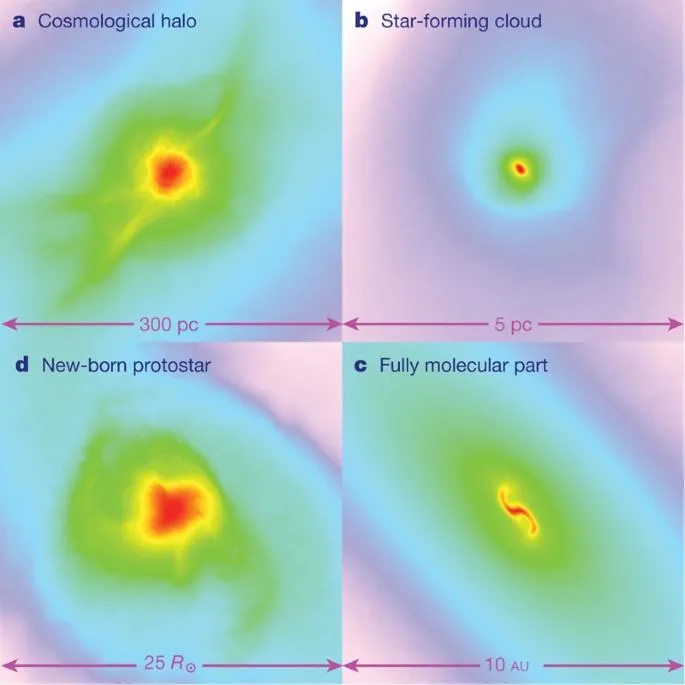
The Formation of the first stars and galaxies.
Independent Confirmation Strengthens the JWST First Stars Discovery
Two Teams, One Result
Scientific confidence increases with independent verification. In this case, multiple research teams analyzed the same region using different techniques. One group identified strong helium emission. Another confirmed hydrogen emission from the same location.
Both analyses reached the same conclusion. The object shows only hydrogen and helium. This agreement reduces uncertainty and strengthens the overall case.
From Theory to Observational Evidence
For decades, Population III stars existed only in models. Theoretical work predicted their properties based on early universe conditions. Direct evidence remained elusive.
The JWST first stars discovery shifts that narrative. It moves the field from expectation to observation. While further confirmation is still required, this represents the strongest evidence to date.
What the First Stars Were Really Like
Massive, Hot, and Short-Lived Stars
The JWST first stars discovery also sheds light on the nature of these early stars. Evidence suggests they were significantly more massive than stars like the Sun. Their size allowed them to burn hotter and emit intense ultraviolet radiation.
These stars likely lived short lives. Instead of lasting billions of years, they may have existed for only a few million years before evolving rapidly.
Why Early Stars Grew So Large
The absence of heavy elements shaped how these stars formed. Metals allow gas to cool and fragment into smaller clumps. Without metals, gas clouds stay warmer and collapse into larger structures.
This process leads to a top-heavy distribution of stellar masses. The JWST first stars discovery provides observational support for this long-standing prediction.
Why GN-z11 Remains a Key Target
A Window Into the Early Universe
GN-z11 offers a unique view into the early universe. Its extreme distance allows astronomers to observe conditions from only a few hundred million years after the Big Bang.
This timing makes it an ideal environment for studying primordial star formation. The JWST first stars discovery benefits directly from this perspective.
A Rare Pristine Environment
The companion object appears to be a small region that avoided chemical enrichment. Its isolation may have preserved the original conditions needed to form Population III stars.
This raises new questions. Did the first stars form mainly near early galaxies, or were they spread more widely across space? Current data does not yet provide a clear answer.
JWST First Stars Discovery and the Bigger Cosmic Puzzle
The Link to Early Black Holes
The JWST first stars discovery connects to another major question in cosmology. Observations show that massive black holes formed surprisingly early.
Population III stars may explain this. Their large masses could lead to rapid collapse into black holes. Over time, these objects could grow into the supermassive black holes seen in early galaxies.
Connections to Other JWST Discoveries
JWST has already revealed unexpected features in the early universe. These include unusually bright galaxies and compact objects often referred to as “little red dots.”
Some models suggest that extremely massive early stars could explain these observations. However, their short lifetimes create challenges for this interpretation.
The JWST first stars discovery adds a crucial piece to this puzzle. It provides real data that helps refine existing models.
What Scientists Still Need to Confirm
Despite its significance, the discovery remains under investigation. Only one strong candidate region has been identified so far.
Future observations will search for similar metal-free signatures in other regions. Repeated detections would strengthen the case for Population III stars.
Alternative explanations also remain possible. Scientists will continue testing these scenarios as more data becomes available.
From Prediction to Reality
Detecting the first stars has always been a central goal of JWST. The telescope was designed to observe the earliest sources of light in the universe.
The JWST first stars discovery shows that this goal is now within reach. Strong spectral data, independent confirmation, and alignment with theory combine to form a compelling case.
This marks a transition in how astronomers explore the early universe. Direct observation is now replacing long-standing assumptions.
Conclusion — Witnessing the Universe’s First Light
The JWST first stars discovery brings us closer to understanding the universe’s earliest moments. These first stars shaped everything that followed. They created the first heavy elements. They influenced the formation of galaxies and black holes.
Now, for the first time, we may be seeing evidence of them directly.
As JWST continues its mission, new discoveries will follow. Each one will sharpen our view of the early cosmos. The question now is simple.
If we are finally seeing the first stars, what else is still hidden in the universe’s earliest light?
Sources:
- https://spacedaily.com/sd-n-jwst-may-have-finally-found-the-universes-first-stars-and-the-evidence-is-stronger-than-anything-before/
- https://www.nasa.gov/mission_pages/webb/main/index.html
- https://www.esa.int/Science_Exploration/Space_Science/Webb