
BY:SpaceEyeNews.
The JWST planet formation study has revealed a critical deadline around young stars. Giant planets must collect their thick atmospheres while enough gas remains available. Yet the same young systems steadily expel that material through jets and winds. By examining 72 planet-forming disks, astronomers have now traced how those gas-removal processes change over time. The results show that planetary construction and disk dispersal happen together. For Jupiter-like worlds, timing may determine whether they become giants at all.
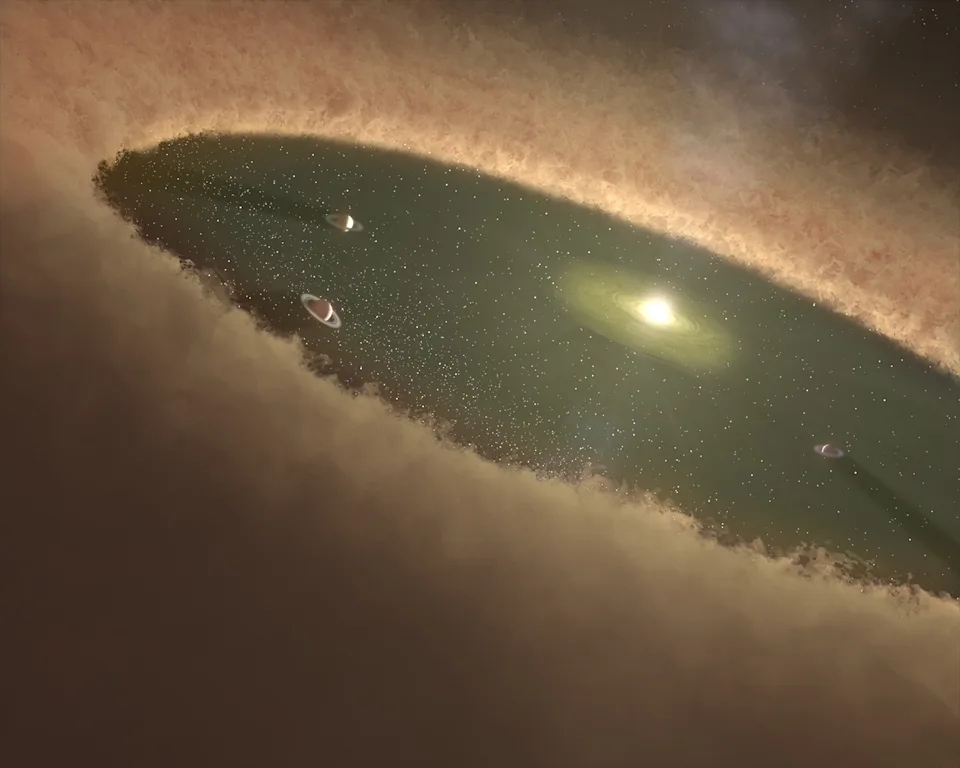
An illustration of an evolved protoplanetary disk in which material close to the infant star has been dispersed | Credit: NASA/ JPL-Caltech/ T. Pyle (SSC).
JWST Planet Formation Study Examines 72 Young Systems
The research team analyzed archival observations from the James Webb Space Telescope’s Mid-Infrared Instrument, or MIRI. The sample included 72 inclined, mostly Class II disks around young, mainly Sun-like stars.
These were not 72 newly discovered planets. Instead, the targets were young stellar systems at different stages of disk evolution. Researchers combined those snapshots to build a statistical timeline. It works like arranging still frames from separate systems into one broad evolutionary sequence.
The team searched for two important gas signatures: molecular hydrogen and ionized neon. Molecular hydrogen can trace broad winds flowing away from a disk. Ionized neon can reveal fast jets and slower atomic winds.
This method gave astronomers a detailed view of material leaving young systems. It also allowed them to compare gas loss with the rate at which disk material falls onto each star.
Early Planet-Forming Disks Produce Strong Jets and Winds
Young stars begin this sequence while they are still actively gathering material. Their surrounding disks contain magnetic fields that can guide gas outward. This creates narrow jets as well as wider disk winds.
The study found a clear connection between these outflows and accretion. Systems with higher accretion rates showed more molecular-hydrogen winds and ionized-neon jets. That pattern supports a magnetically driven origin during the early phase.
The University of Arizona reports that gas in these outflows can travel at roughly 10 to 100 miles per second. The winds remove mass from the disk. They also carry away angular momentum, which affects how material moves through the system.
Molecular Hydrogen Reveals a Missing Piece
Before JWST, astronomers could not directly examine warm molecular hydrogen with the same detail across such a large sample. Earlier research predicted that young systems should produce dense molecular winds. Those winds could even block X-rays from reaching the disk during the most active stage.
MIRI allowed the team to trace this hydrogen directly. The observations therefore connect earlier theoretical predictions with visible structures around dozens of young stars.
Disk Winds Change as Young Systems Mature
The JWST planet formation study found that disk dispersal does not follow one unchanging process. The dominant outflows evolve as accretion slows.
During the earlier stage, molecular and atomic winds appear alongside strong jets. As the system matures, those jets weaken. The hottest molecular-wind signatures also become less common. Eventually, the remaining winds become mainly atomic.
Radiation Gains Influence Later
As the disk and its surrounding winds thin, more high-energy radiation can reach the remaining gas. Ultraviolet light and X-rays heat that material. Some gas then escapes through a process called photoevaporation.
This does not mean that one mechanism suddenly stops and another instantly starts. The observations instead suggest a gradual transition. Magnetically driven outflows dominate active, high-accretion systems. Atomic winds, including photoevaporative winds, become more important at lower accretion rates.
Researchers still need to measure each mechanism’s exact contribution. Therefore, the study identifies an evolutionary pattern rather than one universal clearing schedule.
The Observations Reveal a Strong Pattern
The numbers make that pattern difficult to overlook. Researchers detected extended molecular-hydrogen or ionized-neon emission in 66 of the 72 disks.
They identified conical molecular-hydrogen winds in 46 systems. They also found high-velocity ionized-neon jets in 40. Every system with a neon jet displayed an associated wind. Molecular hydrogen traced about 85% of those accompanying winds, while oxygen traced the remainder.
The team also found that jets and molecular winds appeared more often around stronger accretors. Lower-accretion systems more commonly displayed slower atomic winds. Together, these results link several gas signatures within a single evolutionary sequence.
The sample does have limits. It mainly includes inclined disks because their geometry makes extended outflows easier to separate from the disk. Even so, the team found no dependence between its detection rates and disk inclination or stellar mass within the sample.
Giant Planets Must Build Atmospheres Before Gas Disappears
This transition creates a deadline for gas-rich planets. Worlds like Jupiter and Saturn need enormous gas reservoirs to form their atmospheres. If disk winds remove that supply too early, a growing planet may remain smaller.
Rocky planets face different conditions because they do not need comparable hydrogen-rich envelopes. The timing of disk dispersal could therefore help explain why planetary systems develop very different arrangements.
However, JWST did not watch individual planets grow in these observations. The researchers studied the changing environments that control their formation. They also did not establish one exact deadline for every gas giant. Disk properties and stellar activity differ from system to system.
What This Means for Our Solar System
The young Sun likely passed through a similar sequence. Strong magnetic outflows may have shaped its disk first. Gentler atomic winds then cleared much of the remaining gas.
That timing could have influenced when Jupiter and Saturn acquired their atmospheres. It may also have changed how much material remained available across the solar system. Still, this study does not directly reconstruct our system’s early history. It provides a broader framework for interpreting it.
JWST Planet Formation Study Opens the Next Investigation
The JWST planet formation study reveals that planets grow while their supply of material is already disappearing. It also shows how gas loss shifts from strong jets and molecular winds toward mainly atomic outflows.
Scientists must now determine how much gas each mechanism removes and where those winds begin within the disk. Those measurements could reveal how quickly the formation window closes. They may also show which disk regions can still produce rocky worlds, ice giants, or Jupiter-like planets before the gas runs out.
Main Sources:
The Astronomical Journal — “JWST/MIRI Reveals the Evolution from Molecular to Atomic Disk Winds”
https://doi.org/10.3847/1538-3881/ae9089
University of Arizona News — “Planet formation is a ‘race against time,’ according to new U of A research”
https://news.arizona.edu/news/planet-formation-race-against-time-according-new-u-research
SETI Institute — “JWST Reveals a Race Against Time for Forming Planets”
https://www.seti.org/news/jwst-reveals-a-race-against-time/
Space.com — “James Webb Space Telescope observes 72 stars and finds planet formation is a race against time”
https://www.space.com/astronomy/james-webb-space-telescope/james-webb-space-telescope-observes-72-stars-and-finds-planet-formation-is-a-race-against-time