BY:SpaceEyeNews.
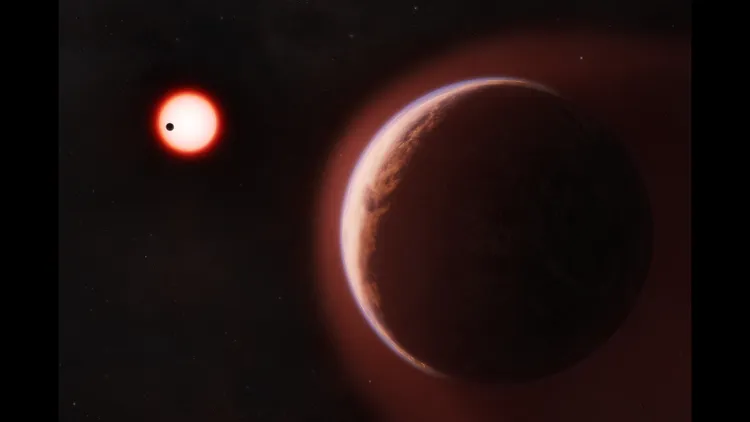
Astronomers have detected the strongest evidence yet for an atmosphere around LHS 1140 b, a planet in its star’s habitable zone. The LHS 1140 b atmosphere revealed itself through helium escaping high above the planet. Researchers describe the result as the first clear atmospheric detection around a rocky world in such a temperate orbit. The discovery does not prove life or oceans. However, it gives astronomers a promising world that is rocky, temperate and able to retain gas.
LHS 1140 b Atmosphere Revealed by Escaping Helium
The new study, published in Science, reports near-infrared observations of LHS 1140 b. The team used the WINERED spectrograph on the Magellan Clay Telescope in Chile.
Researchers watched the planet cross its small red dwarf star. During that transit, some starlight passed through gas surrounding the planet. Helium absorbed a narrow set of wavelengths and left a recognizable fingerprint in the spectrum.
The observations did not capture a picture of clouds or a visible atmospheric layer. Instead, they detected helium flowing away from the upper atmosphere. That escaping gas provides direct evidence that a larger atmospheric reservoir remains below it.
The session also covered LHS 1140 c, a smaller inner planet. Scientists found no comparable helium signal around that world. The contrast suggests that LHS 1140 b retained an atmosphere while its more irradiated neighbor did not.
What the Helium Signal Actually Means
Stellar radiation heats gases high in the atmosphere. Some helium atoms then gain enough energy to escape the planet’s gravity. Astronomers can detect that flow when the planet crosses its star.
The study interprets the upper atmosphere as helium-rich and hydrogen-poor. Yet this does not mean the whole LHS 1140 b atmosphere consists mainly of helium. Heavier molecules may remain trapped lower down, beyond current measurements.
Those deeper gases will determine whether the surface can support stable liquid water. Nitrogen, carbon dioxide and water vapor are among the molecules that future observations may target. For now, the lower atmosphere’s composition and pressure remain unknown.
The helium signal appeared in 2024 observations but not in a second set from 2025. Researchers say this points to changing atmospheric escape. Variations in stellar radiation or the outflow’s shape could alter the signal between transits.
A Large World, but Not an Earth Twin
LHS 1140 b lies about 48 light-years away. NASA lists it as a super-Earth with a radius about 1.73 times Earth’s and a mass near 5.6 Earth masses. It circles its star every 24.7 days at roughly 0.095 astronomical units.
The planet sits in the habitable zone, where temperatures could allow liquid water under suitable conditions. However, that label only describes the energy a planet receives. It does not confirm an ocean, a comfortable surface or life.
Calling LHS 1140 b “Earth-like” also requires care. It is larger and more massive than Earth. Earlier measurements suggested that its density may fit a water-rich planet better than an enlarged rocky world. Models estimated that water could make up around 9% to 19% of its mass.
James Webb Space Telescope observations previously ruled out a thick, hydrogen-rich mini-Neptune atmosphere. Those data left an airless world or a planet surrounded by heavier gases as leading possibilities. Webb also found tentative evidence for a nitrogen-rich atmosphere, but the signal lacked enough strength for confirmation.
The helium result changes that picture. An airless planet now struggles to explain the full evidence. LHS 1140 b appears to possess an atmosphere, although its deeper chemistry remains open.
Why Atmospheric Survival Matters
Red dwarf stars can expose nearby planets to high-energy radiation that removes gas over time. That raises a key question: can temperate planets around these common stars preserve atmospheres for billions of years?
LHS 1140 b offers an important answer. The research team estimates that its atmosphere has likely survived for more than three billion years. The planet’s strong gravity may help it retain heavier gases, even while some helium escapes.
Its system also provides a useful comparison. LHS 1140 c receives more radiation and shows no helium signature. Meanwhile, the cooler outer planet still carries detectable gas. Together, they may reveal the boundary between worlds that keep atmospheres and those that lose them.
The result also expands available tools. Space telescopes remain essential, but ground-based instruments can search for escaping helium. Researchers may now apply this method to other nearby rocky planets.
Does LHS 1140 b Have Water or Life?
No evidence of life has emerged. Astronomers have not detected a biosignature, confirmed an ocean or measured surface conditions. The discovery establishes an atmosphere, not habitability.
Climate models suggest that a water-rich LHS 1140 b might maintain liquid water in a region facing its star. The planet probably keeps the same side pointed toward the red dwarf. Under some conditions, that permanent dayside could stay warm enough for surface water.
Still, those models depend on assumptions about pressure, greenhouse gases, clouds and heat circulation. Until scientists measure those properties, an ocean remains a possibility rather than an observation.
What Astronomers Will Search for Next
The next goal is to identify gases below the escaping helium. Webb could search for carbon dioxide, water vapor and other molecules. Repeated transits may also show how often the outflow changes.
A confirmed heavier atmosphere would help researchers estimate surface temperature and pressure. Water-related signals would make the planet more compelling, although they would still not prove life.
LHS 1140 b Atmosphere Opens a New Chapter
The LHS 1140 b atmosphere marks a major step in exoplanet research. Astronomers have moved beyond locating a temperate planet and estimating its size. They now have direct evidence that this nearby world retains an atmosphere despite billions of years around a red dwarf.
LHS 1140 b is not a second Earth, and scientists have not found life there. Yet it now stands among the strongest targets for studying whether a rocky, habitable-zone planet can preserve conditions needed for liquid water.
Main Sources:
Science study:
https://www.science.org/doi/10.1126/science.aea9708
Full study on arXiv:
https://arxiv.org/abs/2607.14326
Center for Astrophysics | Harvard & Smithsonian:
https://www.cfa.harvard.edu/news/first-atmosphere-detected-habitable-zone-rocky-world
NASA Exoplanet Catalog:
https://science.nasa.gov/exoplanet-catalog/lhs-1140-b/
Previous JWST atmospheric study:
https://arxiv.org/abs/2406.15136
Mass, radius and water-world study:
https://arxiv.org/abs/2310.15490