BY:SpaceEyeNews.
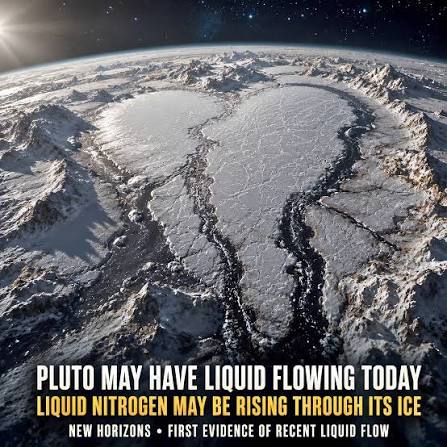
Liquid nitrogen on Pluto may occasionally seep through its frozen surface, leaving dark traces across its enormous nitrogen glacier. A new analysis of New Horizons observations suggests that these markings could reveal liquid rising from beneath the ice.
The proposed activity centers on northern Sputnik Planitia, within Pluto’s recognizable heart-shaped region. Scientists led by Southwest Research Institute’s Alan Stern suggest that underground melting could briefly wet parts of this landscape.
That possibility adds a surprising dimension to Pluto’s geology. However, the evidence supports a hypothesis, rather than a confirmed observation of liquid flowing today.
Dark Markings Reveal a Possible Liquid Clue
A Pattern Between the Ice Cells
Across northern Sputnik Planitia, large convection cells divide the glacier into distinctive sections. Narrow dark boundaries outline these cells, while broader, fainter dark zones border some of those lines.
The team examined whether liquid could explain this combination of sharp edges and diffuse patches. In their interpretation, nitrogen emerging from below could spread into surrounding low areas before freezing.
These details matter because the proposed explanation must account for the arrangement of the markings. A plausible process needs to explain both where the dark material appears and how it spreads.
A New Interpretation of Existing Images
New Horizons encountered Pluto on July 14, 2015. This investigation revisits observations from that flyby; it does not describe a new close approach. NASA mission record
The distinction also separates two different processes. Solid nitrogen ice can move slowly as a glacier. The new hypothesis concerns nitrogen that actually melts and travels as a liquid.
Why Scientists Compared Pluto With Greenland
To investigate the markings, the researchers compared Pluto images with Landsat 9 views of Greenland’s ice sheet.
On Earth, liquid water can darken ice and snow. Narrow wet zones and surrounding patches can create recognizable patterns across otherwise bright terrain. The team noticed similarities between those features and the markings on Sputnik Planitia.
That comparison offers a useful clue, but it has limits. Greenland’s surface conditions differ greatly from those on Pluto. Similar appearances do not automatically establish identical processes.
Instead, the terrestrial examples helped researchers frame a testable question: could liquid nitrogen temporarily wet the glacier and produce comparable patterns?
The proposed source lies underground. Pluto’s present atmospheric and temperature conditions do not support nitrogen rain as an explanation for these features.
How Liquid Nitrogen on Pluto Could Reach the Surface
Melting Beneath a Thick Glacier
Computer modeling led by SETI Institute researcher Orkan Umurhan explored how the proposed process might work.
Sputnik Planitia contains a nitrogen ice sheet several kilometers thick. The models suggest that nitrogen could melt near its base, creating a potential liquid source beneath the frozen surface.
Researchers must therefore consider conditions deep inside the glacier, alongside conditions at its exposed upper boundary. A frozen exterior does not describe every environment within a thick ice sheet.
The team also highlights a need to understand nitrogen ice under stress and strain. Laboratory experiments could help establish when these conditions promote melting.
A Race Against Freezing
Producing liquid would only solve the first part of the problem. That nitrogen must also travel upward through colder ice without freezing along the way.
The proposed mechanism involves narrow channels, with pressure or buoyancy potentially helping liquid rise.
After reaching the surface, it would need enough time to spread downhill and enter depressions. Brief wetting could then leave the patterns that researchers see in the spacecraft images.
This sequence makes timing essential. Melting, upward transport, and surface movement must all work together. The study explores the physical requirements for that sequence; it does not directly observe the entire process. Original research abstract
What the Evidence Shows About Pluto’s Possible Flows
Recent Does Not Mean Happening Today
The glacier’s relatively young surface makes the proposed activity especially interesting. Surface overturn models suggest an age below roughly one million years for Sputnik Planitia’s surface.
Consequently, the markings must fit within that relatively recent geological history. But that estimate does not tell researchers exactly when an individual dark feature formed.
Nor does it establish whether liquid currently reaches the surface. Scientists need to distinguish a young landscape from a precise measurement of ongoing activity.
Important Questions Remain
The strongest uncertainty concerns the interpretation itself. Dark markings provide indirect evidence, while computer models test whether the suggested mechanism could work.
Neither approach alone confirms liquid nitrogen on Pluto.
Researchers still need stronger constraints on melting conditions, transport pathways, and freezing times. Additional observations could also help test whether the features change. Such measurements would connect the proposed activity to visible changes, strengthening the case beyond a single set of images.
The hypothesis concerns nitrogen within the glacier. It does not establish surface liquid water or provide evidence for life.
What This Could Mean for Other Frozen Worlds
A Possible Connection With Triton
If further work supports the hypothesis, the same physics could help researchers investigate other nitrogen-rich environments.
The team identifies Neptune’s moon Triton as one possible comparison. Voyager 2 observed active plumes there, making its surface processes particularly interesting.
However, a possible connection does not demonstrate a shared mechanism. Researchers would need to test the relevant conditions on each world.
Better Images and Laboratory Tests
Much of Pluto still lacks detailed imaging. Future high-resolution observations could reveal whether similar markings appear in other regions.
Repeated images would offer another opportunity: checking whether particular features brighten, darken, or change shape over time.
Meanwhile, experiments with extremely cold nitrogen could improve the models. Together, these approaches could turn an intriguing visual resemblance into a more rigorous explanation.
Liquid Nitrogen on Pluto: A Clue Worth Following
Liquid nitrogen on Pluto remains a compelling possibility. Dark glacier markings, comparisons with wet terrestrial ice, and physical modeling together suggest a process worth investigating.
The next step is to test that explanation more closely. Better measurements could reveal whether nitrogen really rises from beneath Sputnik Planitia and briefly spreads across its surface.
For now, Pluto’s frozen heart offers a specific scientific puzzle: how much activity can hide beneath a landscape that looks completely frozen?
Main sources:
- Original research: Evidence for possible N₂ basal flow beneath Pluto northern Sputnik Planitia
- NASA: New Horizons mission and Pluto encounter timeline
- ScienceDaily: Supplied coverage attributed to Southwest Research Institute