
BY:SpaceEyeNews.
Liquid nitrogen on Pluto may be rising from beneath its enormous heart-shaped glacier. A new study links unusual dark markings on Sputnik Planitia to liquid that could briefly reach and wet the frozen surface. If the interpretation is correct, it would provide the first evidence of recent liquid flow on Pluto. However, researchers have not watched the liquid move or sampled it directly. Their case combines New Horizons images, comparisons with glaciers on Earth, and computer models of nitrogen ice.
Dark Markings Across Pluto’s Heart-Shaped Glacier
Sputnik Planitia forms the western side of Pluto’s bright heart-shaped region. This vast basin is filled mainly with frozen nitrogen and reaches several kilometers deep in places.
Images captured during NASA’s New Horizons flyby in 2015 revealed large polygonal cells across its surface. These city-sized structures form as warmer nitrogen ice rises and colder ice sinks around their edges.
Along the northern part of the glacier, scientists also noticed thin dark lines and wider, diffuse patches. Many appear near the boundaries of those convection cells. Their shapes and locations raised an important question: could a liquid be darkening the surface?
This area is also geologically young. Models of surface overturn suggest that much of Sputnik Planitia may be less than one million years old. Therefore, the markings cannot be ancient features preserved since Pluto’s earliest history. They must have formed after the glacier renewed its surface.
Why Greenland Helped Explain the Pluto Features
Researchers compared the New Horizons images with NASA Landsat 9 observations of Greenland’s ice sheet. On Earth, liquid water can create narrow dark streaks and larger darkened areas across snow and ice. Wet surfaces reflect light differently from dry frozen material.
The markings in northern Sputnik Planitia display a striking visual resemblance. Yet the comparison does not prove that liquid exists there. It simply provides a known process that can produce similar patterns.
Rain offers no explanation. Pluto’s thin atmosphere and extreme surface conditions make liquid nitrogen rainfall physically implausible. If a liquid created the features, it probably came from below the glacier.
How Liquid Nitrogen on Pluto Could Reach the Surface
Computer simulations offer a possible route from the glacier’s base to its surface. The models indicate that nitrogen ice could melt under conditions found beneath the kilometers-thick ice sheet. Pluto’s internal heat, pressure, and deformation within the glacier may all contribute to basal melting.
Basal Melting Beneath Sputnik Planitia
Basal melting occurs where a glacier meets the material beneath it. In this case, solid nitrogen could become liquid near the glacier’s base. The study does not propose a hidden nitrogen ocean. It describes localized melt that may exist in limited areas for short periods.
Why the Liquid Could Move Upward
Liquid nitrogen is less dense than solid nitrogen ice under the relevant conditions. As a result, the liquid would tend to rise instead of sinking. Buoyancy or pressure from below could push it through cracks and narrow tube-like passages.
The main challenge is temperature. Rising nitrogen must travel through colder layers without freezing first. Simulations suggest this may be possible through small conduits. At the surface, the nitrogen could move downhill and gather in shallow depressions before freezing or evaporating. Wetting would alter the ice’s brightness and explain both types of dark feature.
What the Evidence Does and Does Not Show
The study presents three connected lines of evidence. First, the markings have shapes associated with liquid-wetted ice on Earth. Second, they occur on a young and active nitrogen glacier. Third, physical models show that nitrogen could melt below the glacier and rise toward the surface.
Still, New Horizons captured a single close encounter rather than continuous observations. It did not record material moving across the ice. The spacecraft also carried no instrument that could sample the markings directly.
For those reasons, scientists describe the result as evidence for “possible” nitrogen flow. Recent can also mean recent in geological terms. It does not necessarily mean that liquid is moving across Pluto today.
Other explanations may emerge. Future work must test whether wetting best explains the color, shape, and distribution of the markings.
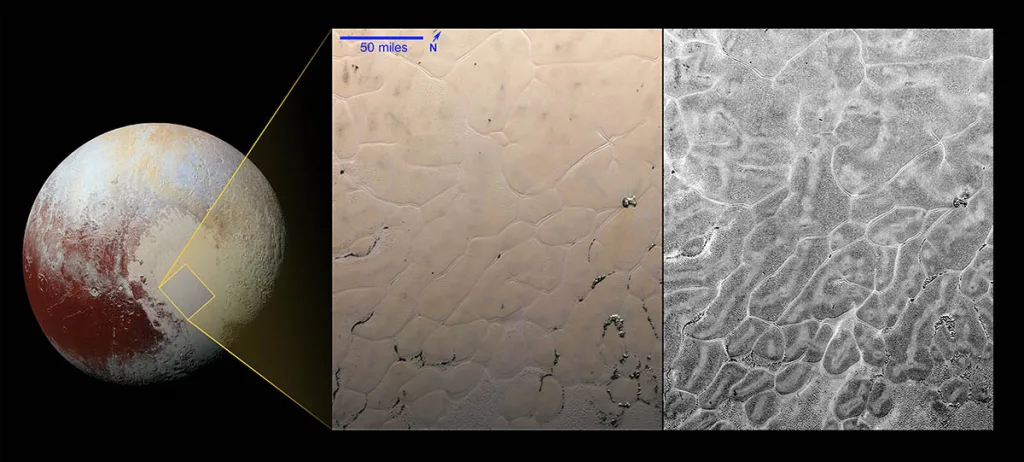
Pluto’s Heart: A Cosmic Valentine in Photos.
Why Recent Liquid Flow Would Matter
Pluto already shows signs of a changing surface. Nitrogen glaciers move across its landscape, while convection continually reshapes Sputnik Planitia. Other regions contain possible cryovolcanic terrain. Temporary liquid flow would add another process to this unexpectedly active world.
The result also highlights gaps in laboratory research. Scientists have not fully tested solid nitrogen under the stress, pressure, and temperatures expected inside Sputnik Planitia.
This proposed nitrogen system should not be confused with Pluto’s possible deep water ocean. The two ideas involve different materials, depths, and evidence. The latest study concerns localized nitrogen melt within or beneath the glacier.
What Pluto Could Teach Us About Other Icy Worlds
Similar physics may operate elsewhere in the outer solar system. Neptune’s moon Triton, for example, displayed active plumes when Voyager 2 passed it in 1989. Rising volatile liquids could help researchers investigate such activity, although the connection remains speculative.
More than half of Pluto still lacks high-resolution mapping. Comparable markings may exist in regions that New Horizons could not examine closely. A future orbiter could repeatedly image the surface and search for changes over time. It could also map temperatures and identify materials with much greater precision.
Conclusion: Liquid Nitrogen on Pluto Remains Possible
Liquid nitrogen on Pluto now has a credible, testable explanation supported by imagery, terrestrial comparisons, and computer modeling. The dark features across northern Sputnik Planitia may record liquid rising through the glacier and briefly spreading over its surface. Yet this remains an interpretation, not a direct detection. Laboratory experiments and a future Pluto mission will be needed to confirm it. For now, Pluto’s frozen heart appears far more dynamic than its distant location suggests.
Main Sources:
NASA — “NASA’s New Horizons Finds Evidence of Recent Liquid on Pluto’s Surface”
https://science.nasa.gov/blogs/science-news/2026/08/05/nasas-new-horizons-finds-evidence-of-recent-liquid-on-plutos-surface/
Southwest Research Institute — “SwRI Study Finds Evidence of Liquid Recently Flowing on Pluto’s Surface”
https://www.swri.org/newsroom/press-releases/swri-study-finds-evidence-of-liquid-recently-flowing-pluto-s-surface
The Planetary Science Journal — “Evidence for Possible N2 Basal Flow beneath Pluto’s Northern Sputnik Planitia”
https://doi.org/10.3847/PSJ/ae7e85
NASA — “Five Years After New Horizons’ Historic Flyby”
https://www.nasa.gov/solar-system/five-years-after-new-horizons-historic-flyby-here-are-10-cool-things-we-learned-about-pluto/