BY:SpaceEyeNews.
The James Webb Space Telescope may have found a missing stage in Little Red Dot formation. A compact galaxy called Pseudo-LRD-NOM contains an active black hole, intense star formation, thick dust, and few detectable heavy elements. That unusual mix could show how some mysterious red sources began to develop.
Astronomers do not yet consider the object a confirmed Little Red Dot. Instead, they describe it as a possible precursor. Its light suggests that a black hole was already growing while the surrounding galaxy remained small and chemically young.
Little Red Dot Formation May Be Starting Here
Pseudo-LRD-NOM sits at a redshift of 5.96. Astronomers therefore see it as it appeared roughly one billion years after the Big Bang. The galaxy lies behind the massive Abell 370 galaxy cluster, which magnified its light through gravitational lensing.
That natural magnification allowed JWST to study an otherwise extremely faint source. Researchers used Webb’s Near-Infrared Spectrograph, or NIRSpec, to separate the galaxy’s light into a detailed spectrum.
The object looks red and compact, much like the Little Red Dots found in Webb surveys. However, a very strong hydrogen-alpha emission line contributes heavily to its color. The research team therefore calls it a “pseudo-LRD” rather than placing it inside the standard category.
This difference may make the object especially useful. It could show what happens before a young system develops the full features of established Little Red Dots.
An Active Black Hole Inside a Small Host
The strongest clue comes from the hydrogen-alpha line. Most of that signal forms a narrow component linked to gas inside the galaxy. A weaker broad component also appears.
Broad hydrogen emission often points to fast-moving gas near an actively feeding black hole. The researchers estimate a black-hole mass of about 2.9 million Suns.
Meanwhile, the galaxy’s corrected stellar mass is about 16 million solar masses, although that figure remains uncertain. The central black hole therefore represents an unusually large share of its host’s mass.
Nearby galaxies usually show a much smaller ratio between black-hole mass and stellar mass. Pseudo-LRD-NOM appears different. Its black hole had already reached a substantial size before the host built a large stellar population.
The result does not prove that the black hole formed before every star. It does show that black-hole growth was advanced during an early stage of galaxy development.
A Dusty Galaxy With Almost No Metal Lines
Pseudo-LRD-NOM presents another puzzle. Its spectrum suggests strong dust attenuation, yet researchers detected no clear oxygen emission or other metal lines.
Astronomers call elements heavier than hydrogen and helium “metals.” Stars create many of them and return them to their surroundings. Active star formation should therefore enrich a galaxy relatively quickly.
Models point to gas and stellar metallicities between about 1% and 10% of the Sun’s value. At the same time, the galaxy contains dense gas and enough dust to reshape its observed light.
Those properties seem difficult to combine. Dust usually signals previous stellar activity, while very low metallicity suggests limited chemical enrichment.
Fresh metal-poor gas may be flowing into the galaxy and diluting enriched material. Dense star-forming regions could also be younger than the wider stellar population. The system may also occupy a brief stage when dust is present but metal signatures remain weak.
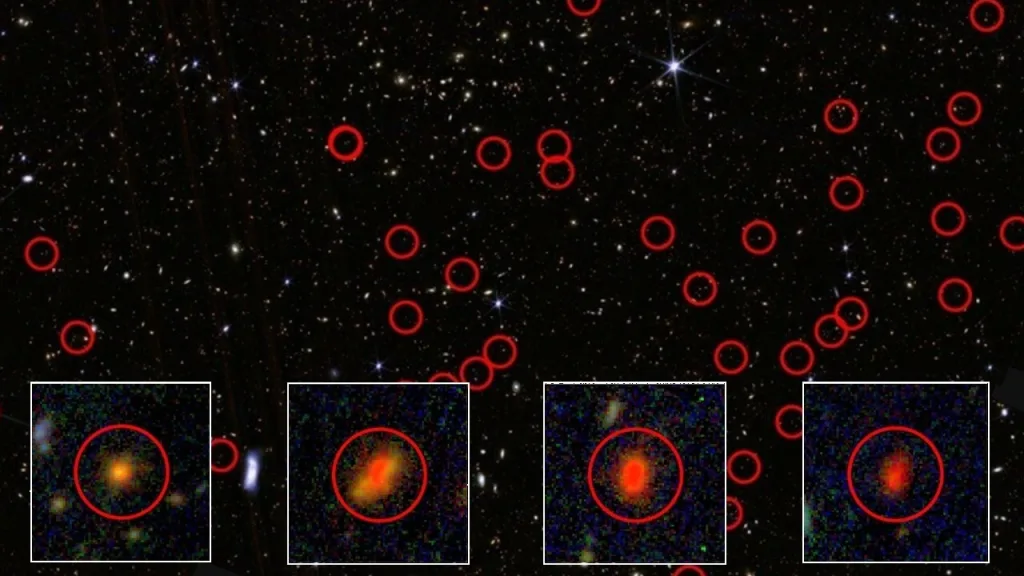
JWST’s ‘little red dots’ could be the ‘parents’ of the universe’s first supermassive black holes.
Why the Missing Metal Lines Matter
The lack of metal lines separates this source from many other active early galaxies. It suggests that astronomers are seeing a dense environment near the beginning of its chemical development.
That timing may help explain why the black hole looks so prominent. A compact gas supply could feed both new stars and the central object before the galaxy becomes larger and more mature.
Dense Star Formation Could Feed the Black Hole
The galaxy’s stellar material appears packed into a small area. Its estimated surface density resembles that of massive or nuclear star clusters.
Such an environment could move gas efficiently toward the center. Star formation would consume part of that material, while another portion could reach the black hole. Both processes could then grow together.
One possible sequence begins when metal-poor gas collects inside a compact young galaxy. Dense clusters form near the center. Gas continues moving inward and feeds a black-hole seed. Dust accumulates while the black hole and surrounding stellar population brighten.
Over time, the source may develop the red colors, compact structure, and broad emission features associated with a full Little Red Dot.
Researchers have not watched that sequence unfold. They are interpreting one object at one moment. Still, Pseudo-LRD-NOM matches several conditions expected from a transitional phase. The study’s authors describe it as a likely precursor to a true Little Red Dot.
What This Means for the Little Red Dot Mystery
Little Red Dots remain a varied and debated population. NASA says they appeared in large numbers around 600 million years after the Big Bang. They became far less common by about 1.5 billion years afterward.
Many show signs linked to active black holes. Yet their weak X-ray emission, compact size, red colors, and unusual spectra resist one simple explanation. NASA observations using Webb and the Chandra X-ray Observatory continue to investigate why many possible black holes inside Little Red Dots appear faint in X-rays.
Recent Webb results suggest that different mechanisms may create similar-looking objects. Some could contain growing black holes hidden by dust. Others may involve black holes wrapped in hot, dense gas cocoons. One detailed JWST spectrum revealed more than 40 features supporting such a cocoon around the object GLIMPSE-17775.
Pseudo-LRD-NOM strengthens a mixed picture. Stars, dense gas, dust, and an active black hole may all shape the same source. Color alone cannot show which component dominates.
Conclusion
Little Red Dot formation may now have a promising candidate caught near its opening stage. Pseudo-LRD-NOM combines a compact starburst, extremely low chemical enrichment, dense dusty gas, and an active black hole of about 2.9 million solar masses.
JWST has not solved the full mystery. However, this galaxy may connect young star-forming systems with the compact red objects seen across the early universe. Astronomers now need more examples and deeper spectra to test that path. Similar sources could reveal how young galaxies fed black holes so efficiently and why Little Red Dots became a brief but important phase of cosmic evolution.
Main Sources:
Primary research paper:
https://arxiv.org/abs/2601.11466
NASA — Newfound Galaxy Class May Indicate Early Black Hole Growth:
https://science.nasa.gov/missions/webb/newfound-galaxy-class-may-indicate-early-black-hole-growth-webb-finds/
NASA — Webb Early Universe and Little Red Dots:
https://science.nasa.gov/mission/webb/early-universe/
NASA — Webb and Chandra Observations of Little Red Dots:
https://science.nasa.gov/missions/chandra/nasa-connects-little-red-dots-with-chandra-webb/
NASA — Strongest Evidence for “Black Hole Stars”:
https://science.nasa.gov/missions/webb/nasa-webb-finds-strongest-evidence-yet-for-black-hole-stars/