BY:SpaceEyeNews.
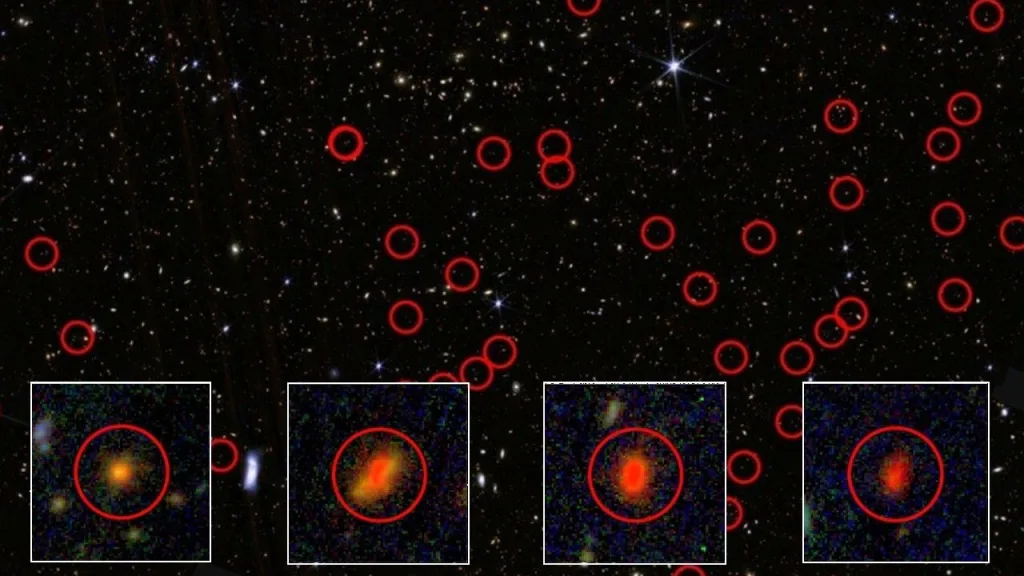
For nearly three years, one of the biggest mysteries revealed by the James Webb Space Telescope has been the appearance of strange objects known as Little Red Dots. These compact, red-colored sources appeared in large numbers during the early universe. Yet they seemed to vanish as cosmic history progressed.
Now, astronomers may be closer than ever to understanding what these objects really are.
A new study based on observations from the James Webb Space Telescope provides the strongest evidence yet that Little Red Dots Black Hole Stars could represent a previously unknown stage of supermassive black hole growth. The findings come from detailed observations of an object known as GLIMPSE-17775, one of the most unusual Little Red Dots detected so far.
Rather than challenging our understanding of the universe, this discovery may help explain how some of the earliest supermassive black holes grew so quickly after the Big Bang.
Why Little Red Dots Became a Major JWST Mystery
When JWST began science operations in 2022, astronomers expected to find distant galaxies, young stars, and early black holes. Instead, the telescope revealed hundreds of compact red objects unlike anything previously observed.
Researchers named them Little Red Dots.
These objects appeared frequently within the first billion years of cosmic history. Their abundance surprised scientists because existing models did not predict such a large population.
The mystery deepened because these objects seemed to disappear later in the universe’s evolution. By the time the cosmos reached roughly two billion years of age, Little Red Dots became far less common.
That pattern raised an important question.
What exactly were astronomers seeing?
Several Explanations Emerged
Scientists proposed multiple theories.
Some researchers suggested Little Red Dots were unusually compact galaxies.
Others argued they might be active galactic nuclei hidden behind thick clouds of gas and dust.
A third possibility involved rapidly growing black holes surrounded by dense envelopes of material. This scenario became known as the Black Hole Star model.
Over time, that explanation gained increasing support. Yet researchers lacked direct observational evidence strong enough to confirm it.
That situation may now be changing.
Little Red Dots Black Hole Stars and the GLIMPSE-17775 Discovery
The breakthrough came from observations of GLIMPSE-17775.
Astronomers observed this object as it existed approximately 1.8 billion years after the Big Bang. While studying the massive galaxy cluster Abell S1063, researchers noticed that the cluster acted as a natural cosmic magnifying glass.
This effect allowed scientists to examine GLIMPSE-17775 in unprecedented detail.
Einstein’s Gravitational Lens Makes the Difference
The galaxy cluster Abell S1063 produces a phenomenon known as gravitational lensing.
According to Einstein’s theory of general relativity, massive objects bend spacetime. As light travels through that curved region, its path changes.
The result is a natural magnification effect.
For GLIMPSE-17775, gravitational lensing significantly increased the amount of information available to astronomers. Researchers effectively gained much more observing power than the telescope could normally provide.
That advantage enabled the team to collect the deepest spectrum ever obtained from a Little Red Dot.
Why Spectra Matter
A spectrum acts like a fingerprint.
It reveals which elements are present and how matter behaves around an object. By examining specific spectral features, astronomers can identify the physical processes occurring inside distant cosmic sources.
In the case of GLIMPSE-17775, the spectrum contained several clues that point toward the Little Red Dots Black Hole Stars interpretation.
Spectral Evidence Points Toward a Black Hole Star
Researchers found multiple signatures that support the presence of a rapidly growing black hole hidden inside dense gas.
No single clue provided the answer. Instead, the combined evidence created a remarkably consistent picture.
Electron Scattering Signatures
One of the strongest indicators involved electron scattering.
The observed emission lines did not match what astronomers would expect from a simple rotating gas cloud.
Instead, the data suggested that energetic radiation was interacting with large numbers of free electrons.
This behavior aligns closely with predictions from Black Hole Star models.
Fluorescence Signals Reveal Intense Radiation
The spectrum also contained evidence of fluorescence.
Fluorescence occurs when radiation excites surrounding material, causing it to emit light at specific wavelengths.
These signals suggest that an extremely energetic source lies at the center of GLIMPSE-17775.
A rapidly feeding black hole provides a natural explanation.
Helium Absorption Supports the Gas Cocoon Scenario
Another important clue involved helium absorption.
The observations indicate that large amounts of gas surround the central energy source.
This dense environment fits a key prediction of the Black Hole Star model.
According to the theory, a growing supermassive black hole remains hidden inside a thick cocoon of partially ionized gas.
The Iron Forest Stands Out
Perhaps the most compelling evidence came from what astronomers describe as an “iron forest.”
Researchers detected numerous iron spectral lines throughout the spectrum.
These features typically appear in environments exposed to powerful radiation fields.
Such conditions are expected when a supermassive black hole rapidly consumes surrounding matter.
Together, these observations form the strongest case yet for Little Red Dots Black Hole Stars.
Why the Black Hole Star Model Makes Sense
The Black Hole Star concept offers a solution to several long-standing questions.
Most importantly, it helps explain why Little Red Dots appear abundant early in cosmic history but become rare later.
A Short-Lived Growth Phase
Under this scenario, Little Red Dots represent a temporary stage in galaxy evolution.
During this phase, a central black hole grows rapidly while remaining hidden inside dense gas.
The object appears as a compact red source.
Eventually, the black hole’s energy clears away much of the surrounding material.
As the cocoon disappears, the object changes appearance and begins to resemble a more typical active galaxy.
In other words, the Little Red Dot does not vanish.
It evolves.
Explaining Weak X-Ray Signals
Astronomers have long wondered why many Little Red Dots appear surprisingly faint in X-rays.
The Black Hole Star model provides a straightforward answer.
Dense gas envelopes absorb much of the X-ray radiation generated near the black hole.
As a result, observers detect weaker X-ray emissions than expected.
The new observations of GLIMPSE-17775 fit this explanation remarkably well.
Could This Solve the Early Black Hole Growth Problem?
One of the biggest puzzles in astronomy involves the rapid appearance of supermassive black holes.
Scientists have detected enormous black holes less than one billion years after the Big Bang.
Growing such massive objects in a relatively short time remains difficult to explain.
A Missing Evolutionary Stage
Little Red Dots Black Hole Stars may represent a previously hidden growth phase.
If these objects contain rapidly accreting black holes, they could reveal how black holes gained mass so efficiently during the universe’s early years.
This possibility makes Little Red Dots far more important than a simple classification problem.
They may provide direct evidence of how some of the first giant black holes formed.
A Better Fit for Cosmic History
The new findings also reduce tension between observations and theoretical models.
Instead of requiring entirely new physics, Little Red Dots may simply represent an evolutionary stage that astronomers had never observed before.
That interpretation fits comfortably within our broader understanding of galaxy formation and black hole growth.
The Mystery Is Not Completely Solved
Despite the excitement, researchers remain cautious.
Some unanswered questions still exist.
For example, many Little Red Dots display a strong spectral feature known as the Balmer Break. In GLIMPSE-17775, that feature appears weaker.
Scientists believe the object’s host galaxy may influence the signal. However, further observations will be necessary to confirm that explanation.
Alternative theories also remain under investigation.
Future JWST observations will help determine whether all Little Red Dots follow the same evolutionary path or whether multiple populations exist.
Conclusion
The discovery of GLIMPSE-17775 represents the strongest evidence yet supporting the idea that Little Red Dots Black Hole Stars are real objects in the early universe.
The object’s spectrum contains multiple signatures that point toward a rapidly growing supermassive black hole hidden inside a dense cocoon of gas. Electron scattering, fluorescence signals, helium absorption, and the distinctive iron forest all support this interpretation.
While the debate is not completely settled, the new observations provide an important breakthrough. Rather than breaking cosmology, Little Red Dots may reveal a crucial stage in the growth of the universe’s earliest supermassive black holes.
As JWST continues exploring the distant cosmos, astronomers may soon discover whether these mysterious red objects truly represent the missing chapter in the story of black hole evolution.
Main Sources:
NASA Webb Mission:
https://science.nasa.gov/missions/webb/nasa-webb-finds-strongest-evidence-yet-for-black-hole-stars/
The Astrophysical Journal Letters (Study):
https://iopscience.iop.org/journal/2041-8205