BY:SpaceEyeNews.
Little Red Dots may owe part of their mystery to the galaxies surrounding them. Astronomers studying James Webb Space Telescope images have uncovered faint light beyond their brilliant centers. That glow offers a fresh way to investigate these puzzling objects from the early universe.
The surrounding galaxies appear unusually compact, with properties consistent with ongoing star formation. Their crowded environments could help explain why these objects emerged. However, researchers still face a central question: what produces the intense light at their hearts?
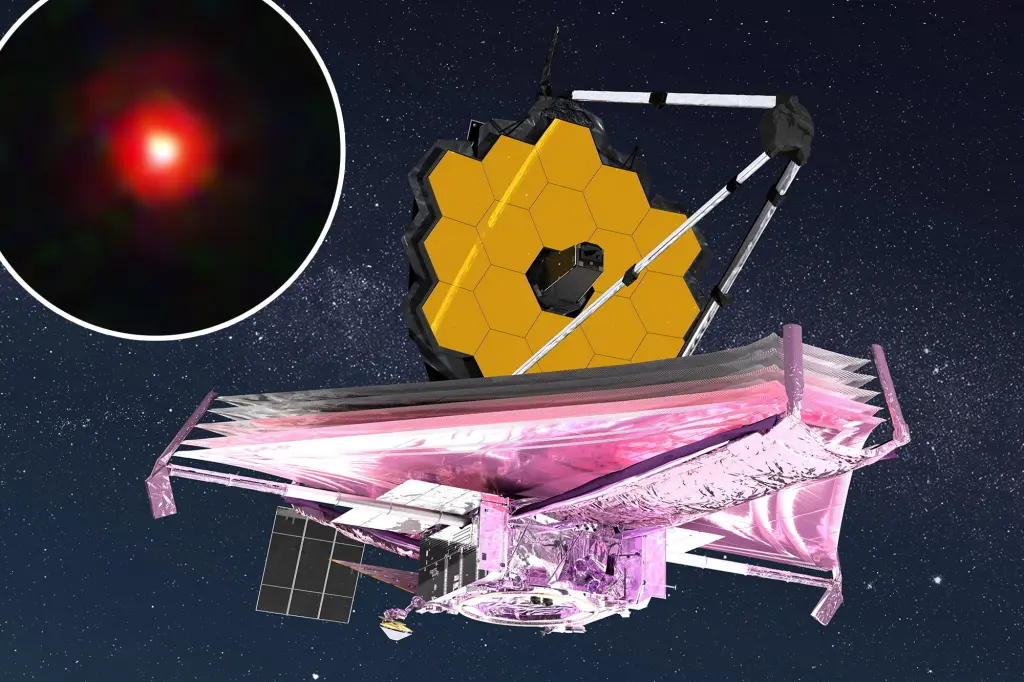
(Main) a mysterious Little Red Dot seen in the early universe by the JWST (Inset) an illustration of the powerful space telescope. (Image credit: NASA, ESA, CSA, STScI, Dale Kocevski/Colby College, ESO)
Looking Beyond the Little Red Dots
For years, the bright centers attracted most of the attention. That focus made sense. These compact sources dominate the light astronomers receive, yet their energy source remains uncertain.
Jorge Zavala, a team member at the University of Massachusetts Amherst, argues that their surroundings also deserve attention. Studying the host galaxies could reveal whether particular conditions encourage the phenomenon.
This approach also addresses a question about their eventual fate. Understanding the environments they inhabit could help connect them with later galaxies. For now, researchers cannot say whether every galaxy or black hole passes through a similar phase.
The shift opens several connected questions. Do these sources favor unusually dense galaxies? Does star formation influence their appearance? Could they represent a temporary stage in galaxy or black hole growth?
Combining Faint Signals
Researchers combined images of 217 objects from the COSMOS-Web survey and modeled their central light. This approach revealed extended emission that usually remains too faint to distinguish in individual images.
Crucially, the measurements describe average properties across the sample. They do not provide equally detailed portraits of 217 separate hosts. ANU’s explanation describes how this technique exposes the faint surroundings.
Compact Galaxies Around Little Red Dots
The host galaxies appear about 2.5 times smaller than comparable star-forming galaxies at similar cosmic epochs. Their inferred average stellar mass reaches roughly one billion times the Sun’s mass.
That combination makes compactness a central clue. A galaxy’s total stellar mass tells only part of its story. How tightly it concentrates those stars also matters when researchers investigate its development.
What the Size Measurement Means
The study gives a characteristic effective radius of roughly 200 parsecs, or about 650 light-years. This radius encloses half the modeled host light. It does not mark the galaxy’s outer edge.
That distinction matters when describing these systems as approximately 1,400 light-years across. Such wording can suggest a complete diameter that the measurement does not establish. The research paper instead supports a comparison based on effective size.
The bright central component and the surrounding stellar population also require separate treatment. Measuring the host does not automatically reveal the size or nature of whatever powers its center.
Could Star Formation Explain the Mystery?
The surrounding light appears consistent with star-forming galaxies. This gives researchers a possible connection between the host environment and the unusual central activity.
Zavala suggests that compact galaxies could concentrate gas enough to encourage strong episodes of star formation. Under this interpretation, the host helps create conditions favorable to the Little Red Dots phenomenon.
However, a plausible connection does not establish cause and effect. Researchers must still determine whether stellar activity produces the central source, supports its growth, or simply accompanies it.
The Possible Role of Massive Stars
Zavala also highlights supermassive stars as a direction for further investigation. Such objects might contribute to the central energy source. Alternatively, they could precede black holes that later occupy these centers.
These ideas extend beyond what the host measurements directly demonstrate. The observations do not identify individual supermassive stars. Instead, the compact surroundings motivate researchers to test whether those stars could play a role.
Keeping that distinction clear preserves the discovery’s significance without turning a proposed explanation into a confirmed result.
Where Black Holes Fit Into the Picture
Evidence for a star-forming host does not exclude a black hole at its center. The two processes could share an environment and influence the same stage of galactic development.
A dense supply of gas might support both stellar activity and central growth. Consequently, researchers need to understand how the surrounding galaxy relates to the source dominating its light.
The broader question concerns timing. Does a central black hole grow rapidly before the host assembles most of its stars? Or do both develop together through closely connected episodes?
A study coauthor’s university explanation discusses this possible connection. Nevertheless, identifying a faint host cannot independently settle what powers every object.
Why This Phase May Become Rarer
The concentration of these sources in the early universe raises another question: why do comparable objects seem so uncommon nearby?
Zavala proposes that changing galactic conditions could help explain the difference. Over billions of years, galaxies develop more chemically enriched gas. Their later environments may therefore differ from those that encouraged the phenomenon.
In astronomy, heavy elements include everything heavier than hydrogen and helium. Their abundance could affect the processes involved, although this explanation remains tentative.
An evolving appearance also differs from physical disappearance. A galaxy could continue developing after its central source stops displaying the characteristics astronomers associate with this population.
What Researchers Need to Measure Next
Spectroscopy offers an important next step. By separating light into wavelengths, astronomers can investigate gas conditions and distinguish possible contributors to the emission.
The current analysis relies on brightness measurements across broad wavelength bands. More detailed spectra could test those interpretations and better establish the sample’s properties.
Nearby analogues offer another route. Their shorter distances could allow closer examination, especially when researchers combine observations from several telescopes.
Little Red Dots Offer a Wider View
Little Red Dots now have a clearer galactic setting. Their faint hosts suggest that compact environments deserve a central place in the investigation. The next challenge is connecting those surroundings to the brilliant sources within them. That connection could clarify an elusive stage of early cosmic growth.
Main sources:
Space.com — Galaxies housing Webb’s mysterious Little Red Dots might have revealed their secrets
Research published in Nature Astronomy — Extended Components of Little Red Dots in the Rest-Frame Optical
Australian National University — A new study shines light on the nature of Little Red Dots