
BY:SpaceEyeNews.
Long-Period Radio Transients May Finally Have an Explanation
For years, Long-Period Radio Transients have remained one of astronomy’s most puzzling discoveries. These unusual radio signals appear at intervals far longer than those produced by typical pulsars. Their strange behavior challenged existing theories and left researchers searching for answers.
Now, a newly identified stellar system known as ASKAP J1745−5051 may have provided the breakthrough astronomers needed. Researchers using Australia’s ASKAP radio telescope have traced one of these mysterious signals to a rare binary system containing a white dwarf and a red dwarf star.
The discovery does more than identify a source. It could help scientists decode an entire class of unexplained cosmic events. Some researchers have even described the system as a “Cosmic Rosetta Stone” because of its potential to reveal the nature of other Long-Period Radio Transients scattered across the sky.
The Mystery Behind Long-Period Radio Transients
A New Type of Radio Signal
Astronomers first began detecting Long-Period Radio Transients only in recent years. Unlike ordinary pulsars, which emit radio pulses every few seconds or milliseconds, these objects produce bursts separated by minutes or even hours.
That difference created an immediate problem.
Traditional pulsar models could not easily explain how such slow signals could remain detectable. The physics simply did not seem to fit.
As additional detections appeared, researchers realized they might be observing an entirely new class of astronomical objects.
Why Existing Models Struggled
Many early studies focused on neutron stars as the likely source. Pulsars were the obvious candidates because they naturally produce radio emissions.
However, calculations revealed major inconsistencies.
The rotational speeds required for some of these signals would place neutron stars outside expected physical limits. In several cases, the observed behavior simply did not match theoretical predictions.
As a result, astronomers began exploring alternative explanations involving binary systems, magnetic interactions, and compact stellar remnants.
The Search for a Confirmed Source
Finding a confirmed origin became one of the most important goals in transient astronomy.
Researchers needed more than signal detections. They needed to identify the actual object producing the bursts.
That challenge required observations across multiple wavelengths, including radio, optical, and X-ray data.
The breakthrough finally arrived with ASKAP J1745−5051.
How ASKAP J1745−5051 Changed the Picture
A Rare White Dwarf Binary
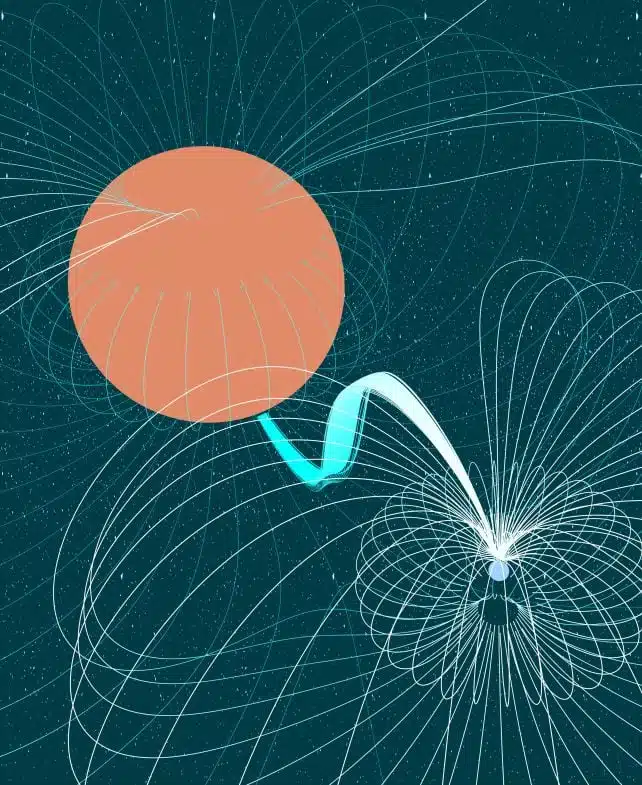
ASKAP J1745−5051 consists of two stars locked in a remarkably close orbit.
The primary object is a white dwarf, a dense stellar remnant roughly the size of Earth. Its companion is a red dwarf star with only a fraction of the Sun’s mass.
The pair complete an orbit in just over one hour.
Because the stars are so close together, material continuously flows from the red dwarf toward the white dwarf. This process, known as accretion, releases significant amounts of energy.
Radio and X-Ray Signals Together
Researchers observed more than radio bursts.
The system also produces regular X-ray emissions.
That finding proved especially important because very few known Long-Period Radio Transients display both behaviors.
The combination provided scientists with multiple ways to study the system and understand its underlying physics.
An Important Timing Difference
One of the most surprising findings involved the timing of the emissions.
The radio bursts and X-ray peaks do not occur at exactly the same point in the orbit.
Instead, they appear offset from one another.
This detail suggests that different regions of the binary system generate the signals. The radio emissions likely originate from one location, while the X-rays emerge from another.
That separation provides valuable clues about the physical mechanisms operating within the system.
Direct Evidence at Last
Previous candidates linked to Long-Period Radio Transients often lacked definitive proof.
ASKAP J1745−5051 changes that situation.
For the first time, astronomers can directly observe both stars, the transfer of material, and the resulting emissions. The entire process appears in action rather than being inferred indirectly.
That makes this system uniquely valuable for future research.
Why Scientists Call It a Cosmic Rosetta Stone
Solving a Long-Standing Puzzle
The discovery provides the strongest evidence yet that at least some Long-Period Radio Transients originate from accreting white dwarf binary systems.
That conclusion represents a major step forward.
Instead of relying solely on theoretical possibilities, astronomers now have a real object that matches the observed signals.
As a result, several competing explanations may now be tested against direct observations.
A Template for Future Discoveries
Scientists believe ASKAP J1745−5051 can serve as a reference object.
Future detections can be compared with its characteristics, including:
- Orbital behavior
- Radio emission patterns
- X-ray activity
- Accretion processes
- Magnetic interactions
This comparison could help classify newly discovered transients much more efficiently.
Understanding Extreme Physics
The value of the system extends beyond solving one mystery.
White dwarf binaries expose matter to powerful magnetic fields, intense gravity, and highly energetic plasma environments.
These conditions cannot be recreated in terrestrial laboratories.
As a result, ASKAP J1745−5051 offers researchers a natural testing ground for studying fundamental astrophysical processes.
The Importance of Multi-Wavelength Astronomy
This discovery also highlights the growing importance of combining different observing techniques.
Radio observations alone would not have revealed the complete picture.
X-ray data supplied critical evidence, while future optical observations may provide even more information about the binary system’s structure.
Modern astronomy increasingly depends on this multi-wavelength approach to understand complex cosmic phenomena.
What Comes Next for Long-Period Radio Transients?
Expanding the Search
Astronomers are already planning additional observations using radio, optical, and X-ray facilities.
Their goal is to determine whether other Long-Period Radio Transients share similar origins.
If they do, researchers may finally understand how common these systems are throughout the Milky Way.
Multiple Origins Remain Possible
Although ASKAP J1745−5051 provides a major clue, the story is not finished.
Scientists caution that not every transient may originate from a white dwarf binary.
Different subclasses could exist.
Some objects may still involve neutron stars or other compact remnants.
Future observations will help determine whether the newly discovered system represents the rule or just one part of a larger population.
Building a Better Cosmic Map
Each new detection adds another piece to the puzzle.
As radio surveys become more sensitive, astronomers expect the number of known Long-Period Radio Transients to increase dramatically.
That growing dataset should reveal patterns that remain invisible today.
The coming years may transform these signals from a scientific curiosity into a well-understood branch of transient astronomy.
Conclusion
The discovery of ASKAP J1745−5051 marks a significant milestone in the study of Long-Period Radio Transients.
For years, these unusual signals challenged astronomers and resisted explanation. Now, researchers have identified a rare white dwarf binary system that appears capable of producing exactly the kind of emissions they have been searching for.
More importantly, the system provides a framework for interpreting future discoveries. By serving as a cosmic Rosetta Stone, ASKAP J1745−5051 may help scientists decode an entire population of mysterious radio sources.
Many questions remain unanswered. Yet for the first time, astronomers have a clear path toward understanding one of the universe’s most intriguing classes of cosmic signals.
Main Sources:
- Daily Galaxy
https://dailygalaxy.com/2026/06/student-astronomer-cosmic-rosetta-stone/ - Nature Astronomy (Research Paper)
https://www.nature.com - ASKAP Radio Telescope – CSIRO
https://www.csiro.au/en/research/technology-space/astronomy/askap - University of Sydney News
https://www.sydney.edu.au/news-opinion