BY:SpaceEyeNews.
Introduction — A Hidden Origin Within the Milky Way
The idea behind the Lost galaxy Loki Milky Way discovery is simple but powerful: not every star in our galaxy was born here. Some arrived billions of years ago, carried in by smaller galaxies that merged into the system we now call home.
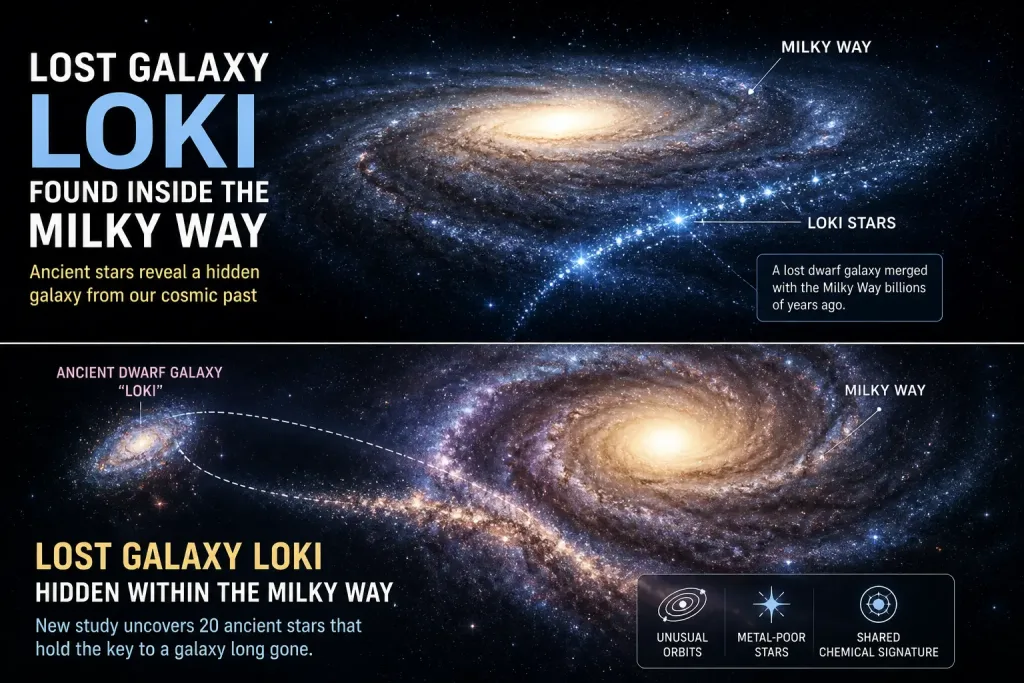
Astronomers now believe they have identified traces of one such system. It no longer exists as a visible galaxy. Instead, it survives through a small group of ancient stars embedded deep within the Milky Way itself. This hidden structure, named “Loki,” offers a rare glimpse into the early assembly of our galaxy.
Rather than adding a new object to the sky, this finding reshapes how we interpret what is already there.
Lost Galaxy Loki Milky Way and the Milky Way’s Layered Growth
Galactic assembly through mergers
The Milky Way formed gradually. Over time, it absorbed smaller galaxies, each contributing stars and material. These mergers did not erase the past entirely. Instead, they left behind patterns that can still be traced today.
Tracing origins through motion and chemistry
Astronomers rely on two main tools to identify these remnants. The first is motion. Stars that originated elsewhere often follow unusual paths. Some move opposite to the galaxy’s rotation. Others travel in elongated orbits.
The second tool is chemistry. Early stars formed with very few heavy elements. These “metal-poor” stars act as markers of ancient environments. When a group of stars shares both motion and chemistry, it often points to a common origin.
The Lost galaxy Loki Milky Way signal emerged from this combination. A small set of stars stood apart from the rest, both in how they move and in what they contain.
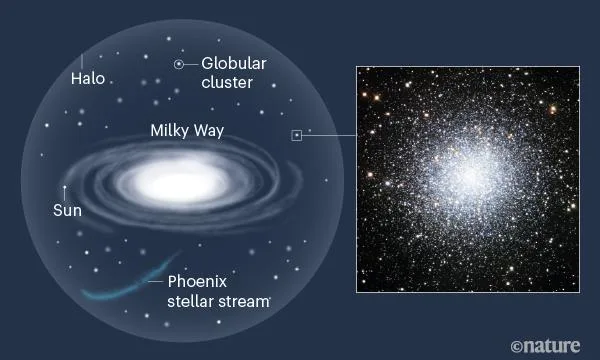
The Phoenix stellar stream rose from the ashes of an ancient star cluster
Lost Galaxy Loki Milky Way Evidence From a Unique Stellar Group
A rare population in an unexpected place
The key evidence comes from a group of 20 stars located in the galactic plane. This region is dense and active, making it an unlikely home for very old, metal-poor stars. Most such stars are found in the outer halo.
Their presence alone raises questions. Their shared properties provide answers.
Consistent chemical signatures
All 20 stars show nearly identical elemental patterns. This level of consistency suggests they formed together, rather than being a random collection.
Mixed orbital behavior
At the same time, their motion appears split. Some stars move with the galaxy. Others move against it. Yet both groups follow similarly stretched paths.
This combination is unusual. Typically, different orbital directions suggest different origins. Here, the chemistry tells a different story.
A single origin emerges
Taken together, the evidence points to one conclusion. These stars likely came from a single dwarf galaxy that merged with the Milky Way long ago. That system is now referred to as Loki.
The Nature of Loki — A Fast and Energetic System
Clues from stellar chemistry
The chemical makeup of these stars reveals the type of events that shaped their origin. The patterns point to high-energy processes such as powerful stellar explosions and compact object interactions.
What is absent is equally important
Equally telling is what does not appear. There is no clear signature of later-stage stellar processes associated with slower evolution. This suggests that Loki did not persist long enough to develop a more complex chemical history.
A brief but intense lifecycle
These clues indicate a system that formed stars quickly and evolved rapidly. It likely experienced intense activity before being absorbed into the Milky Way.
This profile sets Loki apart from many known dwarf galaxies. It represents a more concentrated and short-lived phase of galactic growth.
One System or Multiple Origins? A Key Question
Interpreting opposing motions
The presence of both forward and backward-moving stars raises a natural question. Could they have come from separate systems?
Why the data favors one galaxy
The chemical evidence argues against that idea. The stars share a remarkably similar composition. Achieving that level of alignment across two independent systems would be unlikely.
Mass estimates also align with a single-source scenario. The simplest explanation fits the data best.
A unified origin
For now, the most consistent interpretation is that all 20 stars originated from one dwarf galaxy. That galaxy has since been fully integrated into the Milky Way, leaving only these subtle traces behind.
What This Means for Milky Way Evolution
Challenging previous assumptions
Until now, many models placed early merger remnants in the galaxy’s outer regions. The Loki stars do not follow that pattern. They reside within the galactic plane.
This suggests that early mergers could reach deeper into the galaxy than previously thought.
A more complex internal structure
The Milky Way may be more layered and mixed than earlier models predicted. Ancient systems may be embedded throughout its structure, not just at the edges.
Reconstructing a hidden past
Each discovery like this adds detail to the galaxy’s formation history. The Lost galaxy Loki Milky Way case shows that even small stellar groups can carry significant information about past events.
What Comes Next for the Lost Galaxy Loki Milky Way Study
Expanding the dataset
The current findings rely on a limited sample. Larger surveys will provide a broader view. Upcoming instruments will analyze far more stars with greater precision.
Refining the picture
With improved data, scientists can test whether Loki is unique or part of a larger pattern. Similar systems may already exist in the data, waiting to be identified.
A growing field of discovery
The search for hidden galactic remnants is accelerating. As tools improve, more of these structures are expected to emerge, offering deeper insight into how galaxies assemble.
Conclusion — A Subtle but Powerful Discovery
The Lost galaxy Loki Milky Way discovery highlights how much of our galaxy’s history remains hidden. A small cluster of stars has revealed the presence of an ancient system that no longer exists as a separate entity.
This finding does not change what we see in the night sky. It changes how we understand it. The Milky Way is not a single, continuous structure. It is a record of many past mergers, each leaving behind traces that can still be uncovered.
As new observations arrive, that record will become clearer. And with it, our understanding of how galaxies like our own came to be.
Main Sources:
- Phys.org: https://phys.org/news/2026-04-lost-galaxy-loki-milky.html
- Monthly Notices of the Royal Astronomical Society (2026 study): https://doi.org/10.1093/mnras/stag563