
BY:SpaceEyeNews.
More than 4.5 billion years ago, the young Solar System looked very different from what we see today. Numerous planetary embryos orbited the Sun, competing for material as the planets gradually formed. Many of these early worlds disappeared through collisions, mergers, or other processes. Now, scientists believe they have uncovered evidence of one of these forgotten worlds.
A rare meteorite found in the Sahara Desert has revealed what may be the first direct evidence of a Lost Moon-Sized World that no longer exists. Researchers studying the meteorite discovered clues suggesting that its parent body was far larger than previously believed. Instead of originating from a small asteroid, the meteorite may have come from a planetary embryo comparable in size to Earth’s Moon.
The discovery offers a new look at the chaotic early history of our Solar System. It also suggests that some ancient worlds formed from materials very different from those that built Earth and Mars.
The Meteorite That Changed the Story
A Rare Rock From the Sahara
The discovery centers on a meteorite known as Northwest Africa 12774, or NWA 12774. Scientists classify it as an angrite meteorite, one of the rarest meteorite groups ever identified.
Angrites are especially important because they formed during the earliest stages of Solar System history. These volcanic rocks solidified only a few million years after the Solar System emerged approximately 4.56 billion years ago.
Researchers have identified more than 80,000 meteorites on Earth. However, only 68 belong to the angrite family. That rarity makes each specimen an important scientific resource.
Why Angrites Have Always Been Different
For decades, angrites puzzled scientists.
Most rocky planets and meteorites contain significant amounts of silica. Earth, Mars, and many asteroids share this characteristic. Angrites, however, contain unusually low silica levels.
Because of this unusual chemistry, researchers previously believed that angrites originated from relatively small asteroids with radii of less than 200 kilometers.
That assumption remained largely unchallenged until scientists examined NWA 12774 in greater detail.
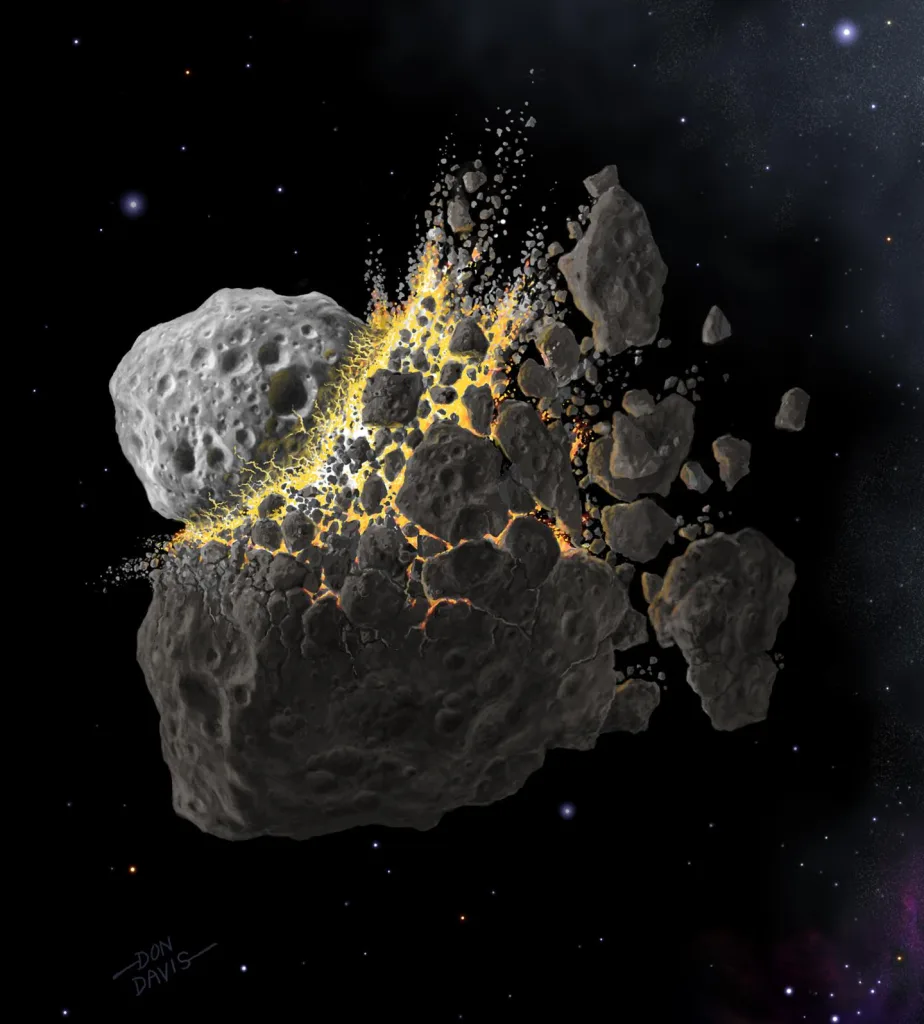
Meteorites on Earth May Come from Just a Handful of Early Lost Worlds.
The Discovery Hidden Inside a Crystal
A Mineral With an Important Secret
While studying the meteorite, researchers identified a mineral called clinopyroxene. This mineral is common in Earth’s crust and mantle. However, the version found in NWA 12774 contained unusually high concentrations of aluminum.
That detail immediately attracted attention.
Scientists understand how aluminum behaves under different geological conditions. By measuring its concentration, they can estimate the pressure environment in which the mineral formed.
Evidence of Extreme Pressure
The team’s calculations produced an unexpected result.
The aluminum-rich clinopyroxene required pressures of at least 17.5 kilobars to form. That is an enormous amount of pressure.
For comparison, pressure at the bottom of the Mariana Trench reaches only about one kilobar.
Such conditions could not exist inside a small asteroid.
Instead, the pressure indicated that the angrite parent body must have been much larger than previously believed.
Reconstructing an Ancient World
Researchers used geological modeling to estimate the size of the object capable of producing these pressures.
Their calculations suggested a minimum radius of approximately 1,000 kilometers.
Even that conservative estimate dramatically exceeded previous expectations.
At this stage, scientists realized they were no longer dealing with evidence from a small asteroid. The data pointed toward a large planetary embryo that once orbited the Sun.
Lost Moon-Sized World May Have Been Even Larger
Crystal Clues Reveal More
The story became even more interesting when researchers examined the meteorite’s crystal structures.
The crystals inside NWA 12774 preserved delicate chemical signatures and remarkably sharp boundaries. These features often disappear when rocks remain buried deep inside large worlds for extended periods.
Their preservation suggested that the crystals likely formed closer to the surface of the parent body.
That observation introduced a new possibility.
Why Size Estimates Increased
If the crystals formed near the surface while still experiencing the required pressure levels, then the parent body must have been substantially larger than the minimum estimate.
Scientists concluded that the original object may have exceeded 1,800 kilometers in radius.
That places it within the same general size range as Earth’s Moon.
The Moon has a radius of approximately 1,737 kilometers. Mars has a radius of about 3,390 kilometers.
As a result, researchers now believe the angrite parent body may have been a genuine planetary embryo rather than a simple asteroid.
A True Protoplanet
Planetary embryos, often called protoplanets, represent an important stage of planetary formation.
These bodies grow through repeated accumulation of material. Some eventually become planets. Others merge with neighboring worlds. Many disappear entirely.
The evidence from NWA 12774 suggests that one such world survived long enough to develop unique geological characteristics before vanishing from the Solar System.
What Happened to the Lost Moon-Sized World?
A Chaotic Early Solar System
The early Solar System was far from stable.
During the first tens of millions of years, countless objects traveled through the inner Solar System. Many followed crossing orbits. Collisions occurred frequently.
Scientists believe these interactions played a major role in shaping the planets we see today.
Earth itself likely experienced several giant impacts during its formation.
A Possible Collision
Researchers do not yet know the exact fate of the Lost Moon-Sized World.
One leading explanation involves a major collision with another large object.
Such an event could have broken apart the planetary embryo and scattered its fragments across the Solar System.
Over time, some pieces may have merged into larger planets. Others may have remained as independent debris.
A few fragments eventually became meteorites.
One of those fragments appears to have landed in the Sahara Desert billions of years later.
Could Parts of It Still Exist?
The possibility remains intriguing.
Some of the material from this ancient world may still exist inside Earth, Mars, or other rocky bodies.
Future studies of meteorites may help scientists identify additional fragments from the same lost protoplanet.
Why This Discovery Matters
A New Path of Planet Formation
Perhaps the most important result involves chemistry.
The materials that formed the angrite parent body differ significantly from those that built Earth and Mars.
That finding suggests that planetary formation followed multiple pathways during the Solar System’s earliest history.
Scientists have long studied how planets form from common building blocks. This research indicates that some planetary embryos may have evolved under very different conditions.
Hidden Worlds May Still Await Discovery
The Lost Moon-Sized World may not be unique.
Researchers believe many protoplanets formed during the Solar System’s infancy. Most disappeared long ago.
Meteorites provide one of the few surviving records of these vanished worlds.
Collections stored in museums and laboratories may contain evidence of additional planetary embryos that have yet to be recognized.
Every rare meteorite offers a chance to uncover another missing chapter in Solar System history.
Rewriting Early Solar System History
This discovery demonstrates how much remains unknown about the earliest stages of planetary evolution.
A single meteorite changed scientists’ understanding of angrites. It also revealed evidence for a previously hidden world.
As analytical techniques continue improving, researchers may uncover more examples of forgotten planetary embryos.
Those discoveries could reshape our understanding of how Earth and its neighboring planets formed.
Conclusion
The discovery of a Lost Moon-Sized World hidden within a rare Sahara meteorite represents one of the most intriguing planetary science findings in recent years. Evidence preserved inside NWA 12774 suggests that a large planetary embryo once existed in the early Solar System before disappearing from view.
Its unusual chemistry points to a formation pathway different from those that produced Earth and Mars. Just as importantly, the discovery hints that many other forgotten worlds may have existed during the Solar System’s chaotic beginnings.
For now, a single meteorite has provided a remarkable glimpse into a vanished chapter of planetary history. Future studies may reveal that this Lost Moon-Sized World was only one of many ancient worlds waiting to be rediscovered.
Main Sources:
- ScienceDaily – Meteorite reveals a lost moon-sized world from the dawn of the solar system
https://www.sciencedaily.com/releases/2026/06/260619101347.htm - University of Colorado Boulder – Rare meteorite provides evidence of giant early planet
https://www.colorado.edu/today/2026/06/01/rare-meteorite-provides-evidence-giant-early-planet - Earth and Planetary Science Letters (research publication)
https://www.sciencedirect.com/journal/earth-and-planetary-science-letters