
BY:SpaceEyeNews.
The M74 hidden disk has changed the apparent boundaries of one of astronomy’s most familiar spiral galaxies. Deep observations reveal faint, blue stars stretching far beyond its previously recognized stellar disk. Their presence roughly doubles its known extent, raising a question: how did this enormous outer structure develop so quickly?
Researchers used a one-meter telescope in the Canary Islands to uncover the extension. The stars’ estimated age suggests a relatively recent growth episode. Meanwhile, a neighboring galaxy offers a possible explanation for what started it.
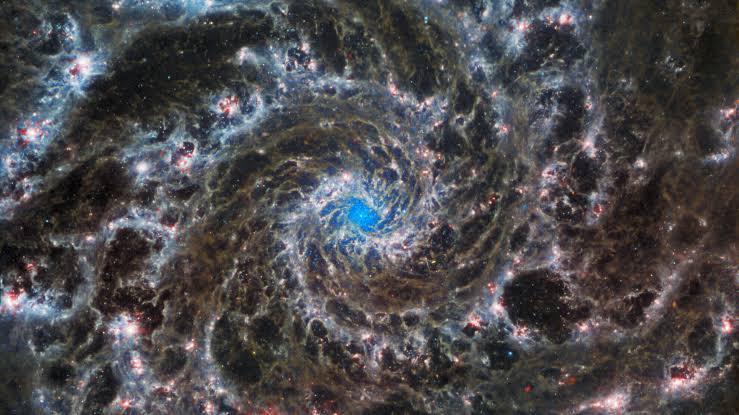
M74 Hidden Disk Extends Beyond the Familiar Spiral
A Boundary Nearly Twice as Far Away
Conventional images traced M74’s stellar disk to roughly 45,000 light-years from its center. The newly detected component reaches nearly 100,000 light-years outward. That places the galaxy’s visible stellar boundary much farther away than earlier observations suggested.
These measurements describe the radius, rather than the full diameter. Across the newly traced structure, the corresponding width approaches 200,000 light-years.
However, a larger stellar extent does not mean twice the stellar mass. The discovery concerns a diffuse outer region whose faint light escaped previous detection. Its enormous reach changes the galaxy’s measured size without implying an equally large increase in star numbers.
A Faint Blue Extension
The outer component surrounds M74’s familiar disk, but its appearance differs from the brighter inner structure. Young stars give the newly revealed region its blue color.
This distinction matters because the outskirts contain clues about when the extended disk formed. Researchers can therefore investigate both its boundaries and its history.
How a Small Telescope Revealed the Outer Disk
An Observing Strategy Built for Faint Light
The discovery comes from the robotic Transient Survey Telescope, or TST, at Teide Observatory. Canary Islands company Light Bridges operates the instrument, which has a mirror one meter across.
Its wide-field camera captures the galaxy alongside a substantial area of surrounding sky. Combined with deep observations, that coverage helps researchers examine faint structures beyond the bright spiral.
The Instituto de Astrofísica de Canarias describes the observations as approximately ten times deeper than older surveys such as SDSS. This extra sensitivity reveals light that shallower images struggle to distinguish.
Preserving the Signal During Processing
Collecting enough light was only part of the challenge. The team also needed image processing that preserved extremely faint features.
Background removal can accidentally erase diffuse astronomical light when processing treats it as unwanted signal. Consequently, the researchers designed their analysis to retain the weak emission around M74.
The lesson concerns the entire observing approach. Mirror size matters, but camera coverage, sensitivity, and careful processing also determine what becomes visible. This result demonstrates the value of matching an instrument’s methods to a specific scientific question.
Young Stars Suggest Rapid Galaxy Growth
A Stellar Population About 640 Million Years Old
The IAC announcement gives the outer stars an estimated average age of 640 million years. Compared with the long history of a galaxy, that represents a relatively brief interval.
Their youth suggests that the extended stellar disk developed within less than a billion years. Instead of tracing only a slow, steady outward progression, M74 may preserve evidence of a concentrated growth episode.
Still, astronomers did not watch the galaxy double in size. They detected its present structure and reconstructed a possible timeline from the stellar population.
That distinction keeps the discovery clear. The extended disk is an observational finding; the speed of its formation follows from interpreting the stars’ properties.
Could a Neighbor Have Triggered Star Formation?
UGC 1176 Offers a Possible Explanation
Researchers identify the neighboring galaxy UGC 1176 as a possible source of the disturbance. The IAC places it approximately 400,000 light-years from M74.
A close passage around a billion years ago could have disturbed cold gas in M74’s outskirts. That gravitational influence may have encouraged the gas to form stars across a much larger region.
Under this scenario, the outer stellar population records the consequences of an earlier encounter. The proposed timing broadly matches the young ages that researchers infer.
The Hydrogen Connection
M74’s neutral hydrogen already extends beyond its previously recognized stellar disk. The gas also shows asymmetries and complex structures that have puzzled astronomers for decades.
A past interaction provides a possible explanation for both the disturbed gas and the young outer stars. It connects two observations within the same growth scenario.
However, the available evidence does not establish that UGC 1176 caused the expansion. The researchers present its close passage as a plausible interpretation, leaving room for further investigation.
Could Other Galaxies Hide Similar Disks?
The M74 hidden disk raises a broader question about how astronomers measure galactic growth. If faint outskirts remain undetected, familiar images may leave substantial stellar extensions outside the apparent boundary.
The finding also suggests that outward growth can proceed unevenly. Some galaxies may experience shorter periods of accelerated star formation alongside longer phases of gradual development.
One example cannot reveal how common that pattern is. Researchers therefore need similarly deep observations of additional galaxies.
Further TST studies and observations from the Vera C. Rubin Observatory could help test the idea. Comparisons should show whether M74 represents an unusual case or a more widespread process.
M74 Hidden Disk Opens a New Question
The M74 hidden disk expands the known reach of a familiar galaxy and offers clues to its recent development. Young outer stars suggest rapid growth, while an ancient close passage remains a possible trigger. The next challenge is finding comparable structures elsewhere. Deeper observations could reveal how often galaxies build extensive stellar disks during relatively brief episodes.
Main sources:
- Instituto de Astrofísica de Canarias — Official announcement, September 4, 2026
- Astronomy & Astrophysics — Research paper
- Authors’ openly accessible manuscript — arXiv