BY:SpaceEyeNews.
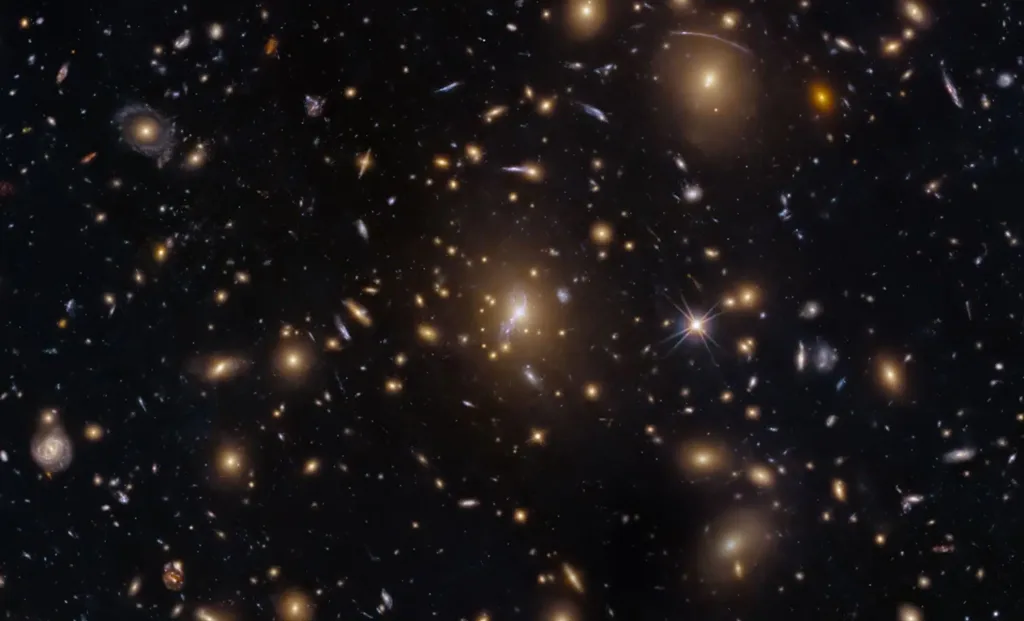
A newly released image from NASA’s Hubble Space Telescope has placed MACS0329-0211 back in the spotlight. At first glance, the cluster appears to be a crowded collection of galaxies scattered across space. A closer look reveals something far more important. MACS0329-0211 functions as a powerful natural telescope, bending and magnifying light from galaxies located billions of light-years behind it.
This capability makes MACS0329-0211 much more than a visually stunning target. The cluster gives astronomers a unique opportunity to study some of the most distant and faint galaxies ever observed. It also provides valuable clues about dark matter, galaxy evolution, and the structure of the universe itself.
The latest Hubble image highlights why massive galaxy clusters remain among the most useful scientific tools in modern astronomy. While advanced observatories continue to push technological boundaries, nature still provides some of the most powerful lenses available.
MACS0329-0211 Is One of Nature’s Most Powerful Telescopes
A Massive Gathering of Galaxies
The new image showcases hundreds of galaxies packed into a single gravitationally bound system. These galaxies display a wide variety of shapes and sizes.
Some appear as large elliptical galaxies with smooth structures. Others show clear spiral arms stretching across space. A few are viewed edge-on, creating thin streaks of light against the dark background.
Galaxy clusters rank among the largest structures held together by gravity. Each member galaxy contains billions of stars. Together, they form enormous cosmic environments that have evolved over billions of years.
MACS0329-0211 stands out because of its tremendous mass. That mass creates one of the cluster’s most valuable scientific features: gravitational lensing.
The Distorted Arcs Hidden in the Image
Several faint arcs appear around portions of the cluster. These arcs represent distant galaxies whose light has traveled through the powerful gravitational field of MACS0329-0211.
Instead of reaching Earth in a straight line, the light becomes bent and stretched. The result creates curved shapes that look dramatically different from the galaxies that produced them.
Near the center of the image, astronomers can identify unusual intersecting curves that resemble a distorted figure eight. These structures may represent distant galaxies whose appearance has changed significantly due to the cluster’s immense gravity.
Although these features create a beautiful image, their scientific value is even greater.
How MACS0329-0211 Helps Astronomers See Farther
Looking Beyond the Cluster
The galaxies inside MACS0329-0211 are not the only objects attracting scientific attention.
Researchers often focus on the galaxies located behind the cluster. Normally, many of these distant objects would remain invisible because they are too faint or too far away.
The immense gravity of MACS0329-0211 changes that situation.
As light from background galaxies passes through the cluster, it becomes magnified. The cluster effectively boosts the brightness of these distant objects, making them easier to detect and analyze.
A Natural Window Into Cosmic History
Every distant galaxy observed through MACS0329-0211 represents a glimpse into the past.
Because light takes time to travel across the universe, astronomers see these galaxies as they existed billions of years ago. Some may come from periods when galaxies were still forming their earliest generations of stars.
This ability transforms MACS0329-0211 into a natural time machine.
Scientists can examine how galaxies evolved over cosmic history. They can compare young galaxies with mature systems seen closer to Earth. These comparisons help researchers understand how large-scale structures developed across billions of years.
Why Gravitational Lensing Matters
Gravitational lensing remains one of the most important tools in observational astronomy.
The technique allows researchers to investigate objects that even powerful telescopes struggle to detect directly.
Clusters like MACS0329-0211 expand the reach of modern observatories. They provide access to regions of the universe that would otherwise remain hidden.
As a result, every newly discovered lensing feature can reveal valuable information about the distant cosmos.
MACS0329-0211 Offers Clues About Dark Matter
Mapping the Invisible Universe
One of the most important applications of MACS0329-0211 involves dark matter research.
Dark matter does not emit, absorb, or reflect light. Scientists cannot observe it directly. However, they can detect its gravitational influence.
The distorted arcs visible around the cluster help astronomers map where mass exists inside the system.
By measuring how strongly light bends, researchers can estimate how matter is distributed throughout the cluster.
This approach allows scientists to build detailed mass maps of MACS0329-0211.
Understanding the Cluster’s Structure
The visible galaxies account for only part of the cluster’s total mass.
A significant amount of matter remains unseen. Dark matter likely contributes a large percentage of the cluster’s gravitational strength.
Gravitational lensing helps reveal this hidden component.
As astronomers refine their models, they gain a clearer picture of how dark matter shapes galaxy clusters and influences cosmic evolution.
Testing Cosmological Models
Galaxy clusters serve as valuable laboratories for testing theories about the universe.
Researchers compare observations of MACS0329-0211 with computer simulations. They examine whether current cosmological models accurately reproduce the cluster’s observed structure.
Each new observation improves our understanding of how matter gathered and evolved over billions of years.
That makes MACS0329-0211 an important target for ongoing research.
How Hubble Captured MACS0329-0211
Combining Multiple Instruments
NASA obtained the latest observations through a program focused on X-ray-bright galaxy clusters.
The research relied on two major Hubble instruments:
- Advanced Camera for Surveys (ACS)
- Wide Field Camera 3 (WFC3)
Together, these instruments collected observations across multiple wavelengths.
This approach gives astronomers a more complete view of the cluster and its surroundings.
Visible Light and Infrared Observations
Visible-light observations reveal the shapes and structures of galaxies.
Infrared observations provide a different advantage. They allow astronomers to detect more distant objects whose light has been stretched by the expansion of the universe.
Some galaxies become easier to identify in infrared wavelengths. Others reveal features hidden by dust.
By combining both datasets, researchers gain deeper insight into the physical properties of MACS0329-0211 and the galaxies located behind it.
Building Better Scientific Models
The multi-wavelength observations help scientists create detailed maps of mass distribution.
Researchers can estimate where dark matter may be concentrated. They can also identify promising targets for future observations.
This information supports studies of galaxy evolution, dark matter, and large-scale cosmic structure.
Why MACS0329-0211 Matters in the Era of James Webb
Hubble and Webb Work Together
The arrival of the James Webb Space Telescope has expanded humanity’s ability to study the distant universe.
Yet galaxy clusters such as MACS0329-0211 remain essential.
Hubble excels at identifying and mapping gravitational lenses across large regions of space. Webb then examines many of the magnified galaxies in greater detail.
Together, the two observatories form a powerful partnership.
Nature Still Provides the Best Magnification
Even the most advanced telescopes face limits.
Gravitational lenses provide a natural boost that technology alone cannot always match.
When a cluster like MACS0329-0211 magnifies a distant galaxy, astronomers gain access to information that might otherwise remain beyond reach.
For this reason, gravitational lensing continues to play a central role in modern astronomy.
Future Discoveries Await
As researchers continue studying MACS0329-0211, they may uncover additional distant galaxies hidden behind the cluster.
Future observations could improve dark matter maps, reveal new details about galaxy formation, and refine models of cosmic evolution.
Every new lensing feature adds another piece to the puzzle.
Conclusion: MACS0329-0211 Is a Cosmic Observatory Built by Gravity
The latest Hubble image demonstrates why MACS0329-0211 remains one of the most valuable galaxy clusters for astronomical research.
Its enormous mass bends and magnifies light from distant galaxies, allowing scientists to look deeper into the universe than would otherwise be possible. The cluster provides access to ancient cosmic history, supports dark matter investigations, and helps researchers test models of cosmic evolution.
More importantly, MACS0329-0211 shows how gravity itself can become a scientific instrument. While modern observatories continue to advance, nature still supplies some of the most powerful tools for exploring the cosmos. As Hubble and future telescopes continue their observations, this remarkable cluster will remain a key gateway to understanding the universe’s most distant frontiers.
Main Sources:
NASA Science – Hubble Sees Swarm of Galaxies
https://science.nasa.gov/missions/hubble/hubble-sees-swarm-of-galaxies/
NASA Science – Hubble Gravitational Lens Gallery
https://science.nasa.gov/gallery/hubbles-gravitational-lens-gallery/
ESA Hubble Space Telescope
https://esahubble.org
Daily Galaxy – Hubble Captures A Cosmic Swarm That Is Bending Light Across The Universe
https://dailygalaxy.com/2026/06/hubble-swarm-bending-light-across-universe/