BY:SpaceEyeNews.
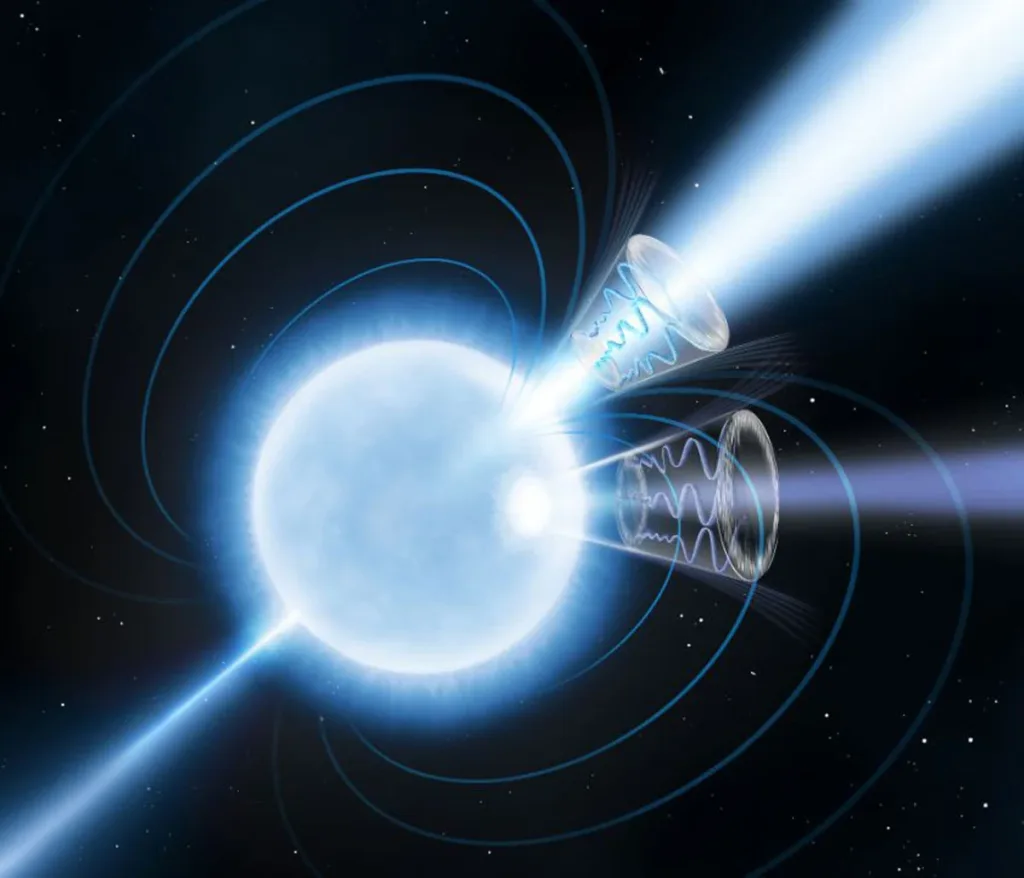
Magnetar vacuum birefringence may sound like an abstract idea. However, a distant neutron star has turned it into an observable test. Astronomers studying 1E 1547.0–5408 detected exceptionally polarized X-rays. The pattern suggests that its enormous magnetic field changes how light moves through a vacuum.
The findings provide some of the strongest evidence yet for an effect predicted in 1936. They could reveal a measurable property of apparently empty space. Still, researchers need more observations before calling the result definitive.
Why This Magnetar Offers a Rare Quantum Test
The magnetar 1E 1547.0–5408, also called 1E1547, has the right features for this experiment. Its surface magnetic field measures roughly 2×10¹⁴ gauss. That strength exceeds the critical quantum electrodynamics field of about 4.4×10¹³ gauss.
As a result, 1E1547 provides conditions that laboratories on Earth cannot reproduce. It also emits persistent radio waves and X-rays. Scientists can therefore compare signals at two very different wavelengths.
Geometry makes this object even more useful. Its magnetic axis and rotational axis appear nearly aligned. Earth also views the star almost along its pole. This arrangement gives astronomers a relatively clean view of its large-scale magnetic field.
The star completes one rotation in around 2.1 seconds. Each turn lets researchers track changes in brightness, polarization strength and polarization direction.
Three Observatories Followed the Same Rotation
The team combined measurements from three major facilities. NASA’s Imaging X-ray Polarimetry Explorer, or IXPE, measured the X-ray polarization. NASA’s NICER instrument supplied supporting X-ray timing and spectral data. Meanwhile, Murriyang, CSIRO’s Parkes radio telescope, tracked the radio signal.
IXPE watched 1E1547 for more than 140 hours between March and April 2025. NASA describes the campaign as the first coordinated radio and X-ray polarization measurement of a magnetar.
Polarization records the preferred orientation of light waves. It can reveal how radiation formed and what happened during its journey. In this case, radio polarization helped researchers establish the magnetar’s geometry. IXPE then showed how the X-ray orientation changed during the same rotation cycle.
That combination matters. A high X-ray polarization value alone would offer an incomplete picture. The radio measurements allowed the team to compare the radiation with the star’s magnetic-field direction.
Empty Space May Not Be Empty After All: Magnetar Reveals a Bizarre Quantum Effect.
Magnetar Vacuum Birefringence and the X-Ray Signal
The strongest result appeared in the magnetar’s softer X-rays. The phase-averaged polarization reached 65% at 2 kiloelectronvolts, or keV. The study gives an uncertainty of eight percentage points.
At certain stages of the rotation, polarization in the 2–3 keV range climbed to about 82%. That measurement carries a 15-point uncertainty. Even while the radio beam crossed our line of sight, the X-ray polarization stayed at roughly 40% or higher.
These values surprised the researchers. Most other magnetars measured in the soft X-ray band show much lower phase-averaged polarization. Some magnetized atmosphere models can reach values near 40%. Yet producing 65%, or brief levels near 80%, remains difficult without another influence.
The polarization angle supplied another clue. It changed smoothly as the star rotated. Its pattern also followed the large-scale magnetic geometry traced by the radio emission. Standard models, where radiation travels outward through an unaffected vacuum, struggle to reproduce all these features together.
How Empty Space Can Influence Light
Quantum electrodynamics does not treat a vacuum as a completely inactive background. Under an extreme magnetic field, different polarization modes can experience slightly different refractive properties.
This is vacuum birefringence. A familiar birefringent crystal separates light according to polarization. Near a magnetar, the magnetic field may give the vacuum a similar optical effect. No ordinary glass, gas or dust needs to fill the region.
As X-rays move through the magnetosphere, their polarization can remain coupled to the local magnetic field. This process keeps polarization from different emitting areas more closely aligned. Consequently, the combined signal can retain an unusually high polarization when it reaches IXPE.
The team tested that explanation with radiative-transfer simulations. Models including vacuum birefringence matched the observed X-ray behavior more naturally than models without it. The results do not show virtual particles directly. Instead, they measure a light pattern that agrees with a major prediction of quantum electrodynamics.
A Second Quantum Signature May Be Present
The polarization fell sharply between 2 and 4 keV. Researchers suggest that polarization-mode conversion near a “vacuum resonance” could explain this energy-dependent change.
In that process, interactions between the magnetized atmosphere and quantum vacuum allow polarization modes to convert. The magnetar’s field strength places this transition within the observed energy range under some atmospheric models.
However, the interpretation becomes less secure above 4 keV. IXPE detected fewer photons there, which reduced the signal quality. Deeper observations must determine whether the energy trend continues.
Strong Evidence Does Not Yet Mean Final Proof
The result marks a major advance, but important uncertainties remain. Simulations require assumptions about the surface atmosphere, magnetic-field structure and X-ray hot spot. More complex activity in the magnetosphere could also influence polarization.
That is why the Nature paper stops short of declaring vacuum birefringence conclusively detected. Even NASA says the mission “may have” captured the effect. CSIRO and Swinburne University also describe the interpretation as awaiting confirmation.
Longer IXPE observations should improve the measurements across energy and rotational phase. Refined simulations could then separate vacuum birefringence from other influences. Comparisons with additional magnetars would provide another independent check.
Conclusion: Magnetar Vacuum Birefringence Opens a New Window
Magnetar vacuum birefringence offers a powerful way to test quantum physics far beyond laboratory limits. The extreme polarization from 1E1547 supports the idea that a strong magnetic field can change how light propagates through a vacuum.
The finding does not mean empty space contains ordinary hidden matter. Instead, it suggests that the quantum vacuum has measurable electromagnetic properties. If future observations confirm the interpretation, magnetars could become precise laboratories for exploring the underlying physics of space itself.
Article body: Approximately 963 words
Main Sources:
Nature — Vacuum birefringence and the polarized X-ray emission from a radio magnetar:
https://www.nature.com/articles/s41586-026-10859-z
NASA — NASA’s IXPE May Have Proven 90-Year-Old Theory:
https://science.nasa.gov/missions/ixpe/nasas-ixpe-may-have-proven-90-year-old-theory/
CSIRO — Rare Ultra-Magnetic Star the Key to Solving a Quantum Cold Case:
https://www.csiro.au/en/news/All/News/2026/August/Rare-ultra-magnetic-star-the-key-to-solving-a-quantum-cold-case
Swinburne University of Technology — Rare Ultra-Magnetic Star:
https://www.swinburne.edu.au/news/2026/08/rare-ultra-magnetic-star-the-key-to-solving-a-quantum-cold-case/