
BY:SpaceEyeNews.
The Marius Hills Pit could open into a much larger underground space, and NASA has selected a project to investigate. Called GIMLI, the effort will search beneath the lunar surface for a possible lava tube. Its measurements could reveal hidden volcanic structures and help scientists assess the potential of natural shelters for future astronauts.
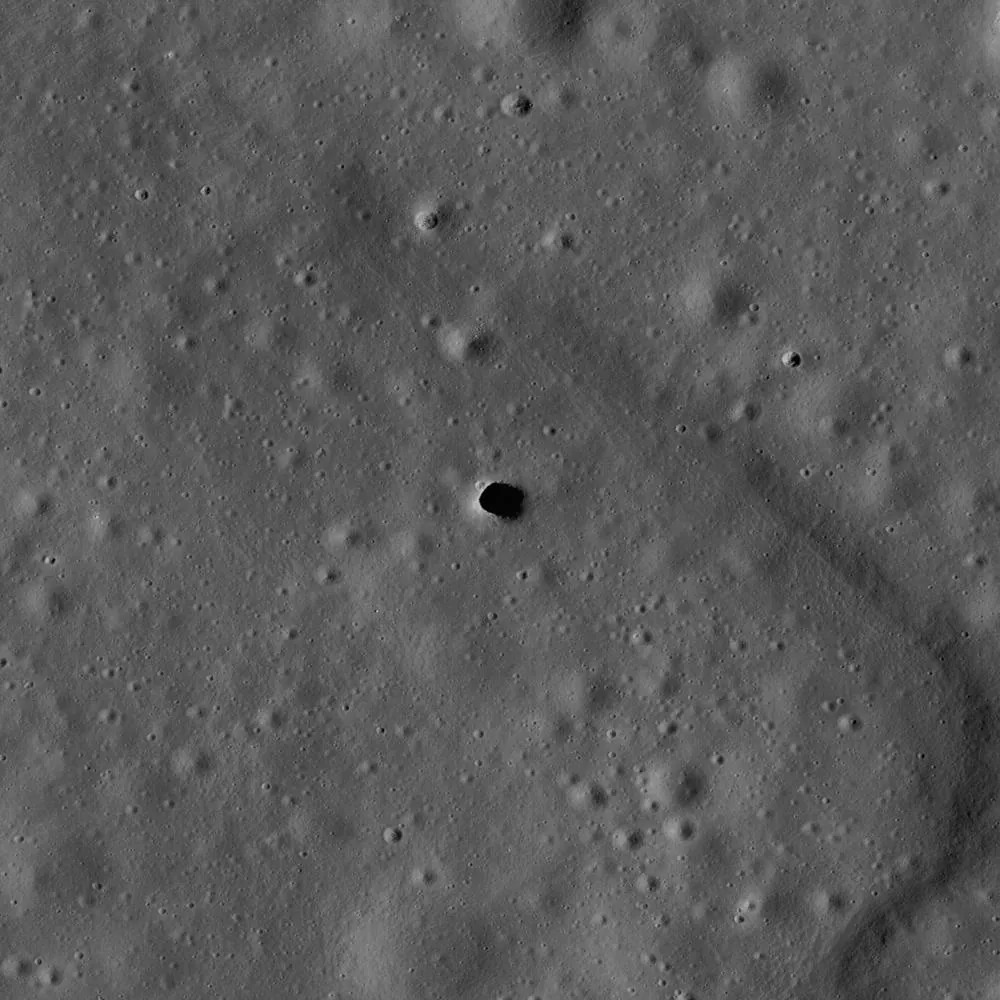
The opening itself is familiar from orbital images. What remains uncertain is the extent of any connected cavern. Now, researchers plan to examine that question from the ground, combining several instruments to investigate what photographs cannot show.
Artist’s impression of the Marius Hills Pit showing layered lunar rock and a shadowed opening.
Why the Marius Hills Pit Matters
Few lunar features offer such a direct view beneath the surface. The pit exposes geological layers that normally remain buried, within a region shaped by extensive volcanic activity. Its walls therefore provide valuable evidence even before scientists investigate any deeper passage.
Earlier images from NASA’s Lunar Reconnaissance Orbiter revealed an overhang. A carefully angled observation also showed a few meters of space beneath it. That glimpse strengthened interest in what might continue beyond the visible opening. science.nasa.gov
However, an overhang does not establish the existence of a vast tunnel. Researchers still need to determine how the underground structure extends and how large it might be.
The visible opening and the potential tunnel also represent different measurements. Images can show the pit’s exposed features, but they cannot establish the dimensions of a hidden passage. Therefore, descriptions of a possible giant cave remain a hypothesis to investigate. The size question is one of the reasons researchers want several kinds of evidence from the site.
This distinction drives the new investigation. GIMLI will test whether the pit connects to a substantial lava tube, rather than assuming one awaits discovery.
GIMLI Takes the Search to the Surface
GIMLI stands for Geophysical Instruments for Marius Lunar pit Investigation. Nathaniel “Than” Putzig, an associate director and senior scientist at the Planetary Science Institute, leads the project.
NASA selected the investigation through its Payloads and Research Investigations on the Surface of the Moon program, known as PRISM. Commercial Lunar Payload Services will provide the delivery framework for its instruments.
The project plans to use a lander and rover to conduct measurements at the site. Honeybee Robotics will build several instruments and help integrate and operate the equipment. Meanwhile, the Norwegian Space Agency will provide ground-penetrating radar.
Neither the NASA announcement nor the institute’s release specifies a launch date. For now, the milestone is selection of the scientific investigation, with surface operations still ahead. www.nasa.gov
How GIMLI Will Search for a Lunar Cave
The instruments will examine the same underground environment through different physical measurements. Together, they should help scientists distinguish possible empty spaces from surrounding material and estimate the dimensions of any connected void.
Radar and Seismic Measurements
Ground-penetrating radar will investigate structures below the surface. Its signals can help researchers identify boundaries between materials and search for evidence of a cavity.
Active seismic measurements will add another perspective. The system will generate vibrations intentionally, then use sensors to record how those vibrations travel through the ground. Their behavior can reveal information about the material beneath the instruments.
Putzig highlights the opportunity to bring intentional seismic surveys back to lunar exploration. Apollo astronauts used this approach decades ago. GIMLI aims to combine it with complementary measurements at a site where underground geometry remains uncertain.
Gravity Readings and Close Views
A gravimeter will measure gravity, adding evidence about the distribution of material underground. Cameras will document the surrounding terrain and exposed pit walls.
Each method contributes a different piece of the investigation. The team can compare those observations when interpreting possible subsurface structures. Crucially, the announced plan describes measurements from the lunar surface; it does not announce a rover journey through a cave.
The Pit Walls Preserve Lunar History
Finding a tunnel would create an opportunity to study how lava once traveled beneath the Moon’s surface. Scientists could compare that structure with terrestrial lava tubes to better understand lunar volcanic processes.
Yet the exposed walls hold their own scientific value. They reveal layers of regolith and lava flows, offering a record of changes within the surrounding landscape.
Researchers want to examine how those layers relate to one another. Their arrangement could help reveal whether long intervals separated individual eruptions. It could also clarify how lava moved across and beneath this volcanic region.
Useful Answers Even Without a Large Cave
If GIMLI finds no extensive connected void, its measurements would still help explain the pit’s formation. That outcome would narrow the possibilities for its origin and improve scientists’ understanding of the local geology.
Could a Moon Cave Shelter Astronauts?
The possibility of natural shelter gives this investigation practical importance. Rock surrounding an underground space could shield future explorers from radiation and reduce exposure to the surface’s dramatic temperature swings.
NASA identifies those potential benefits in its announcement. Understanding such spaces could inform future habitat planning, especially if measurements reveal substantial protected areas. www.nasa.gov
Still, a detected cavern would not automatically become a suitable home. Any future assessment would need to address access, structural stability, available space, and the systems astronauts require to live there.
GIMLI’s immediate task is more fundamental: establish what lies beneath the opening. Its observations could supply evidence for later exploration decisions. They would not, by themselves, certify a location for human habitation.
What Comes Next for the Marius Hills Pit?
The Marius Hills Pit offers a rare connection between visible lunar geology and an underground mystery. GIMLI could help establish whether that opening leads to a substantial lava tube while revealing more about ancient volcanic activity.
Either result would matter. A connected cavern would raise new scientific and exploration questions. Its absence would still sharpen our understanding of the pit’s origin. The next advance depends on collecting measurements at the surface and testing the possibilities that orbital images have kept open.
Main sources:
- NASA — NASA Adds New Science Investigations for Moon Base — September 30, 2026; updated October 2.
- Planetary Science Institute — PSI-led team selected for NASA PRISM program to explore potential lunar cave — October 1, 2026.
- NASA — Sublunarean Void — earlier orbital observations of the pit’s overhang.