
BY:SpaceEyeNews.
Markarian 501 black holes could be approaching a merger on a timescale that sounds almost impossible: roughly a century. An unusual radio jet suggests that this galaxy may host two supermassive companions orbiting every four to five months. However, the evidence does not establish a reliable countdown.
The strongest clue comes from changing structures near the galaxy’s center. Researchers interpret those changes as signs of a second black hole. If their model holds, Markarian 501 could offer a rare view of the final approach before a supermassive merger.
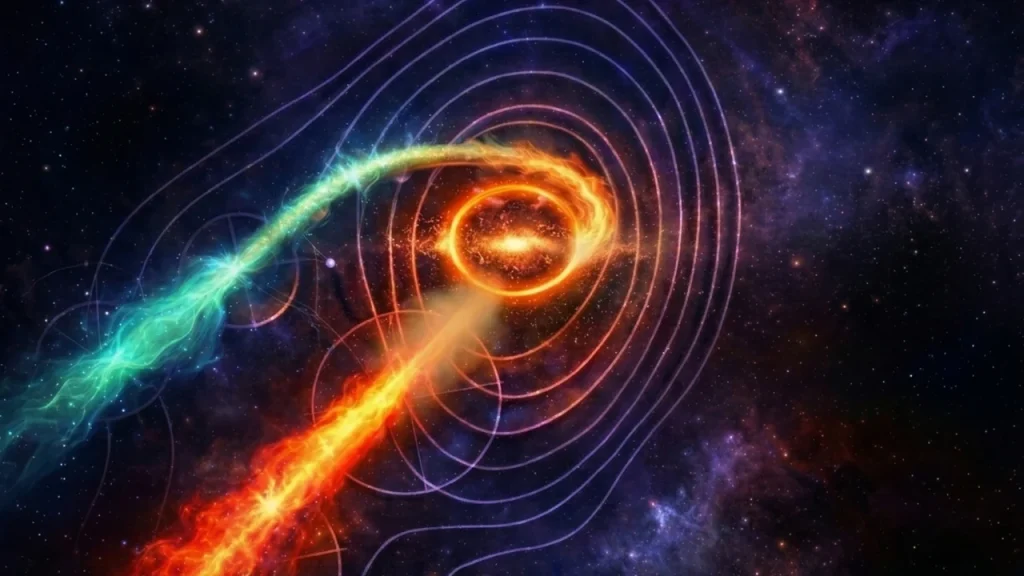
Artist’s impression of the proposed Markarian 501 black holes, showing two jets and curved light near the core.Credit: Emma Kun / HUN-REN Konkoly Observatory, created with AI assistance, via Max Planck Institute for Radio Astronomy.
A Second Jet Changes the Picture
Markarian 501 lies about 460 million light-years away in Hercules. Its familiar bright jet points almost toward Earth. Yet the region around its core has long puzzled astronomers because the jet changes direction across different scales.
To investigate, researchers reanalyzed 83 radio observations from the Very Long Baseline Array. These observations span September 2011 to July 2023 and use a frequency of 43 gigahertz.
Alongside the known jet, the team identified a second structure. It appears to emerge behind the core and curve anticlockwise around it. Its changing shape raises the possibility that another black hole powers it.
Twelve Years of Crucial Observations
Some coverage refers to 23 years of data. That broader history includes earlier observations at lower frequencies. The second jet analysis specifically relies on the newer, roughly twelve-year collection.
This distinction matters because sharper images reveal structures that older observations could not separate clearly. Even so, the images show radio emission. They do not resolve two individual black holes.
Markarian 501 Black Holes May Orbit Within Months
The proposed orbital period has two main estimates. A faint pattern in the core’s brightness suggests about 121 days. Repeating jet configurations instead indicate approximately 146 days, with an uncertainty of 22 days.
Both estimates suggest a remarkably compact system. Neither provides a precise orbital clock. Gaps between observations make it difficult to follow the jet continuously or distinguish every cycle.
Consequently, the often-quoted 121–146 days should describe a plausible timescale, rather than a firmly measured range. Uneven sampling could even conceal faster motion.
A Small Gap Between Enormous Objects
Under an equal-mass assumption, the team considers black holes weighing between 100 million and one billion Suns each. Their proposed separation reaches roughly 250–540 Earth–Sun distances.
Those dimensions depend on the model’s assumptions. Researchers have not directly measured the gap in an image. Changing the masses or orbital period would also change the inferred separation and remaining lifetime.
Could a Merger Really Happen Within a Century?
Such a close pair would release orbital energy through gravitational waves. As energy leaves the system, the orbit would shrink. The team’s calculations suggest that a century-scale remaining lifetime is possible under particular assumptions.
The Max Planck Institute’s announcement also presents 100 years as a possibility, dependent on the black holes’ actual properties. It does not establish a scheduled event.
Orbital Shape Complicates the Estimate
The simplified lifetime calculation assumes a nearly circular orbit. However, the team also discusses a slow wobble to explain a longer rhythm in the system. That interpretation requires a highly elongated orbit.
These different assumptions need a more consistent calculation before researchers can confidently estimate the remaining lifetime. A different orbital shape could substantially alter the result.
Distance adds another perspective: the observations show the galaxy’s distant past. A century-scale estimate concerns evolution from the stage whose signals reach us now. It does not describe events happening there simultaneously with our present on Earth.
A Ringlike Feature Adds Intrigue—and Uncertainty
One observation from June 2022 shows radio features arranged along an almost circular arc. The team interprets this as possible gravitational lensing. In that scenario, the foreground black hole bends radiation from the second jet.
The geometry creates a problem, however. Bending light directly from the proposed companion into a ring of that size would require a much larger separation.
The researchers therefore consider light from the extended jet instead. That possibility may explain the arc, but it introduces additional assumptions. The feature supports an interesting interpretation without independently proving the entire binary model.
Why Image Alignment Matters
The observations also lack a fixed reference point on the sky. Researchers must align changing structures carefully when comparing images across different dates.
In 17 of the 83 observations, another feature outshone the core. That complicates the task of identifying consistent positions. Alternative studies have also proposed different companion masses and orbital periods for this galaxy.
Together, these issues explain why the proposed pair still needs independent confirmation.
The team considered explanations involving a single black hole, including disturbances traveling through the jet. They argue that these alternatives cannot explain all the observed behavior. Nevertheless, favoring one model does not settle every uncertainty within it.
A convincing orbital interpretation should explain the jet’s changing position, brightness patterns, and apparent curvature together. Future observations can test whether those separate clues continue to support the same physical picture over additional cycles.
What Could Confirm the Hidden Black Hole Pair?
More frequent radio imaging offers the clearest immediate test. Researchers could follow the second jet through successive cycles and check whether its motion repeats as predicted.
A longer, denser record could also test whether the orbital pattern changes over time. That would strengthen attempts to connect the images with an evolving binary system.
Directly separating the two proposed black holes remains beyond the Event Horizon Telescope’s resolution. Therefore, confirmation will likely depend on several complementary measurements.
Listening for Gravitational Waves
Pulsar timing arrays offer another route. These projects track highly regular pulses from neutron stars, searching for timing changes caused by gravitational waves.
The proposed system would emit waves within their observing band. However, evidence for a broader gravitational-wave background does not confirm a signal from Markarian 501 itself.
A future detection tied specifically to this galaxy would provide a powerful independent test. Tracking a rising wave frequency could then reveal how the orbit evolves.
Markarian 501 Black Holes: A Candidate Worth Watching
The Markarian 501 black holes scenario combines an unusual second jet, possible rapid orbital motion, and a potentially short remaining lifetime. Its appeal comes from the chance to examine a stage astronomers rarely access.
For now, the evidence supports further investigation rather than a confirmed century-long countdown. Better radio coverage and independent gravitational-wave measurements could clarify the picture. Whether the merger estimate survives or changes, testing this candidate can sharpen our understanding of how supermassive black holes come together.
Main Sources:
Max Planck Institute for Radio Astronomy — First Close Pair of Supermassive Black Holes Detected (April 7, 2026):
https://www.mpifr-bonn.mpg.de/pressreleases/2026/first-close-pair-of-supermassive-black-holes-detected
Monthly Notices of the Royal Astronomical Society — Detection of a second jet within the nuclear core of Mrk 501 (published online March 27, 2026):
https://doi.org/10.1093/mnras/stag291
Space Daily — Two giant black holes at the heart of one galaxy may circle each other every 121 to 146 days and could merge in as little as 100 years (November 5, 2026):
https://spacedaily.com/two-giant-black-holes-at-the-heart-of-one-galaxy-may-circle-each-other-every-121-to-146-days-and-could-merge-in-as-little-as-100-years/
You Might Also Like:
Supermassive Black Holes May Drift From Galactic Centers
Supermassive Black Hole Binary Markarian 501 Discovered.
Markarian 501 Black Holes: A Merger Within 100 Years?