BY:SpaceEyeNews.
For decades, scientists have debated whether Mars once hosted vast oceans, rivers, and a climate capable of supporting stable liquid water. Now, new observations from the European Space Agency may have brought researchers one step closer to answering that mystery.
A massive Martian valley called Shalbatana Vallis is emerging as one of the strongest clues yet that a Mars ancient ocean may have once covered part of the Red Planet. The region contains enormous flood channels, collapsed terrain, volcanic deposits, lava plains, and geological scars formed billions of years ago.
New imagery captured by the Mars Express mission shows a landscape that looks far more dynamic than the cold and dusty Mars we see today. Scientists now believe this giant valley was carved by catastrophic floods released from underground water reservoirs roughly 3.5 billion years ago.
The findings are helping researchers reconstruct a very different version of ancient Mars — one that may have been warmer, wetter, and potentially habitable.
Mars Ancient Ocean Clues Found in Shalbatana Vallis
Shalbatana Vallis stretches across Mars for roughly 1,300 kilometers. That is about the length of Italy. The valley sits near the Martian equator and cuts through a transition zone between the heavily cratered southern highlands and the smoother northern plains.
Scientists consider the region extremely important because it belongs to a group of giant Martian outflow channels. These channels formed when massive amounts of water suddenly rushed across the surface.
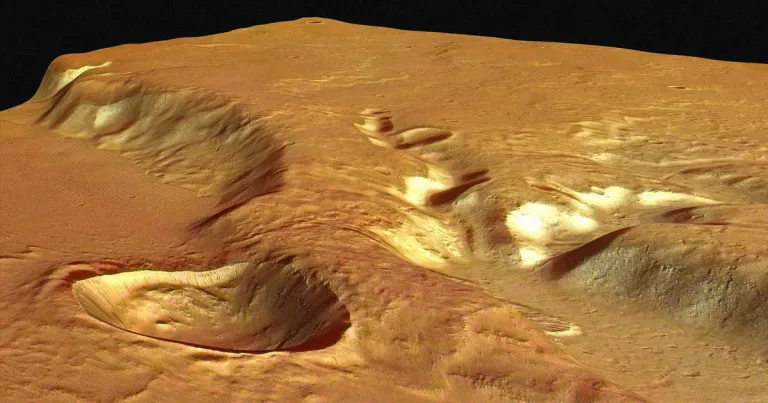
The newly released images focus on the northern section of the valley. There, the terrain reveals deep winding channels, collapsed surfaces, impact craters, volcanic deposits, and signs of ancient geological activity.
Researchers say the main valley channel measures around 10 kilometers wide and reaches depths of roughly 500 meters in some areas. The structure itself strongly suggests that powerful floods once moved through the region at extraordinary speed.
Unlike smaller seasonal water flows seen in some Martian studies, these floods would have reshaped entire landscapes.
Ancient Groundwater May Have Burst Onto the Surface
According to ESA scientists, Shalbatana Vallis likely formed after underground water suddenly erupted onto the surface billions of years ago.
As the groundwater escaped, it rushed downhill with tremendous force. The floods carved deep channels into the surrounding terrain and transported huge amounts of sediment across the region.
Researchers believe the valley may originally have been even deeper. Over billions of years, volcanic ash, dust, and other materials gradually filled parts of the channel.
One especially dark section of the valley appears blue-black in the latest images. Scientists think this material may be volcanic ash later redistributed by Martian winds.
This combination of water activity and volcanism paints a picture of an active early Mars. The planet may once have contained underground ice systems, volcanic eruptions, and flowing surface water operating at the same time.
That possibility is important because it suggests ancient Mars was not geologically dead. Instead, it may have experienced long periods of environmental change and climate activity.
Why Chryse Planitia Supports the Mars Ancient Ocean Theory
One of the strongest arguments for a Mars ancient ocean comes from the location of Shalbatana Vallis itself.
The valley eventually leads toward Chryse Planitia, one of the lowest regions on the planet. Many of Mars’s giant outflow channels terminate there.
Because so many water-carved valleys end in the same lowland region, some scientists believe water may once have collected there to form a massive ocean.
This theory has existed for years, but discoveries like Shalbatana Vallis continue adding new evidence.
If Mars truly hosted an ocean, the implications would be enormous.
A large body of water would mean ancient Mars likely had:
- a thicker atmosphere,
- warmer temperatures,
- active weather systems,
- rainfall cycles,
- rivers,
- lakes,
- and stable liquid water for extended periods.
Those conditions would make ancient Mars far more Earth-like than previously imagined.
More importantly, liquid water remains one of the key ingredients scientists search for when studying possible ancient life.
Chaotic Terrain Reveals a Violent Geological Past
Another major clue appears in the strange “chaotic terrain” surrounding parts of the valley.
These regions contain broken blocks of rock, collapsed surfaces, irregular ridges, and disrupted landscapes. Scientists believe the terrain formed after underground ice melted beneath the surface.
As the ice disappeared, the ground above it collapsed.
Similar chaotic terrain has been observed in several other Martian regions, but the formations around Shalbatana Vallis appear closely connected to ancient flood activity.
The combination of collapsed terrain and giant outflow channels strengthens the theory that underground water systems once existed across large parts of Mars.
Some researchers think these underground reservoirs may have remained stable for long periods before suddenly releasing enormous floods.
That process would explain why many Martian valleys appear rapidly carved rather than slowly eroded over time.
Lava Flows and Volcanic Activity Changed the Landscape
Water was not the only force shaping this region of Mars.
Scientists also found evidence of ancient lava flows spread across the surrounding plains. Much of the smoother terrain appears volcanic in origin.
As lava cooled and contracted, it created uneven surface features known as wrinkle ridges. These folded structures remain visible today.
The region also contains isolated hills called mesas. These elevated formations are remnants of older surfaces that gradually eroded away over time.
Together, the volcanic deposits and flood-carved valleys reveal a planet shaped by multiple powerful geological processes.
That complexity is changing how scientists understand Mars’s evolution.
Rather than viewing Mars as a permanently frozen desert, researchers increasingly see it as a world that experienced dramatic environmental transitions over billions of years.
Impact Craters Help Reveal the Region’s Age
The Shalbatana Vallis region also contains numerous impact craters scattered across the landscape.
Some craters remain sharply defined. Others appear partially buried or eroded.
These craters help scientists estimate the relative age of different geological surfaces. Older terrains usually contain more visible impacts because they have remained exposed longer.
Several craters also display ejecta blankets. These are layers of debris blasted outward during asteroid impacts.
The mixture of preserved craters, lava plains, flood channels, and collapsed terrain allows scientists to reconstruct the sequence of events that shaped this region.
Every new image from Mars Express adds another piece to that planetary puzzle.
Mars Express Continues Transforming Mars Science
The images were captured by the High Resolution Stereo Camera aboard Mars Express.
Launched in 2003, the spacecraft has now spent more than two decades studying Mars. During that time, it has mapped huge portions of the planet in color and three dimensions.
The mission has helped scientists better understand:
- Martian geology,
- ancient water systems,
- volcanic history,
- atmospheric evolution,
- and possible habitable environments.
Even after more than 20 years in orbit, Mars Express continues producing discoveries that reshape scientific thinking about the Red Planet.
The latest observations from Shalbatana Vallis show how much there is still left to learn.
A Lost Ocean Beneath the Martian Dust?
The growing evidence surrounding a Mars ancient ocean continues to reshape planetary science.
Shalbatana Vallis is more than a giant valley. It may represent the remains of a planet that once looked dramatically different from modern Mars.
Ancient floods, underground water systems, volcanic eruptions, collapsing terrain, and lowland basins all point toward a wetter and more active world billions of years ago.
Scientists still do not know how long these watery environments survived or whether ancient microbial life ever emerged there.
But discoveries like this are narrowing the gap between theory and evidence.
With every new image from Mars Express, the possibility becomes harder to ignore: Mars may once have been a planet of rivers, floods, lakes, and perhaps even oceans.
Main Sources:
ScienceDaily: https://www.sciencedaily.com/releases/2026/05/260515002137.htm
ESA Mars Express: https://www.esa.int/Science_Exploration/Space_Science/Mars_Express
DLR HRSC Mars Express Camera: https://www.dlr.de/en/hrsc